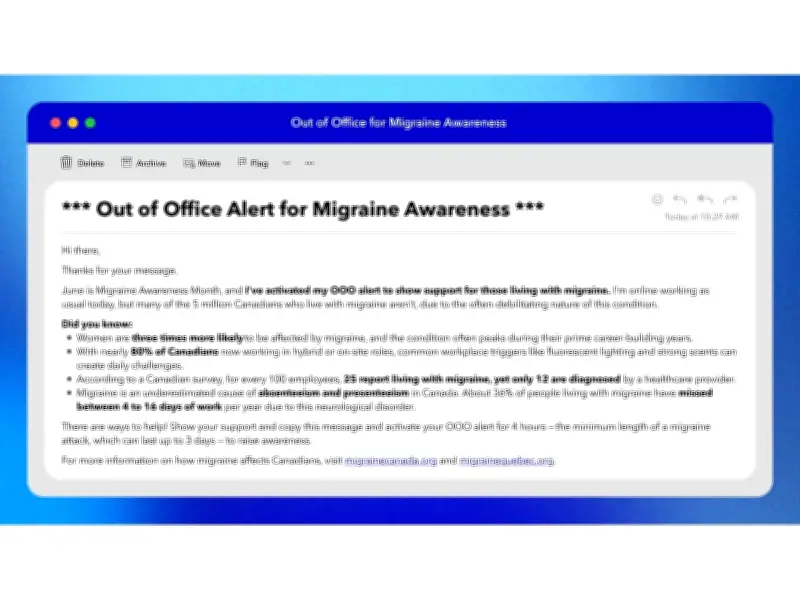
In recognition of Migraine Awareness Month in June, Pfizer Canada, in collaboration with Migraine Canada and Migraine Québec, has announced the return of the Out of Office for Migraine Awareness campaign for its third consecutive year. This national initiative aims to challenge the invisible burden of migraine, particularly as it affects workplace environments and productivity across the country.
Understanding the Impact of Migraine in the Workplace
Migraine is a debilitating neurological disease that affects over five million Canadians, taking a profound toll on mental health, careers, and daily life. With increasing return-to-office mandates across professional sectors, individuals who struggle with migraine face challenges in managing their symptoms due to misunderstanding or lack of support. New survey data from Migraine Canada and Migraine Québec confirms that significant support gaps remain in workplaces, highlighting the ongoing need for migraine care and resources.
Campaign Details and Public Participation
During Migraine Awareness Month, Canadians are encouraged to turn on their Out of Office (OOO) alert for four hours—the minimum length of a migraine attack, which can last up to three days—to raise awareness and show solidarity with colleagues living with migraine. This simple act can help make those affected feel seen, heard, and less alone at work.

“People living with migraine spend a lot of energy trying to manage and mask symptoms in the workplace, and that can be isolating because many people misunderstand or aren’t aware of the impact,” says Susan Cape, a patient advocate with Migraine Canada. “The simple act of reaching out and saying, ‘I sense you’re struggling, and do you need some support,’ can be all someone needs. It’s a small step, but it can make an incredible difference.”
Evolving Workplaces and the Disproportionate Burden on Women
As the modern hybrid workplace evolves, new challenges are emerging for employees with migraine. With nearly 80% of Canadian workers now in on-site or hybrid roles, many are losing the controlled, low-trigger environments that remote work provided. The return to shared workspaces means renewed exposure to common triggers such as fluorescent lighting and strong scents, which can lower the threshold for an attack.
“For someone living with migraine, this isn’t a matter of preference – it’s a clinical issue,” shares Dr. William Kingston, Assistant Professor of Neurology at University of Toronto and Neurologist at Sunnybrook Hospital, Toronto. “Employers and workplaces working with someone to adjust to a more favourable work environment can prove to be a huge benefit to a person with migraine.”
The campaign underscores the need for greater awareness and education to bridge the support gaps in workplaces across Canada. By participating in the Out of Office for Migraine Awareness initiative, individuals and organizations can contribute to a more inclusive and understanding work culture for those living with migraine.