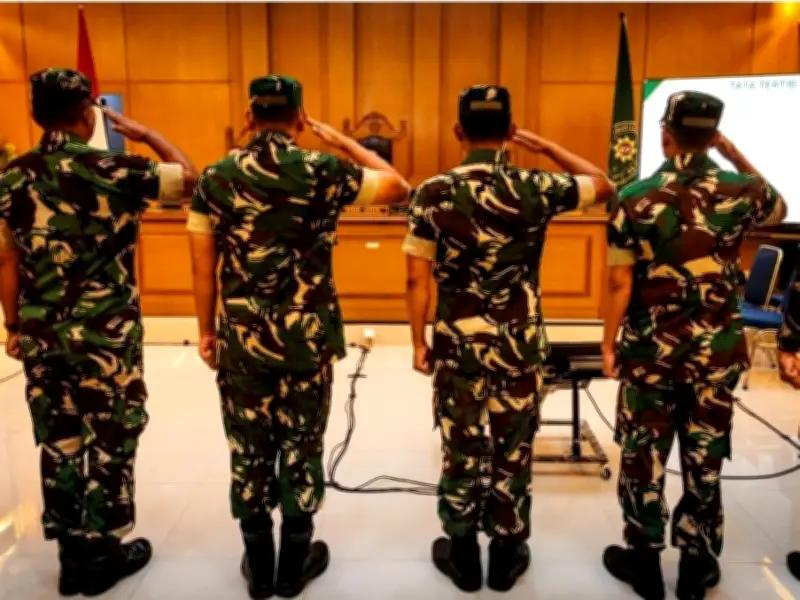
Military court jails Indonesian soldiers over acid attack on activist
Four Indonesian soldiers were sentenced on Wednesday to up to three years in prison by a military court for an acid attack that left an activist blind in one eye. The judge described their actions as “arrogant.”
The four soldiers, all members of the military’s Strategic Intelligence Agency (BAIS), were found guilty of premeditated assault for the March attack on Andrie Yunus, 27, who lost sight in one eye. They were arrested shortly after the attack, and BAIS head Yudi Abrimantyo resigned in what officials called a “form of responsibility.”
However, critics argue that those who planned the crime have not been identified and may never be. Rights group Amnesty International described the trial as “a blatant whitewash.”

The convicted soldiers—Edi Sudarko, 45; Budi Hariyanto Widhi Cahyono, 43; Nandala Dwi Prasetya, 40; and Sami Lakka, 41—received sentences ranging from 1.5 to three years. Two were dismissed from the military as part of their punishment.
Presiding judge Fredy Ferdian Isnartanto cited “arrogant conduct” in the ruling. Military prosecutors contended that the soldiers acted on their own initiative, not on orders, and were angered by Andrie and another activist interrupting a lawmaker’s meeting in 2025 to protest a revision to Indonesia’s armed forces law. That amendment, passed last year, expanded the number of government ministries and state institutions where active-duty military personnel can work from 10 to 14.
Andrie had just finished recording a podcast about the military’s expanding influence when he was attacked while riding his motorbike in Jakarta. “The actions of the defendants constitute an extrajudicial act of revenge,” prosecutor Wasinton Marpaung said last week, having requested a 2.5-year sentence for each man.
Amnesty International Indonesia head Usman Hamid stated: “Today’s verdict downplays the severity and impact of the life-threatening attack on Andrie. It fails to duly consider the involvement of other actors or the chain of command despite independent investigations recently alleging that at least 14 individuals had been involved.”
Andrie and others—including UN human rights experts—had called for the trial to be held in a civilian court rather than a military one, fearing a cover-up in a country where attacks on activists are rarely punished. He refused to attend any trial hearings, citing health reasons and distrust of the court.
One of the judges, Mokhamad Zainal Abidin, said the defendants had “only intended to teach Andrie a lesson” so he would “no longer trample upon and demean” the military. Usman Hamid denounced the verdict, saying it “protects the institutional integrity of the military and shields the full chain of command and other actors potentially linked to this incident from scrutiny. It is a blatant whitewash which brings neither justice nor truth to Andrie Yunus.”
Separately, parliament passed a revision to the national police law on Tuesday that critics say would grant the police excessive power in government, similar to that enjoyed by the military. Last month, Amnesty warned that the government under President Prabowo Subianto was taking an “authoritarian” turn, citing “a growing pattern in which Indonesian authorities—including the military—deploy online disinformation to target journalists, activists, academics and protesters in retaliation for their legitimate activism and expression.”