In a video shared to her Facebook on Monday, Jo Frost — best known as the parenting expert and face behind the reality show "Supernanny" and "Nanny on Tour" — offered a bit of tough love to parents based on her concerns about what she is seeing more and more with clients.
The Core Worry: Disabling Children Unintentionally
Her worry? The unintentional ways that parents might be keeping their kids from cultivating independence. "I'm going to say something that might make you uncomfortable, so sit tight: We are slowly disabling our children, and I don't say that lightly. I say that because I work with families continuously every day and I'm seeing a pattern that's growing: children who are capable but not being taught," she said.
Life Skills on the Decline
Frost began to list out the symptoms of what she is seeing via "life skills" that she believes have fallen off for many families: children not moving and learning coordination in age-appropriate ways (via extended use of strollers or push-bikes), use of pacifiers well into the toddler years, kids in grade school who cannot brush their teeth, use a knife or fork, or master how to use the bathroom, wipe and wash their hands effectively.

While Frost said that she understands the pressures of modern parenting and how busy life can be for parents navigating work, life and children every day, she insists that teaching these skills to kids "isn't about time, it's about intention." She warns that every time a parent opts to kick the can down the road on these skills — because it would be time-consuming, messy or labor-intensive — she worries how that sets kids up for more of a struggle as they grow.
The Message: Intention Over Convenience
"In our desire to help, protect and make life easier, we can sometimes unintentionally rob our children of the opportunity to learn the very skills that build confidence, resilience and independence," Frost wrote in the post accompanying her video. "We keep them infantile."
"Whether it's riding a bike and pushing down on those pedals, brushing their teeth, tying their shoes, wiping their own bottom, using a knife and fork properly, washing their own hair and brushing it, cleaning up their stuff or simply helping around the home in general, life skills aren't optional extras, they are essential building blocks for adulthood," she continued.
Educators and Parents Agree
A lot of people — including educators and parents — were quick to agree with her concerns. Among the most passionate respondents to the video on X were educators, who cited seeing similar struggles to the ones Frost describes. One educator warned that small things like being unable to tie their shoelaces by age 10 or 11 are "just the tip of the iceberg."
"I work in a primary school, predominantly in year 6 (10/11 year olds). Out of the 31 children in the class, I'd say that only about 6 know how to tie their shoelaces, even less know how to tell the time on an analog clock. That's just the tip of the iceberg. It's terrifying," wrote one user.
Others warned that while these skills — from nascent emotional regulation to bathroom hygiene — were once considered a prerequisite for schooling, the situation in classrooms has changed significantly. "Teachers are supposed to build on a foundation, not be responsible for laying the entire thing," one user wrote.
"As an educator, she didn't tell a damn lie. I've had to teach students basic life skills that should've been introduced at home long before they got to my classroom. Teachers are supposed to build on a foundation, not be responsible for laying the entire thing," another user commented.
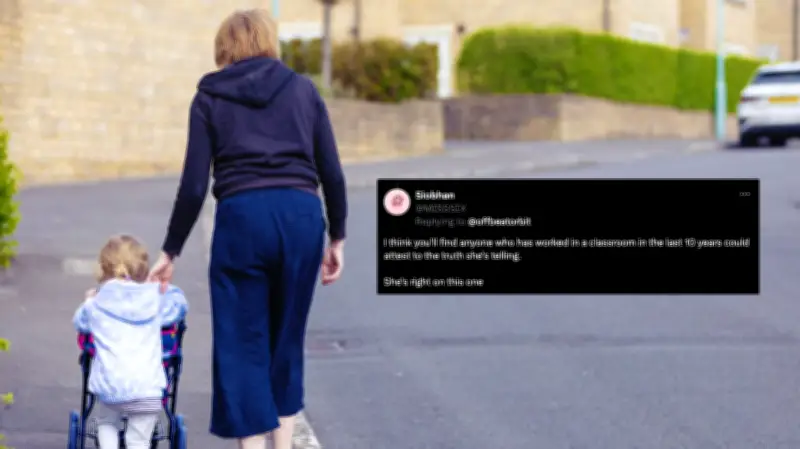
"I think you'll find anyone who has worked in a classroom in the last 10 years could attest to the truth she's telling. She's right on this one," added another.
"I have 13 yr olds who don't know how to spell their parents names or their phone numbers," one user noted.

Parents Who Prioritize Feel at Odds
Parents who do prioritize this kind of work with their kids also acknowledged that they feel a bit at odds with some of their peers. "She's completely right, and anyone who's triggered by it, is personally feeling targeted by what she said. Life isn't always smooth & easy, same as parenting. We have to accept the fact that it's not gonna be comfortable raising a child but still do our best to raise them well," one user wrote.
There were even some parents — who admit to occasionally avoiding the messy, complicated lessons in the heat of the moment — who also chimed in to agree with Frost. "I legit thought everyone agreed with this. Like even when I do this to my own kids because I am fucking exhausted in the moment I know I am fucking up and gotta do better," one user admitted.
One mom to a young grade-schooler said she "spent most of his life getting disbelieving looks in public from other parents for expecting him to do things for himself" or for encouraging him to take age-appropriate risks. "It's an epidemic. As a mom to an almost 6yo, I've spent most of his life getting disbelieving looks in public from other parents for expecting him to do things for himself, or encouraging him to do 'scary' things like ride a bike w/o training wheels, treating a minor fall as nbd," she wrote.
Shockingly Low Bar for School Readiness
Another mom shared the requirements for her child beginning school and said she was "genuinely shocked by how low the bar has been set" for kids — when the bar is to be potty trained, able to use a knife and fork, speak in full sentences, recognize at least three letters and be able to dress and undress themselves by the age of 4. "My son is a capable, independent little boy who already has the attitude (and determination) of a teenager. He thrives when he's given real responsibility and the chance to prove to himself what he can do," user @shropswife1 wrote.
Her concerns demonstrated some of the big-picture worries about the adults that kids raised this way can turn into with such low expectations: "It feels like we're slowly raising a generation of children who are being taught that very little is expected of them — and that worries me."
Another user, @misspennygadget, shared concerns about what kids who were taught these skills might internalize by seeing such a stark contrast between themselves and their peers: "I think about the ones that have been taught and how jarring it must be to see so many peers unable and ill-prepared, wondering why."
Adult Regrets and Neglectful Upbringing
Some adults had rough stories looking back on their own childhoods, wishing these skills had been better prioritized by their own parents. One user, who called Frost's assessment a "truth nuke," shared that they had a particularly restrictive upbringing where they weren't allowed "near stoves" until they turned 15, noting that they feel their growth was "stunted."
"Such a truth nuke, started happening when i was a kid. I wasnt allowed near stoves till 15, not allowed outside most the day just spent in my room, not allowed the radio or playing with other kids outside on our (hardly travelled) street in the suburbs. Stunted my growth fs," one user wrote.
Another 31-year-old poster named the lack of attention to this work as "neglectful," in the case of their parents, noting that they seemed to feel that the child being both "fed and alive" was the bar for decent parenting. "I'm 31 and I had to teach myself or have other adults teach me. My parents were neglectful and felt like as long as I was fed and alive then I was good. Some people who were not taught life skills become regretful parents and aren't able or do not care enough to teach kids," the user wrote.
The Solution: Scaffolding Independence
Frost's answer to this problem is very similar to what other experts recommend for raising independent kids. Ultimately, Frost identifies the solution in parents learning to prioritize these skills and take the "slower, messier" route to accomplishing day-to-day tasks. "Every time we step in and do it for them or avoid teaching because it's slower, messier or inconvenient, we take away an opportunity for them to become capable," as Frost said in her video. "And children want to feel capable."
As Frost notes, independence isn't something that just happens to kids. It takes foundational work, demonstration, repetition and support from parents to get a toddler out of their baby habits and into the ones that are considered developmentally appropriate for them as young children. "We guide, we repeat, we expect," Frost said. "Not perfectly, but consistently."
Providing that support — and learning when it's time to step away — is key for helping your kid grow into their confidence in the long term. In a call to "go back to basics," Frost advocates for what experts call "scaffolding" — where you provide more support early on when introducing a task you want a kid to eventually pull off independently and slowly remove the support when it is not needed anymore.
"By scaffolding this support, parents can provide a high level of support initially and gradually reduce it as kids and parents feel more comfortable," as Jill Hartrich, a child therapist and parenting coach at Foundations Therapy, previously told HuffPost. "This support helps kids build problem-solving skills so they can feel confident making smart decisions when they are without an adult."