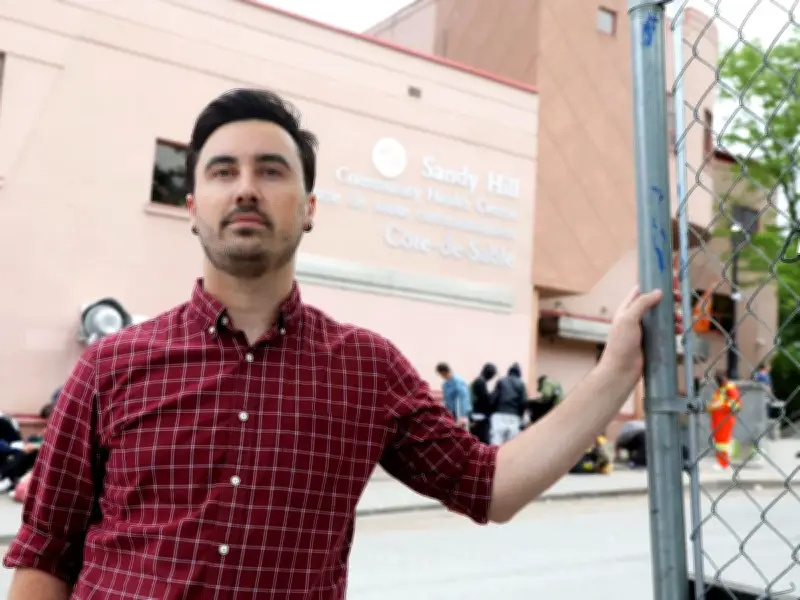
A limp hand sticks out through the bars of a metal fence, where a man lies unconscious on the hot pavement. It is the afternoon of June 12, the final day of operation for Ottawa’s two remaining supervised consumption sites.
Out in front of the Sandy Hill Community Health Centre, nobody appears alarmed. At least not yet. Instead, a group of people who notice moves to him carefully and waits. One woman, swaying back and forth over the unconscious man, crouches down and tries to offer him water. When minutes pass and he does not budge, someone kicks him. His hand twitches. As he slowly rises, confused and mumbling, everyone disperses.
This area is a usual gathering spot for clients of the health centre. The nearby consumption and treatment services (CTS) site is what often brought them inside. Whether it continues to be a regular hangout — with people looking out for one another for signs of overdosing — is still to be determined.

The Citizen spent three days observing Ottawa’s last two supervised consumption sites — the CTS at Sandy Hill and the site down the street at the Shepherds of Good Hope — from their last day on June 12, the day after on June 13, and June 15. As Canada continues to struggle to find solutions for a growing opioid crisis, those who depend on and work inside these sites expressed an overwhelming fear their closure will lead to more deaths from overdosing in Ottawa this summer.
Closure of Last Two Sites Raises Alarm
The Shepherds of Good Hope’s website says their space, known as the Trailer (operated by Ottawa Inner City Health), served about 225 people and reversed on average 2.3 overdoses every day. Its hygienic space allowed for people to consume pre-obtained drugs, with nurses on hand to watch for signs of overdose. Once clients are inside, they often end up getting help for other conditions, like wound and infection care, says Dean Dewar, the director of the Sandy Hill Community Health Centre.
“A lot of times, this is the one place where they can sit down and just have a nice conversation with someone who’s smiling at them. That’s one of the things I just can’t fully grasp in words. This is a place where clients feel like they belong, or that they’re not judged for doing what they’re doing,” Dewar said.
And, because staff would see and get to know the same clients daily, these spaces were often the first step of recovery, Dewar adds. “A lot of comments I’ve gotten say harm reduction is against recovery. And that’s not the case. Harm reduction is the pathway to recovery for a lot of people.”
Shift to HART Hubs Sparks Concerns
But now, Dewar says the Province of Ontario cut health-care funding for his clients in favour of recovery-focused spaces, known as Homelessness and Addiction Recovery Treatment (HART) hubs. But relying solely on HART hubs is not the solution, Dewar says, adding that his centre has worked closely with Ottawa Public Health to understand the community’s impact when supervised consumption sites close.
The closure of these sites means more people injecting on Ottawa’s streets, leading to increased risks of overdose deaths, discarded needles, and public drug use. Those who know the area well are already sounding the alarm bell, warning that the city may not be ready for the consequences.