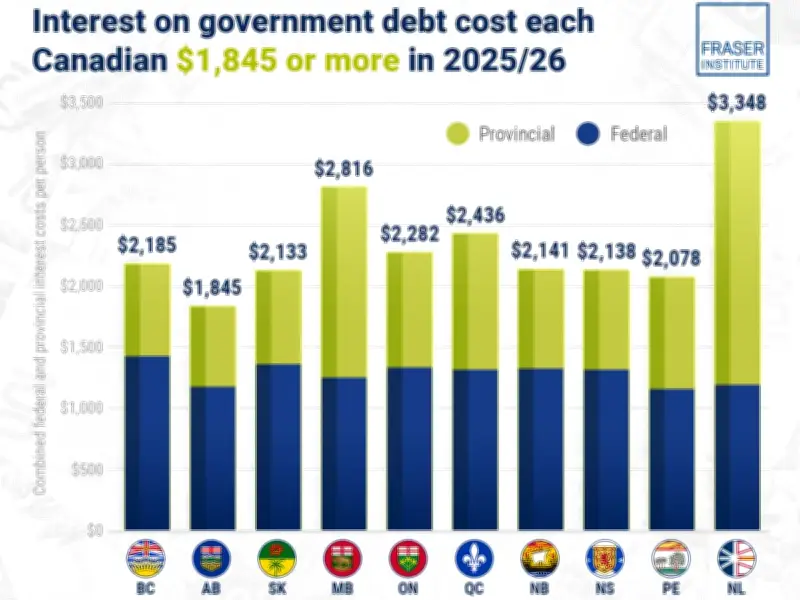
A new study from the Fraser Institute reveals that every Canadian will pay hundreds or even thousands of dollars this year to service interest on federal and provincial debt. Newfoundlanders and Manitobans bear the highest burden, while Albertans pay the least.
Record High Debt Levels
According to the report authored by Jake Fuss, director of Fiscal Studies at the Fraser Institute, deficit spending and growing government debt have become a persistent trend for many Canadian governments. In 2025/26, both the federal government and all ten provinces are projected to record deficits. Combined federal and provincial net debt is expected to reach a record high of $2.4 trillion in 2025/26, with projections indicating this trend will continue into 2026/27.
Interest Payments by Province
The study estimates that total interest payments by federal and provincial governments will amount to $94.4 billion in 2025/26. Residents of Newfoundland and Labrador face the highest combined federal-provincial interest payments per person at $3,348, followed by Manitoba at $2,816. Alberta has the lowest per-person cost at $1,845. Ontario residents will pay $2,282 each, while British Columbians face significant costs as well.

Federal Spending Comparison
More than half of the interest costs come from the federal government, which is projected to spend $54 billion on debt servicing in 2025/26. This amount is nearly equivalent to the $54.7 billion allocated for the Canada Health Transfer and far exceeds the $38.1 billion spent on childcare benefits. Jake Fuss emphasized that these comparisons highlight the magnitude of the problem, noting that money spent on interest is not available for programs like education, health care, and pensions.
Provincial Breakdown
In Ontario, the provincial government is projected to spend $16 billion on interest costs, which is $2 billion more than what the province spends on post-secondary education. Ontario’s interest costs are growing at an average annual rate of 7.1 per cent between 2025/26 and 2028/29, compared to just 2.9 per cent for health care spending. In British Columbia, $5 billion will go toward provincial interest payments in 2025/26, surpassing the $4.5 billion spent on child welfare. Alberta is expected to spend $2.9 billion on provincial interest payments, nearly double the $1.6 billion allocated to the Department of Children and Family Services.
Implications for Canadians
The study underscores the growing burden of government debt on Canadian households. As interest costs rise faster than spending on key services, the opportunity cost becomes increasingly apparent. Fuss urged policymakers to address deficit spending to free up resources for essential public services.