Rare Waved Albatross Spotted Off California Coast in Extraordinary Sighting
Marine scientists conducting research off the central California coast have made an extraordinary discovery: a waved albatross, marking only the second recorded sighting of this critically endangered bird species north of Central America. The remarkable observation occurred approximately 23 miles (37 kilometers) offshore from Point Piedras Blancas, situated roughly midway between San Francisco and Los Angeles.
A Mysterious Visitor Far From Home
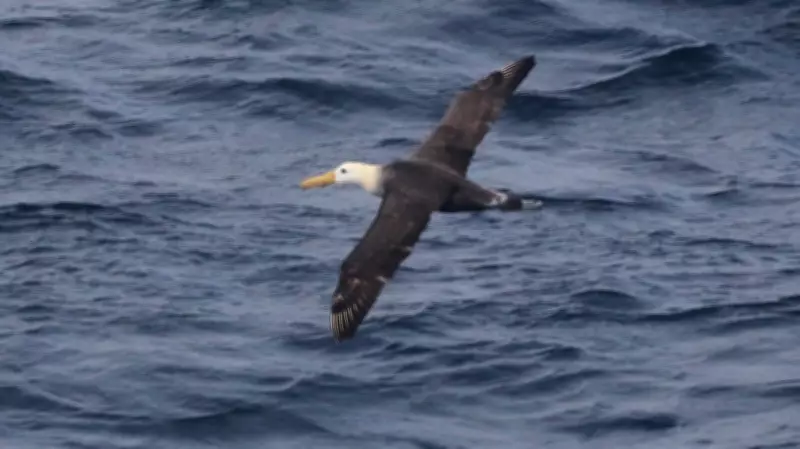
The yellow-billed bird with distinctive black button eyes represents a significant mystery for researchers. Known for its impressive 8-foot (2.4-meter) wingspan and ability to spend most of its life airborne over ocean waters, this species typically breeds exclusively in the Galapagos Islands—approximately 3,000 miles (4,800 kilometers) south of where it was spotted. Scientists classify such animals as "vagrant" when they travel far beyond their established range, making this sighting particularly noteworthy.
Marine ornithologist Tammy Russell, who was aboard the research vessel during the discovery, expressed her astonishment at the encounter. "I can't even believe what I saw," Russell wrote on social media. "I'm still in shock." Russell serves as a contract scientist with the Farallon Institute and a postdoctoral scholar at the University of California, San Diego's Scripps Institution of Oceanography.

Unanswered Questions About the Albatross's Journey
The adult bird appears to be in no hurry to return southward, according to Russell, who noted that the same individual was apparently spotted in October off the Northern California coast. Determining exactly why this albatross ventured so far from its tropical habitat presents significant challenges for researchers.
Several theories have emerged about the bird's unusual journey:
- The albatross may have been driven northward by powerful storm systems
- Some individual birds possess what Russell describes as a "rambling spirit" that leads them to explore beyond typical boundaries
- The bird might be taking a year off from breeding activities, as adults typically lay eggs in spring with chicks leaving nests by January
"Perhaps it went wandering on its year off and will soon return to the Galapagos to be reunited with its mate for the next season?" Russell speculated in an email. "Who knows how long it will stay around or if it will ever return? But that's why these sightings are so special."
Conservation Status and Ecological Significance
The International Union for Conservation of Nature classifies the waved albatross as critically endangered, with the American Bird Conservancy noting its range is typically restricted to tropical regions. As the largest bird species in the Galapagos, it nests on lava fields among scattered boulders and sparse vegetation. These remarkable birds can live up to 45 years, feeding primarily on fish, squid, and crustaceans.
Russell highlighted the potential environmental implications of this sighting. If multiple waved albatrosses begin appearing in California waters, it could signal broader ecological shifts. The researcher has previously documented five species of Booby that have become common off California due to warming temperatures and marine heatwaves.
"If this is a sign of this species moving north, we now have some baseline data when we first detected one," Russell added, emphasizing the scientific importance of documenting such rare occurrences for understanding changing marine ecosystems.