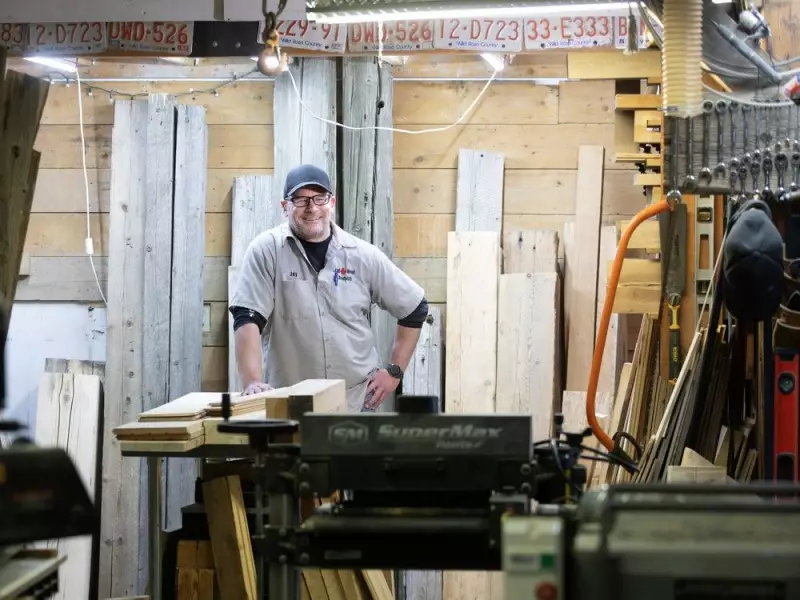
An Edmonton-based company is pioneering a new path for the city's old wood, salvaging timber from aging buildings and turning it into a reliable supply of construction lumber. Backroads Reclamation Ltd. is focusing its efforts on the inner city, where densification initiatives are leading to the demolition of many older homes.
Building an Inevitable Infrastructure from Urban Waste
Jay Sanderson, founder and co-owner of Backroads Reclamation, describes his mission as creating an "inevitable infrastructure." Instead of sourcing wood from old barns across the Prairies, Sanderson now finds a wealth of material in the walls of Edmonton homes built before 1960 that are being torn down.
"There's tonnes of houses coming down in the inner city because of the densification initiatives," Sanderson explained in early January 2026. "By focusing on inner city, there's a budget to remove buildings and the quality of material that's locked away in the inner city homes prior to 1960 is basically what we're after."

The company gathers wood from various sources, including the old Northlands stables, aging residential properties, and structures from Fort Edmonton Park. While artisans have long used reclaimed lumber for unique furniture and decorative beams, Sanderson has a much larger vision.
Scaling Up from Artisanal to Industrial
Sanderson's ambition extends beyond the custom furniture market. He is working with local architects to establish standards for reclaimed wood products, aiming to create a formal supply chain that connects construction and demolition sites with new building projects.
"We're creating an infrastructure, and I would call it an inevitable infrastructure," Sanderson stated. His goal is to industrialize the reclamation process, creating a system that can salvage wood at scale, treat it, and reintroduce it into the construction supply chain as a certified new product from old material.
Alberta's significant construction and deconstruction activity makes it an ideal location for this venture, given the large volume of wood waste produced. Sanderson's interest in reclaimed wood began when he helped a relative dismantle a barn and salvaged the lumber, but he now sees a much bigger opportunity within the city limits.
The Stark Reality of Construction Wood Waste
The scale of the problem Backroads Reclamation is addressing is underscored by research on construction waste. Kaia Nielsen-Raine, a PhD student at the University of British Columbia studying architecture, landscape architecture, and forestry, wrote her 2023 master's thesis on wood waste in Metro Vancouver.
Her research found that of 1.7 million tonnes of construction and demolition waste, the majority of materials destined for landfill was wood. "Essentially, we produce a lot of wood waste, and very little of it gets used for any kind of value-added purpose," Nielsen-Raine said.
She noted that when wood is recycled, it's typically for "thermal recycling or hog fuel," meaning it gets burned for energy. "It isn't the worst recycling use, but it's also the end of the line in terms of value." Her thesis, titled the "Seven Generations Wood Project," was inspired by a sustainability principle suggesting people should plan for seven generations when they build something.
Nielsen-Raine's work highlights the significant opportunity that exists for businesses like Backroads Reclamation to find higher-value uses for this abundant waste stream.
By establishing a system to salvage, process, and recertify old wood, Backroads Reclamation is not just creating a business—it's building a more sustainable model for urban development in Edmonton and potentially beyond. The company's work represents a practical application of circular economy principles, turning what was once considered waste into a valuable resource for future construction.