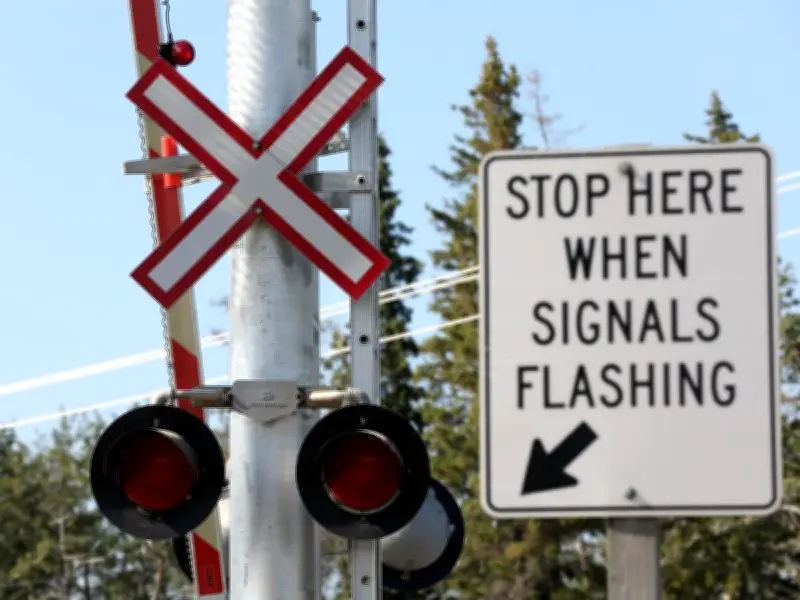
Alberta recorded 37 accidents at its roughly 2,900 public and private rail crossings in 2025, or about one every 10 days, resulting in two deaths, according to data from the Transportation Safety Board of Canada (TSB). This marks the third time in five years that Alberta has led all provinces in rail crossing accidents.
Provincial comparison and trends
The 37 accidents in Alberta surpassed 33 accidents on Ontario’s 4,500 crossings and 29 accidents on Quebec’s 6,800 crossings. Alberta also led all provinces in accidents each of the four years prior, except for 2024 when its 35 accidents ranked second to 39 in Ontario.
Over the past five years, Alberta has recorded between 29 and 37 crossing accidents annually, resulting in a total of 11 deaths.

High-risk crossings and incidents
The crossing with the highest number of recorded accidents in Alberta since 2021 is near the hamlet of Monarch in Lethbridge County, where four collisions have occurred at a single-track crossing that lacks gates, lights and bells. A crossing near Taber saw three collisions in 2024 alone, and the town was the site of a violent collision between a semi-truck and a train last March.
Across Canada, collisions at crossings represent about 12 per cent of all rail accidents but also result in serious injuries more than half of the time.
Safety campaigns and shared responsibility
Rail crossing safety is regulated by the federal government and has been the subject of ongoing public-awareness campaigns. One of the most prominent campaigns, Operation Lifesaver Canada, told Postmedia in an emailed statement that crossing incidents are preventable.
“Rail crossing safety is a shared responsibility between pedestrians, motorists, cyclists, municipalities, other stakeholders and the railway. Every incident at a rail crossing is one too many,” it reads. “Trains always have the right of way at any railway crossings. Trains are significantly larger and heavier than other vehicles and cannot stop quickly. The average freight train can take the length of 18 football fields or more to come to a complete stop.”
“Never attempt to beat a train at a crossing.”
The TSB data does not account for traffic volumes, train movements or other factors that may affect collision risk.