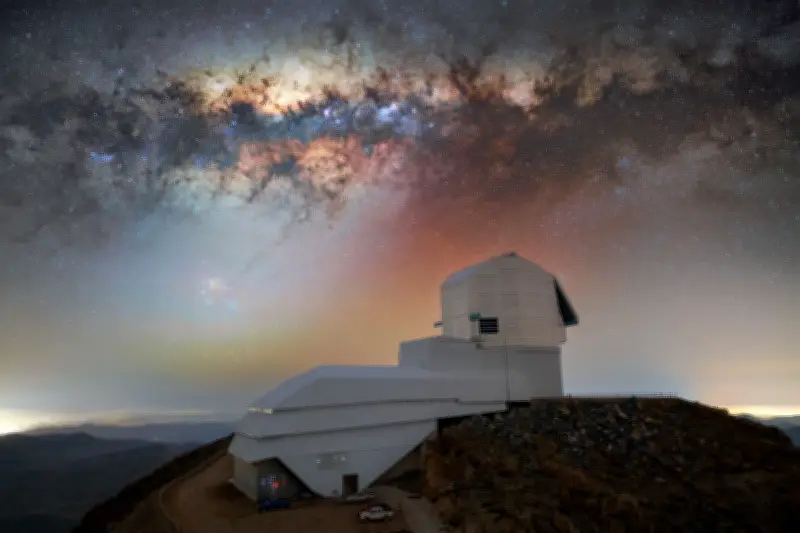
The Vera C. Rubin Observatory in northern Chile has begun an unprecedented survey of the universe, promising to revolutionize our understanding of the cosmos. Located in the Coquimbo region, the observatory is equipped with the world's largest digital camera, capable of capturing the entire southern sky every few nights.
Unprecedented Survey Begins
The observatory, a joint project of the National Science Foundation and the Department of Energy, will conduct a 10-year survey known as the Legacy Survey of Space and Time (LSST). This survey aims to catalog billions of galaxies, stars, and asteroids, providing a dynamic view of the universe. Astronomers have described it as 'the greatest cosmic movie ever made,' as it will capture changes in the sky over time.
The telescope's 8.4-meter mirror and 3.2-gigapixel camera will produce images of unprecedented depth and breadth. Each night, the observatory will generate about 20 terabytes of data, which will be processed and made available to scientists worldwide.

Scientific Goals
The LSST will address key questions in astronomy and physics, including the nature of dark matter and dark energy, the formation of galaxies, and the detection of near-Earth asteroids. It is expected to discover millions of new celestial objects and transient events, such as supernovae and gravitational wave counterparts.
According to Dr. Sarah Johnson, an astronomer at the Rubin Observatory, 'This survey will transform our understanding of the universe. We will see things we've never seen before, and we expect many surprises.'
Impact on Astronomy
The Rubin Observatory's survey will provide a wealth of data for researchers around the globe. It will also serve as a public resource, with images and data available online. The project is expected to produce numerous scientific discoveries and inspire a new generation of astronomers.
The observatory's location in Chile's Atacama Desert offers some of the clearest skies on Earth, making it an ideal site for astronomical observations. The survey will cover about 18,000 square degrees of the sky, observing billions of galaxies and stars.