U.S. forces struck Iran for a third time in a week, prompting retaliatory attacks on at least five Arab nations as Tehran declared the Strait of Hormuz closed “until further notice.” The Islamic Republic responded early Sunday with drone and missile assaults on American allies across the Middle East, including Kuwait, Jordan and Qatar. So far, only minor damage was reported and no casualties.
Hormuz closure and maritime impact
The Joint Maritime Information Center, a global monitoring body, reported the southern route of the Hormuz strait near Oman’s coast was still open on Sunday, despite Iran’s announcement. U.S. Central Command said President Donald Trump had ordered fresh strikes targeting Tehran’s ability to attack commercial vessels after Iranian forces hit a Cyprus-flagged container ship. Iranian media reported blasts on the country’s southern coast, including at the energy and petrochemical hubs of Bushehr and Asalouyeh, the port cities of Bandar Abbas and Bandar-e Dayyer, and the Sirik area near the Hormuz strait, a global energy chokepoint. A communication tower was hit in the southern province of Kerman, injuring two people, according to the Mehr news agency.
Retaliatory strikes across the region
The IRGC said it fired ballistic missiles at the Prince Hassan Air Base in Jordan on Sunday, targeting a U.S. command and control centre and multiple drone hangars. The kingdom reported being hit by three missiles, without giving further details. Qatar, meanwhile, said three people were injured by falling debris after Iranian missiles were intercepted. Iran’s semi-official Fars news agency reported the Guards had targeted Al-Udeid Air Base with ballistic missiles. Kuwait also said it was responding to aerial attacks, after Iran’s regular army announced drone assaults aimed at a U.S. Patriot missile battery, an ammunition depot and a radar site in the country. The Iranian military said a U.S. communications array and radar installation in Bahrain were targeted too. Iranian state media reported other strikes against U.S. naval logistics hubs and aircraft carrier refuelling platforms at Oman’s Port of Duqm. Oman said a drone targeted the northern Musandam governorate, without giving details.

Shipping disruptions and casualties
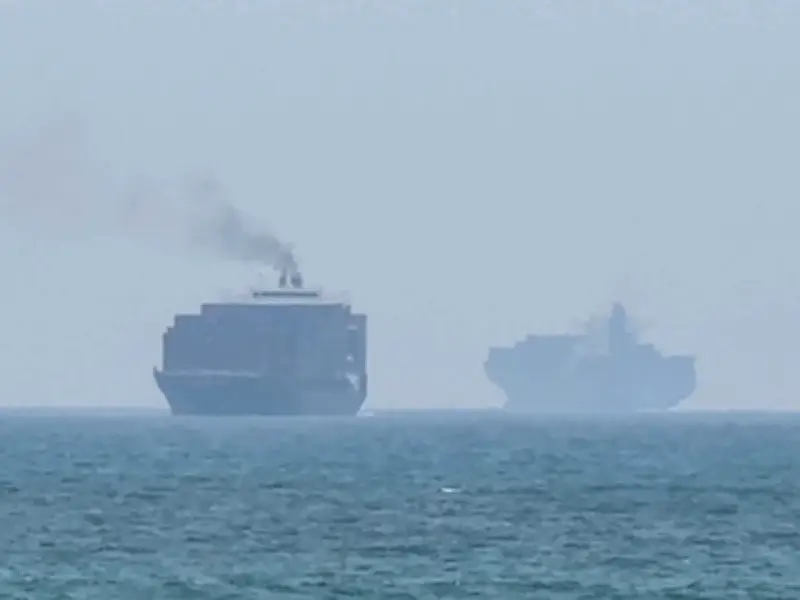
The IRGC halted a cargo ship after firing a warning shot because it tried to transit the Hormuz strait on Saturday despite a warning, IRIB reported. Fars reported Iranian forces had “struck and halted a second non-compliant vessel,” though it didn’t provide further details. A Cyprus-flagged container ship that was hit, M/V GFS Galaxy, is missing a civilian crew member and was unable to continue its journey after suffering significant damage, U.S. Central Command said. Only two oil products tankers were seen approaching the Strait of Hormuz on Sunday. One empty very large crude carrier began signalling again in the Persian Gulf close to the Omani side early in the day, suggesting it pushed through the waterway from the Gulf of Oman without its transponders turned on. Bloomberg News couldn’t immediately determine when the supertanker crossed the strait.
Diplomatic fallout and future talks
The increasingly heated tit-for-tat attacks are throwing into doubt the fate of U.S.-Iran negotiations that are supposed to lead to settling key issues such as the Islamic Republic’s nuclear program and eventually bring an end to the war Washington and Israel began in late February. “Iran made a poor choice,” Pentagon chief Pete Hegseth said on social media. “Now they pay.” Iran’s Islamic Revolutionary Guard Corps announced the latest Hormuz closure earlier Sunday, saying it won’t allow any vessels to pass until foreign interference ends, according to state-run IRIB News. Control of the waterway — through which a fifth of the world’s crude oil and liquefied natural gas once moved — has been central to U.S.-Iran negotiations. The IRGC accused the U.S. of seeking “to create disruption in the south of the Strait of Hormuz” by “instigating several vessels.” There was almost no visible traffic in the strait on Sunday. The maritime security threat “remains severe,” the multinational JMIC said in a note, as it described the waterway as still technically open to traffic.

Demands and threats
Iranian Foreign Minister Abbas Araghchi traveled to Oman on Saturday for talks on the future of Hormuz, but there was no sign of involvement by senior U.S. envoys. Earlier, Iran demanded that the U.S. implement key commitments under a recent deal before more talks take place, rejecting Trump’s contention negotiations could continue without a ceasefire. Tehran said Washington must meet Iran’s conditions for resolving transit issues through the strait and normalizing its oil exports. On Friday, Trump had threatened to shower Iran with “1000 Missiles” if it acted on a threat to kill the U.S. leader, “in this case, ME!” The U.S. had also demanded that Iran publicly declare all channels of the Hormuz open to shipping and pledge not to attack civilian vessels transiting the waterway. Tehran would face consequences if it fails to deliver the public assurance, senior Trump administration officials told reporters on condition of anonymity.