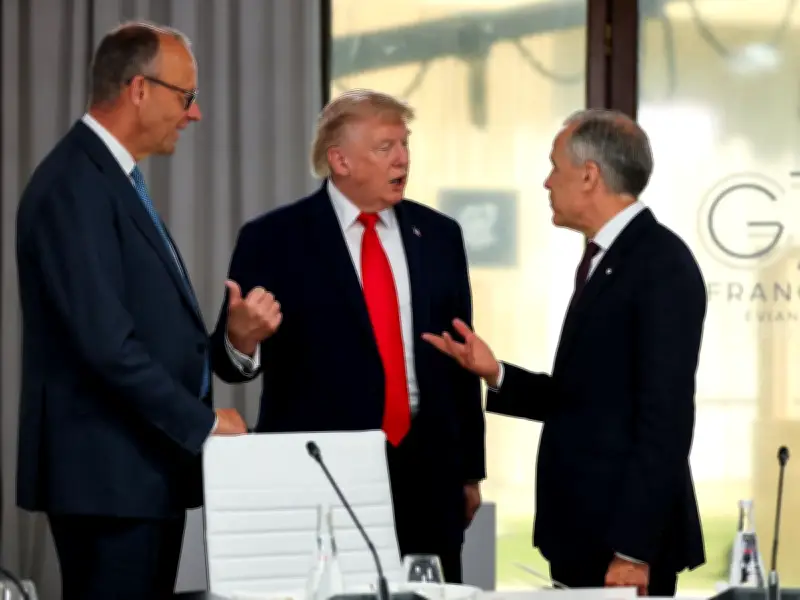
U.S. President Donald Trump continues to assert that the Strait of Hormuz, through which one-fifth of the world's oil and liquefied natural gas normally flows, will reopen by Friday. However, on the sidelines of the Group of Seven summit in Evian, France, it is clear that his European allies do not share his optimism.
Allies Question Trump's Timeline
European leaders disagree that trade can resume by week's end as Trump promised. They have practical questions about what exactly was agreed before committing to de-mining missions and patrols. According to a G7 official speaking on condition of anonymity, there are serious difficulties in finding a common position among the group regarding the situation in Iran. Few expect a joint communique, a pattern that has proven elusive during the Trump era.
Conditional Support from Italy
Italian Prime Minister Giorgia Meloni, who has largely avoided provoking Trump, stated that her country's contribution is conditional on a cessation of hostilities in Lebanon, where Israel's military has carried out recent strikes. She is not alone in questioning Trump's accelerated timeline.

Internal U.S. Disagreements
Even within Trump's own administration, there are prominent figures who did not go as far in promising that navigation along the vital chokepoint can return to normal immediately. A senior U.S. official said traffic in the waterway would ramp up over time, potentially taking as many as two weeks for shipping to increase significantly, and even longer to return to pre-February levels, when the U.S. and Israel attacked Iran. Mines in the strait still need to be cleared, and shippers have different risk tolerances about navigating Hormuz.
Memorandum of Understanding Details
The official said the memorandum of understanding between the U.S. and Iran will explicitly state that the strait will be open toll-free for 60 days, and the U.S. expects that provision to be included in a final agreement. However, free navigation, once a given, is now subject to negotiations that have not yet started.
Industry Concerns
Oil industry leaders have told the White House for months that it would be untenable for the U.S. to permit tolls for safe passage through the Strait of Hormuz, according to a person familiar with those discussions. The White House is aware of the industry's stance.
While the U.S. and Iran both announced an interim agreement to reopen the strait, no official document has been released, and both sides offer different descriptions of its content. Senator Lindsey Graham, a South Carolina Republican and close Trump ally, said, "The way Iran describes it, it's awful; the way we describe it makes sense to me. Let's look at it and see what it actually is."