Old myths die hard in Ottawa, and one of the hardest to kill is the notion that Justin Trudeau's government was on track to meet Canada's climate change targets under his failed $200-billion-plus strategy, before Prime Minister Mark Carney dismantled them.
Trudeau's climate warriors gather at Rideau Club
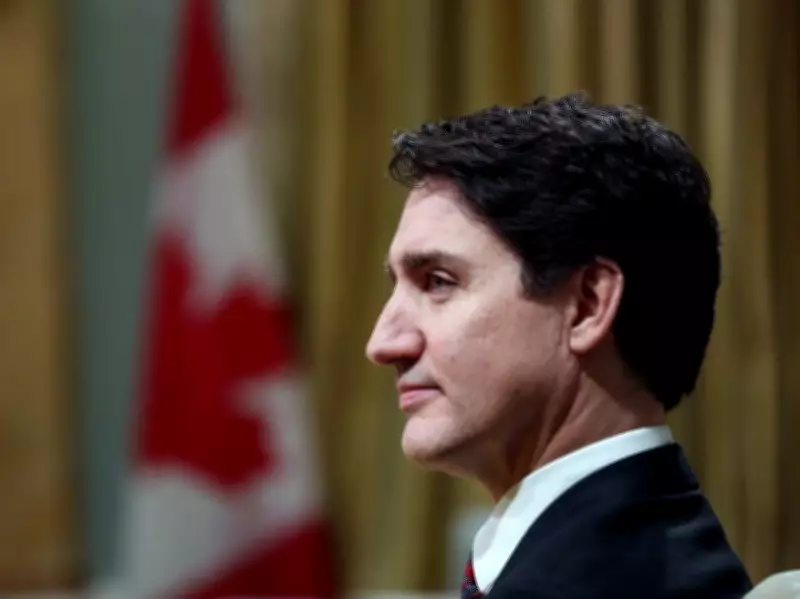
The myth was on full display at a recent social gathering of Trudeau's former environment ministers and climate change advocates—Steven Guilbeault, Catherine McKenna, and Jonathan Wilkinson—along with the former prime minister himself, at the private Rideau Club near Parliament Hill, as reported by CBC.
McKenna, in 2019, absurdly blamed human-induced climate change for flooding at the south end of Toronto's Don Valley Parkway—a location that has been flooding since the glaciers retreated 12,000 years ago. Wilkinson, now Canada's ambassador to the EU, wrongly predicted in 2021 that 2019 would be the last year of increasing greenhouse gas emissions, based on federal data always reported two years after the fact.

But the most laughable claim, reported by CBC as if it were serious, was that in 2023, under the Trudeau plan, for the first time ever, Canada was on track to achieve at least one of its climate change targets.
Guilbeault's optimistic projections
Guilbeault in 2023 stated that the government was projected to exceed Canada's interim objective of reducing emissions to 20% below 2005 levels by 2026, while remaining firmly set on track to meet the ambitious but achievable 2030 target of 40% below, based on modelling from Environment Canada that year.
While one climate activist group supported this finding at the time, a series of independent reports by federal environment commissioner Jerry V. DeMarco exposed such nonsense for the myth it was, in a series of scathing assessments.
Independent reports debunk the narrative
In 2023, DeMarco reported that the government was not on track to meet its 2030 target—and thus not its 2026 interim target. He found that the measures most critical for reducing emissions had not been identified or prioritized, and that 95% of its measures did not include a target or expected emission reductions. Environment Canada, he said, had still not taken sufficient steps to improve the transparency and reliability of its economic and emission modelling, which included overly optimistic assumptions, limited analysis of uncertainties, and a lack of peer review.
In a follow-up report in 2024, DeMarco repeated his warning that the government program was insufficient to meet its own targets. He noted that measures were being implemented too slowly to meet intended emissions reductions in a timely manner, and that estimates of expected emissions reductions were often overly optimistic. Of the 20 measures (out of 149) he audited that were being developed or implemented by the federal government, only nine were on track, nine were facing challenges, and two had significant barriers, such as delays in meeting milestones.
DeMarco also reported that the recent decreases to projected 2030 emissions were not due to climate actions taken by governments, but instead because of revisions to data or methods used in modelling. The lack of transparency in the modelling continues to be an ongoing concern, which can undermine trust and credibility in reported progress.
Of 32 new measures added to the 149 previously announced by the Trudeau government, DeMarco noted that only seven were new, while three enhanced existing measures and 22 were existing measures already reported. Regarding hydrogen, reduction estimates were overestimated, the model applied to determine its potential was inadequate, assumptions were overly confident, and quality control on modelling was limited.
During a media conference, DeMarco said that overly optimistic assumptions, the potential for double counting of emission reductions, plus the lack of timeliness and implementation, all coalesce to essentially jeopardize Canada's ability to meet its target.
All of this occurred long before Mark Carney became prime minister. Based on the latest government data, Canada would have to shut down the equivalent of its entire buildings sector this year to meet the 2026 target.