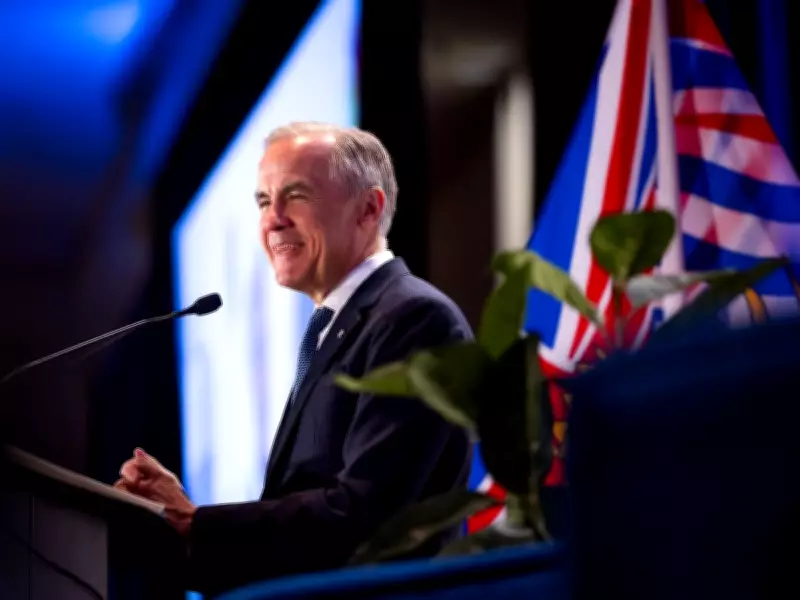
In a recent address to the Greater Vancouver Board of Trade, Prime Minister Mark Carney framed Canada's current situation as an "energy crisis" and a test of national resolve. He spoke of mastering energy as a way of mastering our destiny, and he invited Canadians to stop telling him what they are against and start telling him what they are for. That is the right question.
A North Shore Perspective
Let me try an answer from North Vancouver — territory shared with the Squamish and Tsleil-Waututh Nations, and the gateway through which much of this debate physically passes. For us, climate ambition is not abstract; it is the engineering constraint within which we want to grow an economy.
We live here because we care about the beauty and sustenance our natural environment provides us. Many of us work at the harbour, whose viability assumes current sea levels. Many of us ski on the North Shore mountains that have less snow every year. Many of us live at the wildland edge, more vulnerable to fire every summer. This is one of the most environmentally progressive areas in Canada.

The Global Context
We also know we live in a world where the United States is no longer a reliable economic partner, and where global demand for the inputs of the energy transition is accelerating, not slowing. The prime minister is right that Canada cannot meet this moment by saying no to everything. He is right that fortune favours the bold in a crisis.
Yet boldness without strategy is just hubris. The Trans Mountain expansion ultimately cost Canadians far more than was originally promised. The lesson is not that we should not build, but that we should be careful about what we build, on whose terms and at whose expense.
What We Are For
So, what are we for on the North Shore? We are for energy sovereignty — but by leveraging the industries that the energy transition is already creating here. We are home to one of the world's leading clusters of carbon management companies, such as Arca Climate Technologies, where I work.
Carbon Removal Canada estimates the industry could add $78 billion annually to Canadian gross domestic product by 2050, support 300,000 jobs, and compete in a global market projected to reach a trillion dollars — building, in effect, something comparable to Canada's oil sector.
These jobs are being built now by Canadian scientists and engineers, with global customers already buying. If we want to understand what "energy superpower" means in a low-carbon century, this is part of the answer.
Critical Minerals and Indigenous Partnerships
We are for critical minerals as the strategic prize. Canada has lithium, copper, nickel, rare earths and graphite at scale. The country that processes these minerals will write the rules of the next economy. A northern corridor designed around critical minerals first looks fundamentally different from one designed around bitumen.
We are for Indigenous nations as project co-owners, not stakeholders to be consulted around. The Cedar LNG model, an equity partnership with the Haisla Nation, is not the answer to every question, but it points the way. Consent treated as a foundation produces relationships that succeed.