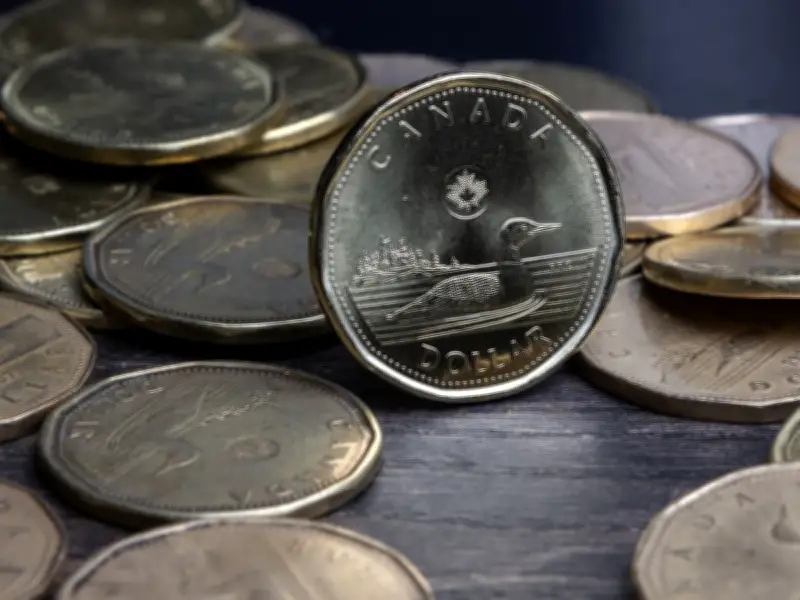
The Canadian dollar slumped to a new closing low for 2026 on Monday, reaching 71.67 cents U.S., as economists at National Bank of Canada highlighted gold as a significant factor behind the loonie's weakness.
Loonie Under Pressure
Chief economist Stefane Marion and senior economist Kyle Dahms noted in a report that "the loonie has been the weakest reserve currency in recent weeks," comparing it to a group of major currencies including the U.S. dollar, euro, and Japanese yen.
The economists pointed out that the Canadian dollar now has a stronger correlation with gold prices than with oil prices, a shift from the 2022 oil shock following Russia's invasion of Ukraine when the loonie moved more in tandem with oil.

Gold's Impact
Gold has fallen 20% from its all-time high of approximately US$5,400 per ounce. The rolling correlation between daily moves in the loonie and West Texas Intermediate crude has turned negative in recent months, while the correlation with gold has strengthened sharply.
After hitting a year-to-date high of 74.1 cents U.S. in late January, the Canadian dollar dropped about 3% as investors sought the safety of the U.S. dollar amid stock market turmoil related to the Iran conflict. The loonie partially recovered from early April to early June but has since given back all those gains.
Additional Headwinds
Marion and Dahms cited several other factors pushing the Canadian dollar lower, including deteriorating economic growth and unfavorable interest rate spreads between two-year Government of Canada and U.S. Treasury yields. The two-year U.S. Treasury yields 4.2% compared to Canada's 2.9%.
Canada's economy contracted in the first quarter following negative growth in the final quarter of last year, sparking talk of a technical recession. However, the economists noted that Canada added 88,000 jobs in May and the unemployment rate dropped, making the recession narrative less convincing.
In contrast, U.S. real GDP is estimated to grow at 1.6%, far outpacing Canada's performance.
Outlook
Marion and Dahms expect the Canadian dollar to rise to 74 cents U.S. by year-end, but this depends on a successful outcome to the review of the Canada-U.S.-Mexico Agreement. "For now, we expect the Canadian dollar to remain under pressure," they said. "Appreciation should resume, but a sustained rally will likely require Ottawa to secure a trade accord with the U.S. this summer."