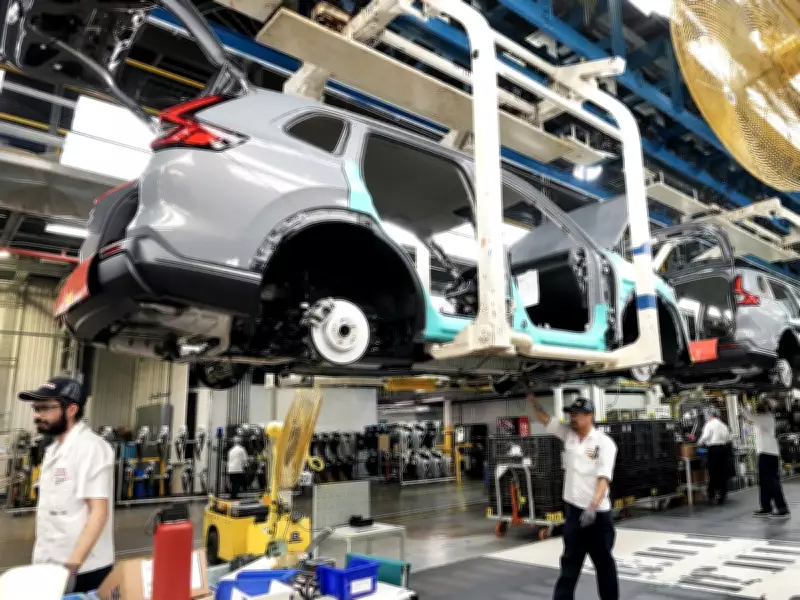
Wednesday's report from Nikkei Asia that Honda has suspended its plan to build a $15-billion electric vehicle plant in Ontario indefinitely comes as no surprise — particularly not to the federal government, which was told in January, sources say.
The big picture is that Canada's ambitious gamble to be the locus for North American electric vehicle production has flopped and the battle now is to conserve the assembly plants that are already here.
In spring 2024, then prime minister Justin Trudeau released a video of himself wandering through Honda's plant in Alliston, Ont. "We bet big on electric vehicles," he said, ahead of the announcement that Honda would build its electric cars entirely in Canada.

It looked like a decent wager then. But that was then.
The strategy involved weaving a welcome mat with billions of taxpayers' dollars — sometimes pledging more in support than the company was investing itself. The Volkswagen battery plant in St. Thomas, Ont., is set to receive more than $15 billion in federal and provincial production subsidies, and another $1.2 billion in construction support, for a facility on which the company will spend $7 billion, according to figures quoted by the Parliamentary Budget Office.
Last month, Volkswagen said it is going to stop making the ID.4 electric vehicle at its plant in Tennessee, one of the two assembly plants St. Thomas was set to supply. It will now assemble the Atlas gas-powered SUV instead.
The Trudeau government's EV strategy expressed a legitimate ambition, but it does not appear to have weighed seriously the prospect that EV demand was not inevitably going to be governed by hockey stick economics — that is, slow growth followed by a sudden, sharp and sustained increase. Trudeau's imprudence was apparent in the whopping nature of the subsidies.
The Canadian largesse was in response to then U.S. president Joe Biden's generous Inflation Reduction Act, which offered huge subsidies for EV producers and consumers.
After the IRA was repealed by President Donald Trump, the Canadian EV policy made little sense. It makes even less sense when Canadian exports to the U.S. are hit by tariffs.
Adam Chambers, the Conservative international trade critic, told reporters on Wednesday that the subsidies on offer by Ottawa induced some manufacturers to move traditional vehicle production outside of Canada to make room for subsidized electric vehicles, and now the market isn't there for them. "Instead of rethinking their entire policy, they (Liberals) are doubling down," he said. "You saw last night, the Japanese ambassador suggesting that access to the U.S. market for automakers is integral to having production here. If we don't have access to the U.S. market, we do not have an industry."
Chambers is right. EV sales in the U.S. dropped 27 per cent year on year in the first quarter, following the expiration of federal subsidies for EV buyers. In Canada, the government has just introduced its $2.3 billion Electric Vehicle Affordability program, where customers are offered a $5,000 rebate this year, declining to $2,000 in 2030. But this is not enough to cover the price differential between most EVs and gas-powered cars.