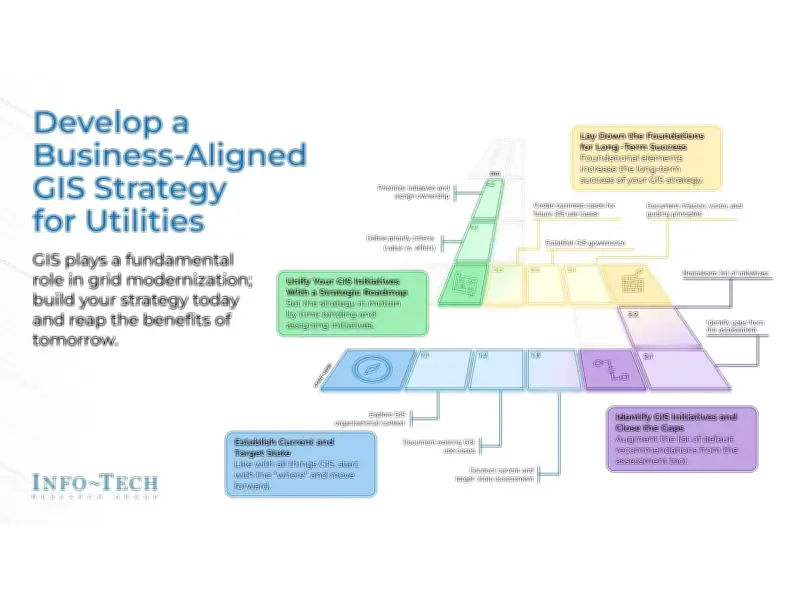
Info-Tech Research Group has released a new blueprint, Develop a Business-Aligned GIS Strategy for Utilities, designed to help utility leaders assess GIS maturity, close capability gaps, strengthen governance, and build a roadmap that supports grid modernization, field operations, and long-term resilience. The research firm emphasizes that geographic information systems are evolving from basic mapping tools into strategic enablers for enterprise-wide decision-making as utilities face rising pressure to modernize grids, improve asset visibility, and integrate operational data.
GIS as a Strategic Platform for Utilities
According to Info-Tech, many utility organizations have not yet aligned GIS capabilities with business priorities, limiting the value they can realize from geospatial data, system integration, and emerging technologies. The blueprint provides a structured methodology to help utility leaders assess current and target GIS maturity, identify capability gaps, establish foundational governance and standards, and build a practical roadmap aligned to organizational priorities.
“GIS can no longer be treated as a back-office mapping function for utilities,” says Bevin Chau, research director at Info-Tech Research Group. “It is becoming a foundational platform for grid modernization, asset management, field operations, and data-driven decision-making. Utilities that align GIS to business objectives will be better positioned to improve reliability, streamline operations, and prepare for emerging technologies such as AI, IoT, 3D modeling, and field mobility.”

Key Challenges in GIS Strategy
Info-Tech’s research highlights several common obstacles that prevent utilities from advancing GIS maturity. Siloed geospatial data stored across multiple systems or departments can prevent utilities from establishing a recognized source of truth, reducing confidence in maps and weakening operational workflows. Limited ownership and sponsorship for GIS strategy, funding, and decision-making can slow progress and prevent the capability from gaining executive support.
Insufficient GIS resources and skills remain a significant barrier, as GIS talent is difficult to acquire and limited internal training prevents teams from advancing toward more sophisticated use cases. Missing or inconsistent standards for data, processes, metadata, versioning, and access increase technical debt and make integrations more difficult. Governance models that are either overly centralized or too decentralized can create bottlenecks, reinforce silos, and reduce cross-functional alignment.
Expanding Capabilities and Future Outlook
Info-Tech’s research notes that GIS capabilities are expanding rapidly as utilities adopt technologies such as AI, IoT, drones, smart meters, 3D modeling, and field mobility. However, many utilities continue to face strategic and operational barriers, including siloed geospatial data, unclear ownership, limited GIS resources and skills, inconsistent standards, and governance structures that have not evolved to support broader enterprise collaboration.
The Develop a Business-Aligned GIS Strategy for Utilities blueprint offers a practical framework to help utility leaders assess GIS maturity, close capability gaps, strengthen governance, and build a roadmap that supports grid modernization, field operations, and long-term resilience. By aligning GIS with business objectives, utilities can improve reliability, streamline operations, and prepare for emerging technologies.