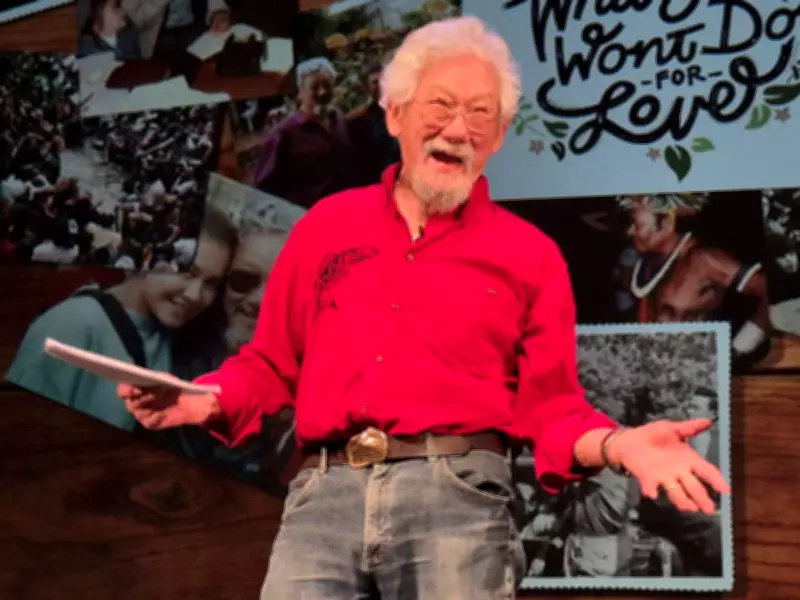
David Suzuki's Environmental Legacy Faces Critical Examination at 90
As environmental icon David Suzuki celebrates his 90th birthday, his career of environmental advocacy faces renewed scrutiny from columnist Colby Cosh. The former television personality, currently promoting a new memoir, expresses profound disappointment about the planet's future despite decades of environmental activism.
A Legacy of Warnings and Regrets
Suzuki recently told CBC Radio's Sunday Magazine that he feels he has fundamentally failed in his mission to protect the environment, believing the biosphere is now headed irreversibly toward catastrophe. This gloomy assessment comes as the ecological sage reflects on his life's work while preparing to depart the public stage.
While Suzuki is widely credited with bringing climate change and greenhouse gas emissions to public attention, Cosh questions why the environmentalist cannot acknowledge his own successes. Despite recent political setbacks for climate policy, carbon-counting and environmental permitting have become permanent features of modern civilization.

The Nuclear Energy Paradox
One significant contradiction in Suzuki's environmental legacy emerges in his lifelong opposition to nuclear energy. "He opposed nuclear energy venomously all his life," Cosh notes, pointing out that this stance may have inadvertently harmed climate efforts more than it helped.
The columnist argues that Suzuki and his generation of environmentalists may have done more damage to climatological balance through their anti-nuclear activism than they contributed through their environmental advocacy. This is particularly ironic given recent technological advances in electric vehicles, solar and wind power integration, and the revival of clean nuclear energy that Suzuki cannot claim credit for supporting.
Population Bomb Theories Revisited
Cosh, who remembers Suzuki's early television career, recalls how the environmentalist spent much of the 1970s and 1980s promoting Paul Ehrlich's "Population Bomb" theories. Ehrlich, who died recently, has been widely criticized as an irresponsible catastrophist whose predictions of mass starvation, political disorder, and resource crunches never materialized.
Remarkably, Suzuki continued promoting and applauding Ehrlich as late as 1989, long after the predicted catastrophes had failed to occur. This raises questions about Suzuki's scientific judgment and the lasting impact of his alarmist predictions.
The Saintly Status Questioned
Suzuki maintains a saintly status in Canada largely because of his early television career during an era when the CBC dominated Canadian media and he served as the "Voice of Science" for the boomer generation. The CBC continues to treat him with reverence, despite what Cosh sees as problematic aspects of his environmental legacy.
The crux of the CBC's recent feature on Suzuki focuses on his complaint that people didn't listen to him enough, that an entire nation of admirers failed to follow his warnings more closely. "Few Canadians did more to change the world than Suzuki," Cosh acknowledges, "yet at 90 he's livid with frustration and disappointment."
This examination of Suzuki's career raises important questions about environmental advocacy, scientific communication, and the complex legacy of one of Canada's most prominent public intellectuals as he enters his tenth decade.