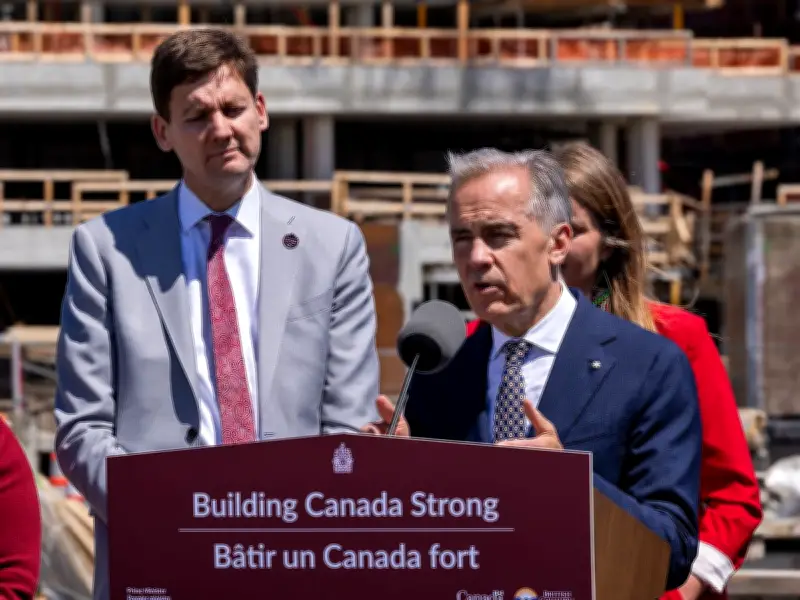
Prime Minister Mark Carney’s announcement that the federal government will buy up to 2,500 unsold condos in Vancouver and convert them into affordable rentals or resell them has drawn sharp criticism for creating a moral hazard that could undermine housing market stability. The plan, unveiled alongside British Columbia Premier David Eby, is part of a broader $3.2-billion, 10-year investment in community infrastructure, but critics argue it effectively bails out developers who took risks in a cooling market.
Moral Hazard Concerns
In economics, moral hazard occurs when an entity takes excessive risks because it does not bear the full consequences. Carney, who as Bank of Canada governor and later as prime minister has criticized the “too big to fail” banking doctrine, now appears to be applying the same logic to condo developers. “Yet this is exactly the approach he unveiled in Vancouver last week,” writes John Ivison in the National Post. The government will buy unsold units using “innovative financing tools” from the Build Canada Homes agency, with details on pricing expected this fall.
The move comes as Vancouver faces a 30-year high in unsold condos, driven by higher interest rates and weak investor demand. Carney said developers “do not want to sell at a loss, but they also can’t afford to hold the empty units indefinitely.” However, Ivison argues that bailing out developers when they cannot sell their homes is fundamentally different from reducing development charges to spur new construction.

Cost and Impact
The cost of buying and converting 2,500 condos could eat up half of the new $3.2-billion cash infusion, according to Ivison. “Even paying half off, the cost will eat half of the new $3-billion cash infusion. At that price, wouldn’t they sell on the market?” he asks. The broader announcement includes using the Build Communities Strong fund to lower development charges, which in the Greater Toronto Area have surged by up to 274 per cent over a decade, adding nearly $200,000 to the cost of an average new home.
While reducing development charges is a sound strategy to address Canada’s housing crisis, Ivison warns that the condo buyback creates a perverse incentive: developers may expect Ottawa and Victoria to act as permanent buyers of last resort, discouraging them from pricing units competitively or adjusting to market conditions. “What does not seem likely is that government action will stimulate more supply, unless developers suspect they can rely on Ottawa and Victoria to be the buyer of last resort in perpetuity,” he writes.
Broader Housing Strategy
Carney and Eby described the agreement as a “landmark” effort to build more homes, reduce buying costs, and modernize infrastructure. The federal government’s strategy includes using the Build Communities Strong fund to pay for local infrastructure, shifting away from the “growth pays for growth” model that forced municipalities to raise development charges instead of property taxes. This approach has been a major contributor to Canada’s housing crisis, according to Ivison.
However, the condo bailout risks overshadowing these positive steps. “Incentivizing developers to build more by creating certainty on the development-charge front is quite different from bailing them out when they can’t sell their homes,” Ivison notes. The plan also raises questions about whether the government will end up overpaying for units that could otherwise be sold on the open market at a discount, potentially wasting taxpayer money.
Political and Economic Implications
Carney’s critics, including Conservative opponents, have seized on the announcement as evidence of his willingness to intervene in markets and pick winners. The prime minister, who has long warned against the moral hazard of bank bailouts, now faces accusations of hypocrisy. Ivison concludes that the plan is a “hazardous look” that may do little to solve the housing crisis while creating new risks for the economy.
The federal government has not yet released the specific pricing mechanism for the condo purchases, but the fall announcement will be closely watched. For now, the plan remains a controversial gamble that could either stabilize the Vancouver market or entrench developer reliance on government support.