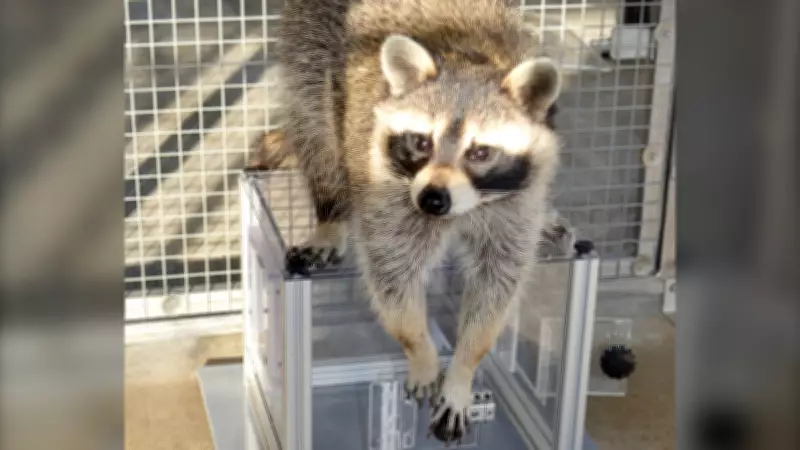
Raccoons Display Remarkable Problem-Solving Skills Driven by Curiosity, UBC Research Shows
A fascinating new study from the University of British Columbia has uncovered that raccoons are not only clever scavengers but also genuinely curious creatures who enjoy solving puzzles purely for the mental challenge, even when no food reward is offered. This research provides compelling evidence of their advanced cognitive abilities and intrinsic motivation to engage with complex tasks.
Intrinsic Motivation Over Food Incentives
The study, conducted by researchers at UBC, involved presenting raccoons with various puzzle boxes designed to test their problem-solving skills. Traditionally, animal cognition experiments often use food as a primary motivator. However, in this innovative setup, the puzzles were presented without any edible rewards. Astonishingly, the raccoons consistently interacted with and solved the puzzles, demonstrating a clear drive to explore and manipulate their environment.
This behavior suggests that raccoons possess a level of curiosity and cognitive engagement that goes beyond basic survival instincts. The animals spent significant time figuring out the mechanisms, indicating that the act of solving itself was rewarding. Researchers observed repeated attempts and varied strategies, highlighting their adaptability and persistence.

Implications for Understanding Animal Intelligence
These findings challenge previous assumptions about raccoon intelligence, which often focused on their foraging and memory skills. The study indicates that their cognitive repertoire includes elements of play and exploration similar to those seen in more traditionally studied intelligent animals like primates and corvids.
The research underscores the importance of considering non-food motivations in animal behavior studies, potentially leading to new methodologies in cognitive science. By recognizing that animals may engage in tasks for mental stimulation, scientists can gain deeper insights into the evolution of intelligence and problem-solving across species.
Methodology and Observations
The UBC team designed several puzzle boxes with different levels of complexity, such as latches, levers, and sliding panels. Raccoons were allowed to interact with these devices in controlled environments, and their behaviors were meticulously recorded. Key observations included:
- Raccoons showed immediate interest in the puzzles, approaching them without hesitation.
- They used their dexterous paws to manipulate components, often exhibiting trial-and-error learning.
- Even after solving a puzzle multiple times, many raccoons returned to it, suggesting ongoing engagement rather than mere novelty.
- No aggressive or frustrated behaviors were noted, indicating a positive experience.
This study not only adds to the growing body of evidence on raccoon intelligence but also opens doors for further research into how urban wildlife adapts cognitively to human-altered environments. Understanding these abilities can inform wildlife management and conservation strategies, particularly in areas where raccoons and humans frequently interact.