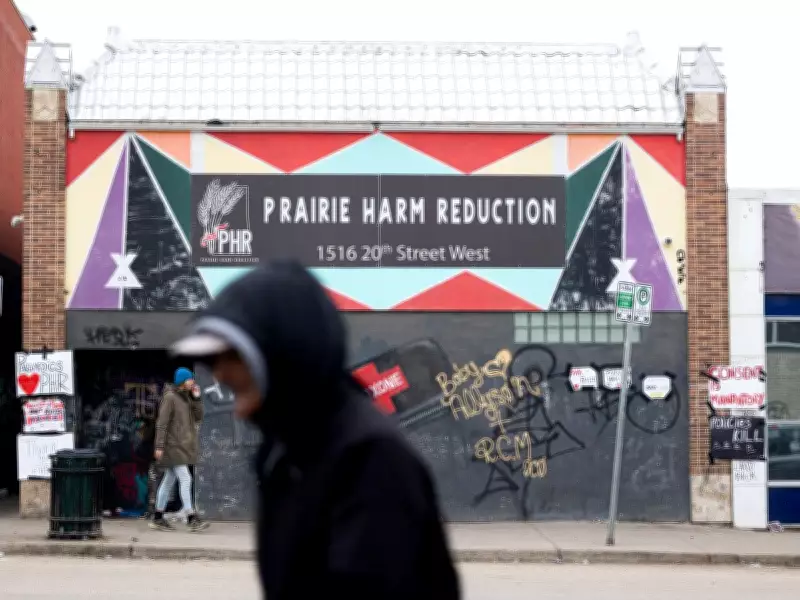
Prairie Harm Reduction's Legacy: Nearly 40 Years of 'No Strings Attached' Care
Support worker Jameen Bomboir leans across the kitchen window of Saskatoon’s drop-in centre at Prairie Harm Reduction (PHR), passing a cup of coffee to someone who likely wouldn’t otherwise have received a warm beverage. The morning in late February took place exactly six weeks before the organization announced to local media that it would cease all operations, following a statement that PHR was facing a significant financial shortfall due to an increased demand for its services.
“It’s a loss that I’ve never experienced before,” Bomboir said about a week after the closure. With a background serving a similar clientele in the city, Bomboir had just started at PHR about two months before its seemingly sudden shutdown. She says she quickly became tight with her co-workers and the regulars she served. “We would joke. I’ve cried with people … It takes a little bit of time for some people to warm up to you when you’re a new face, but once they got to know me and they knew that I wasn’t a threat, it was beautiful to be quite honest. People just opened up. And just doing that as you’re pouring cups of coffee, it doesn’t seem like much, but the impact and the connection you can have with people by sharing a coffee … is massive.”
According to those with ties to PHR, pouring coffee — and the spirit of no strings attached care — are themes that underpinned the organization’s decades-long history of practising harm reduction. The organization was AIDS Saskatoon before it became PHR, moving to 20th Street in 2020. There, it offered the controversial but research-backed supervised consumption site, along with a slew of other resources, including youth and family housing programs designed to help those in care repair relationships and build stability.

Advocates Warn of Worse Health Outcomes
Now, advocates who say that spirit was essential for the harm reduction model to save lives worry that PHR’s absence has opened a dam for a wave of overdoses, HIV transmission and strain on nearby organizations and emergency rooms already bursting at the seams. Shortly after PHR announced its dire financial situation and removed its executive director, Kayla DeMong, the organization lost its Health Canada exemption, which allowed the supervised consumption site to operate legally. Having never supported the site, the provincial government quickly followed by pulling the funding it was contributing to PHR’s other programs.
Before the closure, some community pushback towards the site was documented at a February Saskatoon West community safety meeting organized by Conservative MP Brad Redekopp’s office. The Riversdale Business Improvement District and the Saskatoon West Business Association were also involved. According to those in attendance, both strong supporters of PHR and critics were vocal. However, Health Canada identified “a significant funding shortfall and organizational constraints” as the reasons for pulling PHR’s exemption, writing in an email that “exemption holders must demonstrate that they have resources available to support the safe and ongoing operation of a supervised consumption site.” The federal agency’s website currently references evidence in support of these sites, which are based on implementing harm reduction principles for those facing substance use disorder, a medical condition often rooted in layers of trauma.
Barb Fornssler is a former PHR board member, but was only comfortable providing information as a U of S substance use researcher. She says harm reduction practices are common in everyday life, citing the example of using seatbelts. She advocated for the benefits of harm reduction when applied to supervised consumption sites: A model she says is made more effective by the human connection offered through a drop-in centre. “It’s enabling safer approaches to that (substance) use that is already going to happen,” she said, adding that demanding abstinence from someone using substances as their only coping mechanism before offering supportive care can further traumatize them.

But some are happy to see a reduction in this approach on the local level, against a backdrop of the federal Conservative party pushing for a shift in addressing addiction. “Saskatoon is safer now that Prairie Harm Reduction’s ‘safe’ consumption site is finally shut down,” Redekopp said in a Facebook post. In a previous interview, he said he wants to see “more of a recovery-oriented model of care.”
For the month of April, up to and including the 19th, Saskatoon fire crews responded to 301 overdose calls, about 20 per cent of those being within five blocks of the former PHR site. That’s up from 165 for the full month of March, and from 178 for the full month of February. In an email, Medavie Health Services West, which heads up the city’s paramedic services, advocated for the importance of public access to naloxone, which can reverse or reduce the effects of opioids.
Pamela Downe, a medical anthropologist at the U of S specializing in HIV and AIDS, worries that a spike in HIV transmission is inevitable after PHR’s closure. Saskatchewan has historically seen transmission rates as high as three times the national average, with federal data showing a rate of 18.6 cases per 100,000 people in 2024, second only to Manitoba (19.5). “Prairie Harm Reduction contained those rates. Now that it is gone, … we are going to see it go up, right? Because when you shut down a centre like Prairie Harm, the crisis doesn’t go away. It escalates,” she said. HIV most commonly spreads through sexual contact and injection drug use. The same federal data showed that in Canada, 38.3 per cent of exposure was through “heterosexual contact”, 32.8 per cent through “male-to-male sexual contact” and 16.9 per cent through “injection drug use.”
Downe understands why some feel frustrated seeing public drug use and homelessness, but says that response misses the bigger picture. “When you walk by the sidewalk or on your way to Saint Paul’s Hospital … what you see is a snapshot. What you see is a moment in time of people struggling. … That particular individual snapshot of seeing people struggle is part of a much longer trajectory or journey of healing.”
Remembering the ‘Whole Archive’
Former PHR support worker Vern Keeper has firsthand experience with that kind of healing trajectory. While providing care at the drop-in, he explained that his lived experiences made him especially adept at helping others through the complexities of substance use disorder. “I used to be a user too, so they relate to me more, and I relate to them. They don’t want some person (saying,) ‘I learned about you guys in school, I learned about you guys in books.’ I lived it.” Keeper was a client of AIDS Saskatoon’s drop-in centre, back when it was located on 33rd Street, which had a needle exchange program. “I could go there and stay warm, ask questions (about) what I needed, like how to get a home and how to get your resumes done … stuff like that,” he said.
During his shift weeks before the shutdown, Keeper said he hoped to become a peer mentor at a group home soon. Now, he is one of more than 120 PHR employees left jobless. “We’re like a tight-knit family around here,” he said about his work environment back in February. According to Bomboir, that environment has since been sustained by an active group chat.
Rachel Loewen Walker wrote about her experience volunteering at AIDS Saskatoon during the early 2000s in an opinion piece for the StarPhoenix, describing a similar come-as-you-are drop-in atmosphere. “I remember, the coffee was always on,” she said in an interview about a time when the organization was focused on both providing education about living with HIV and adapting to serving those battling substance-use disorder. “The value of a drop-in centre like that is that it’s not just the staff that are there to provide support, it’s the other people in the space … There’s a peer support network that builds,” said Loewen Walker, who is now a non-profit consultant.
Despite PHR’s final chapter, which includes some still unanswered questions about exactly how the organization’s finances ended up so far in the red (former board member Brady Knight has said a forensic audit would be required to identify specific causes, but there are no funds to pay for one), Loewen Walker encouraged people to consider the decades of work and hundreds of staff that came before. The organization was founded in 1986 and tackled the AIDS crisis in the city head-on. “We’re not remembering the whole archive when we only focus on this final event, and at the same time, I’m kind of like, we need an organization like this,” she said.
Erin Beckwell, a Saskatoon-based lecturer in social work and former executive director of AIDS Saskatoon from 2003 to 2007, says the drop-in centre was quickly assembled when the organization existed on Idylwyld. It became purpose-built once it moved to 33rd Street, where it stayed until 2020. “(The drop-in) happened over time, but it always started at this place of, we need to give people somewhere that they can be in with no strings attached,” she said. Having dedicated years of her life to the cause, Beckwell said she believes PHR is “irreplaceable” in its philosophy. “PHR was sort of plugging the dam that is now going to burst,” she said. “I think if people thought we had an issue on our streets before because of PHR, sometimes, they will see what PHR was actually doing.”
“I worry very much that everyone in our community, health care providers, human service providers, are maxed out, and so I believe we need to find a way to try to resurrect PHR, or a new version of PHR, and carry on just as folks were doing until last Thursday,” she said, speaking about a week after the closure.
Bomboir is part of a group working to try to keep PHR’s spirit alive. She became emotional during a phone interview while grocery shopping for a volunteer-funded meal for the community, organized by former staff. “Everybody’s shopping … We’re going to hand out naloxone kits and just check on our people, because we miss them so much,” she said.