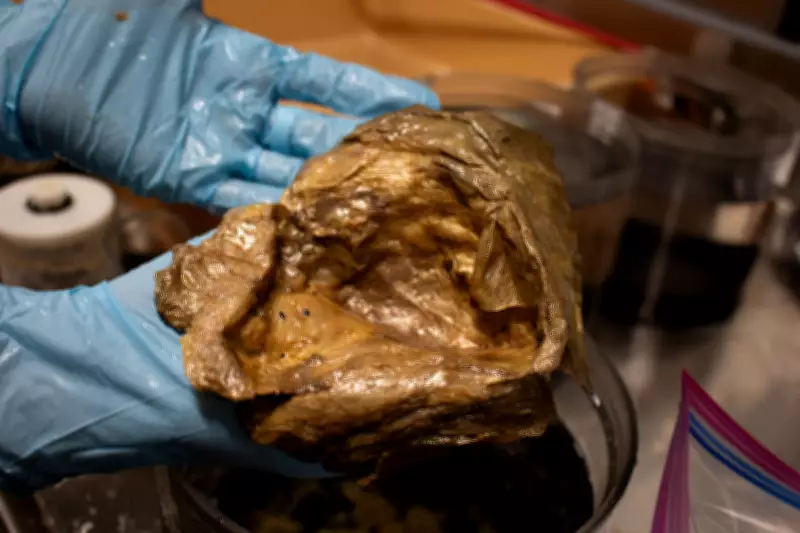
Scientists have identified a mysterious golden orb discovered on the ocean floor near Alaska, sparking curiosity and further investigation. The specimen, which was found during a deep-sea exploration mission, has been transported to the Smithsonian Institution for analysis.
Discovery and Initial Analysis
The golden orb was located by researchers from the National Oceanic and Atmospheric Administration (NOAA) during a routine survey of the seafloor off the coast of Alaska. The object, approximately the size of a small melon, appeared to be a smooth, golden-hued sphere with no visible openings or features. Its unusual appearance prompted the team to collect it for further study.
Upon arrival at the Smithsonian's laboratory, scientists conducted preliminary examinations, including imaging and material sampling. The orb's composition and origin remain unknown, but initial tests suggest it may be biological in nature, possibly a new species of marine organism or an unusual egg case.

Ongoing Research
Researchers are now conducting detailed genetic and chemical analyses to determine the orb's identity. Dr. Emily Carter, a marine biologist at the Smithsonian, stated, "This is an exciting discovery that highlights how much we still have to learn about our oceans. The golden orb could represent a previously unknown species or a rare biological phenomenon."
The discovery has garnered widespread attention, with experts from various fields offering hypotheses. Some speculate it could be a type of deep-sea sponge or a mollusk shell, while others suggest it might be a geological formation. NOAA plans to return to the site for further exploration.
Implications for Marine Science
This finding underscores the importance of deep-sea exploration and the potential for discovering new life forms. The ocean floor remains largely unexplored, and each discovery contributes to our understanding of marine biodiversity and ecosystem dynamics.
As the investigation continues, the golden orb serves as a reminder of the mysteries that lie beneath the waves. Further updates are expected as scientists publish their findings in peer-reviewed journals.