MOOSE JAW — The roaring whoosh of jet engines overhead is a sound everyone in Moose Jaw knows. It draws people to windows, onto porches, even onto the street, with necks craned upwards. Eyes search the skies for the familiar red and white livery slicing through the air, in perfect formation.
“I always go somewhere in my yard where I can see them, or if I’m driving somewhere, I’ll pull over and stop to watch,” said Bonnie Johnson. She has seen hundreds of flybys from the Snowbirds over the years, living in the city. At eight years old, Johnson watched the Snowbirds’ debut in 1971 over the airbase at 15 Wing Moose Jaw, from her parents’ car. They had to park along the highway south of the city because there were too many spectators to get any closer. And still now, anytime she hears that familiar hum: “It just gives you goose pimples,” she says.
Hands wrapped around a coffee mug at Hopkins Dining Parlour in the heart of downtown, Johnson is feeling nostalgic. It has only been two days since David McGuinty, minister of national defence, visited Moose Jaw to reveal the Snowbirds would be grounded at the end of this show season until at least the 2030s, to await a new fleet. He described it as an operational pause; the Snowbirds crew of more than 80 personnel will be redeployed for a time, and then brought back to revive the long-standing air demonstration team so loved by the country.

For Johnson and much of the city, the news their hometown sweethearts would be grounded even temporarily was only the first drop in the pond. Questions and emotions rippled from its epicentre. It has had Johnson thinking about the 25 years she spent working at Hopkins, once a favourite spot for Snowbirds members to unwind. Retired crew still visit, often stopping in with family to say hello. “To think that they’re not going to be practising in the air or there’s not going to be flybys anymore, that feels pretty sad,” mused Johnson.
Moose Jaw is not alone. The news has Canadians across the country mourning the pause, and anxious to know what the future may hold for the iconic nine-jet aerobatics team. The Snowbirds have flown thousands of shows across North America, inspired and connected millions of people as a symbol of national unity, sovereignty and pride. But however deeply Canadians feel about the Snowbirds, and the idea of an indefinite hiatus on the ground — it runs just a little deeper in Moose Jaw. More than just a Canadian symbol, the Snowbirds have been the heart and soul of this prairie city for decades.
“It’s a sense that Moose Jaw has, that we are their roots,” Johnson said. “I just hope we don’t lose that in the years they say they’ll be shut down.”
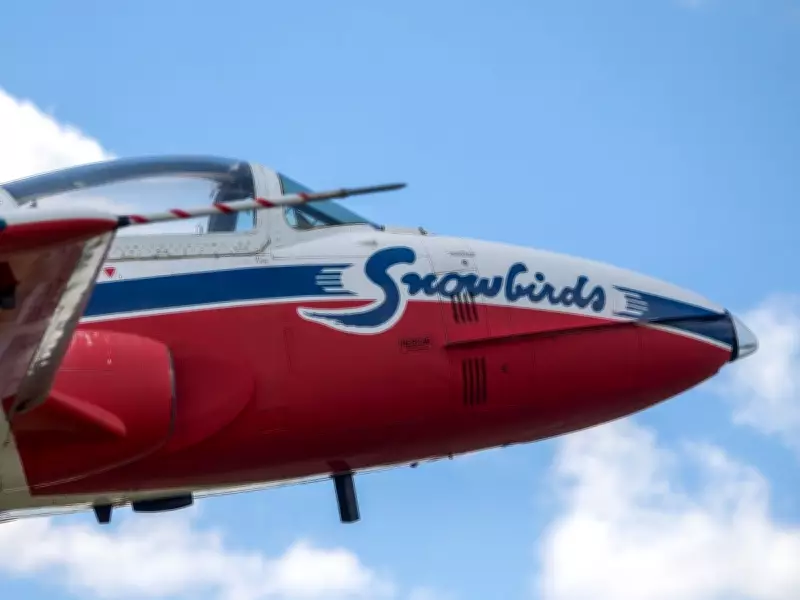
Roger Blager has been fanatical about planes since childhood, when he could point out the car window at a passing jet and clock its make and model on the spot. He was born the same year the Snowbirds launched their inaugural show in 1971. The first time he remembers seeing the synchronized team dip, dive and twist was around age seven or eight. For a kid like him — one who unsurprisingly went on to get his private pilot’s license and now flies his own Cessna 172 — the Snowbirds and their CT-114 Tutor jets are a hometown beacon. He wagers uncountable pilots in the Royal Canadian Air Force (RCAF) fly because they saw the Snowbirds and felt a calling.
“We’re so proud of them, and we feel like every time they fly out of Moose Jaw, they’re not just ambassadors for Canada. You really can’t separate one from the other,” says Blager, who is president of the Moose Jaw Flying Club. “It’s just part of who we are, and it’s part of who we always have been.”

Evidence is scattered throughout the city. Walking through downtown, you see the Snowbirds cameo in murals painted on the broad sides of historic buildings, trash cans and benches. A Snowbird jet is blazoned on the Temple Gardens Centre, and in the logo for the Western Hockey League’s Moose Jaw Warriors. It was changed in 2022. There are at least three decommissioned Tutor trainer jets on display around town. One is just outside 15 Wing’s base, with a memorial plaque naming all the crew members lost in the line of duty. A replica Tutor hovers along Highway 1, perched on display in the parking lot of the Tourism Moose Jaw visitor centre. Tens of thousands of people stop in during the summer, many curious about the vibrant red jet outside. The third lives in the gallery dedicated to the Snowbirds inside the Western Development Museum, a trove of memorabilia like flight suits, pilot logs and old show banners donated by Snowbirds alumni. It has been on display since 1992. And inside the Hopkins dining room, framed photographs of the Snowbirds line the walls — a storied collection that dates back to 1986, thanks to late owner Gladys Pierce who was a dedicated fan and friend of the team.
What Johnson remembers most are the air show parties in the 1980s and 1990s. 15 Wing’s annual hometown air show was once Moose Jaw’s anchoring event — a weekend in the summer that saw the city’s modest population swell three times its size with visitors giddy to see jet pilots do what they do best. It was a glorious time to be a restaurant or a hotel, or even one of the campgrounds around town. The show was an economic backbone for the city’s tourism sector. At its peak, as many as 80,000 people would flock to Moose Jaw. “People came from far and wide to Moose Jaw. I remember 9th Avenue South and onto the highway lined with trailers and campers, people sitting on the roofs of houses,” Johnson said.
Always on the Thursday before the show, Hopkins would close Athabasca Street for the night. People would fill the block, enjoying drinks and food and live music, mingling with Snowbirds and pilots from across the world in town to perform. “The fun thing about it was that it was unity,” said Johnson. “It didn’t really matter where you were from, you were all at the same party.” It is the epitome of what the Snowbirds mean to so many: unity and connection, a sense of camaraderie unlike any other. In this political and international climate, Johnson worries losing that is as concerning as anything. “I just feel like we’re going to lose a little piece of Canada,” said Johnson, thinking again on the upcoming pause.
Blager feels the same anxiety. But mixed in is a small sense of relief as a pilot, however amateur. “It is really bittersweet, to see the (Tutors) go, to see the Snowbirds in their current form go,” Blager said. “But it’s also exciting for new equipment, which is long overdue.” The CT-114 Tutor jets have defined the Snowbirds image since they took the skies in 1971, becoming synonymous with the look and sound of the team. Hearing they will be replaced with new Swiss-made, single-engine turboprop PC-21 from Pilatus — to be called the CT-157 Siskin II once a part of Canada’s air force — has some relieved, he said. Deep-seated attachment to the Tutors aside, Blager sees this shift as part of a bigger picture to modernize and improve the fleet. Servicing the aging jets, first commissioned into RCAF’s service in 1963, has become a pressing concern. “We’ve known for years that they’re an anachronism,” Blager said. “We’re sad to see them go. But we always have wanted new airplanes for them, because chiefly we want to see our pilots safe.”
Since 1972, the Snowbirds have been involved in a number of accidents during air shows and practice flights that have resulted in the deaths of six pilots and two crew members. Most have been caused by wingtips clipping mid-air or unpredictable crashes, but questions about safety have surfaced. Most recently was the tragic loss of Halifax native Capt. Jennifer Casey in 2020, during a performance over Kamloops, B.C. as part of Operation Inspiration. That crash was caused by a bird striking the jet’s engine, according to the investigation by the Department of National Defence. Casey and pilot Capt. Rich MacDougall ejected from the aircraft, but their altitude was too low for Casey’s parachute to properly deploy. Because it happened in the depths of the COVID-19 pandemic and countrywide lockdowns, the country mourned in solitude. Moose Jaw residents paid their respects with signs in windows and by laying flowers at the foot of the Tutor at Tourism Moose Jaw for weeks after the crash.
A spokesperson from the Canadian Armed Forces (CAF) said maintenance is a big part of why the Tutors are being retired three years earlier than planned in 2030. The military is struggling with sourcing parts for the CT-114, and with an inability to put new technology into a 60-year-old aircraft. CAF said the CT-157 will have improved ejection seats that provide safe escape at lower altitudes, and collision avoidance systems linked to pilots’ head-up displays. The CT-157 will also be capable of flying the Snowbirds’ routines as they are known and loved by the public, according to CAF. The planes have a comparable speed, range and rate of climb to the Tutor, and a far superior roll rate that is a plus for aerobatic manoeuvres. Replacing the Tutors will be an overall positive, in Blager’s opinion, however some may feel about trading the after-burn of a jet engine for the whir of a turboprop plane. As proof, he looks to Australia’s air demonstration team — the Roulettes — who have flown in the PC-21 since 2019. “They are wicked fast,” Blager said. “Other than the very, very highest loops they do, to the average person on the ground, I don’t think we’ll know the difference.”
Despite assurances the Snowbirds will still be based out of 15 Wing once they return, many cannot help but feel skeptical this pause is a turning point. “There is worry that they won’t come back,” said Johnson, eyes trained on one of Hopkins’ many framed aerial photos. “A five-year hiatus is a long time. Too long, for a community like ours.” Blager, too, worries that a gap in operations will have a human cost — a loss of institutional knowledge on the team’s crew as they are deployed elsewhere, and a loss of neighbours who live in the community. “It will be harder to restart them from nothing,” he warned.
But, even while the Snowbirds leave Moose Jaw’s airspace empty for a time, the city intends to keep alive the legacy of its shared history while awaiting their return. The Western Development Museum is in the early stages of a campaign to expand the Snowbirds gallery, making the iconic Tutor trainer jet a centrepiece of the museum’s aviation exhibit. CEO Joan Kanigan says it is an idea that has been in the works for some time, and will launch more formally later this year. “We really felt the Snowbirds should be more centrally located within the museum, so that it’s one of the first things people see when they go into the aviation gallery,” said Kanigan. “We have lots of ideas, and that’s why we’re looking into this.”
Hopkins Dining Parlour is also creating a Snowbirds showroom with the collection of photos, newspaper clippings and team rosters Hopkins has collected since 1986. Linda Lin, the restaurant’s current owner, says the plan was in mind long before the announcement. Now, she hopes that once it is open, it can be another place for people to connect with the Snowbirds in their absence. And in true Moose Jaw fashion, a hometown air show is on the calendar this July 11, organized by the Moose Jaw Flying Club. The Snowbirds are set to headline the annual event out at the city’s municipal airport, exactly 55 years to the day since the team first wowed a massive Saskatchewan crowd. It feels a bit like kismet, said Blager, given 2026 is now a last hurrah for the Tutor fleet. In planning the event, the flying club had set aside 600 tickets. He is pretty sure that won’t be enough now, as Canadians vie to see one last performance from the beloved icons before a chapter closes on this era of the Snowbirds.
“It could be the last time they fly here in Moose Jaw,” Blager added — because currently, the Snowbirds’ 2026 schedule has them ending their season in Sacramento, in October. Adding one more show to end the Snowbirds’ run in Canada is not impossible, hinted RCAF commander Lt.-Gen. Jamie Speiser-Blanchet at the press conference, but nothing official has been announced yet. If the Snowbirds were to return home to Moose Jaw for their last show, to draw one last heart in smoke over the city that birthed them, Johnson says it would be a phenomenal balm for the sting. “It would mean a huge amount to the community, and I think to Canada,” she said. “It really would keep our hopes up, us citizens, just a little bit.”