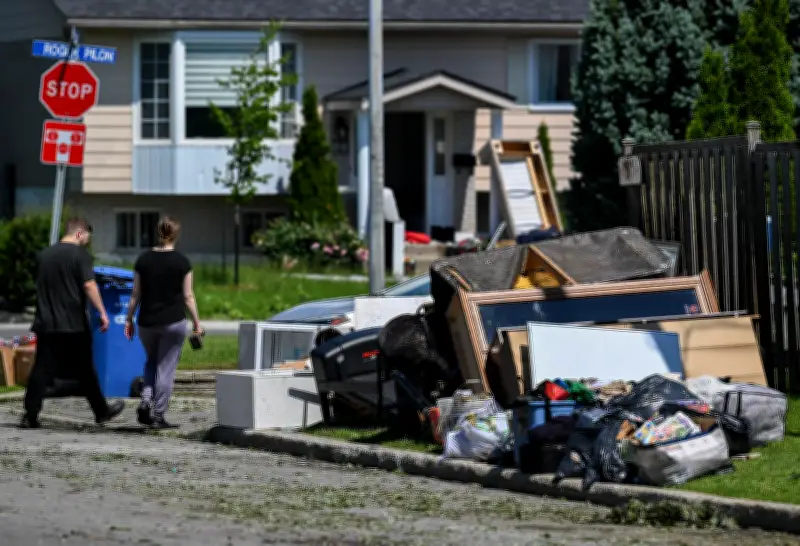
Montreal's flash floods on Sunday, June 21, 2026, submerged streets and homes, forcing residents to pile furniture and household belongings on curbsides in affected areas like Dollard-des-Ormeaux. The sudden deluge, part of a series of severe thunderstorms, knocked out power for thousands and triggered widespread property damage across the West Island and beyond.
Widespread Power Outages and Property Damage
As of Sunday evening, Hydro-Québec reported that over 30,000 customers were without power, with restoration efforts hampered by ongoing storms. The hardest-hit areas included Dollard-des-Ormeaux, Pointe-Claire, and Kirkland, where streets turned into rivers and basements filled with water. Residents used pumps and buckets to remove water, while others salvaged soaked furniture and carpets.
Environment Canada issued additional severe thunderstorm warnings for Greater Montreal on Sunday afternoon, warning of more heavy rain, strong winds, and the risk of hail. Meteorologist Jean-Philippe Bégin stated, "The ground is already saturated, so any additional rainfall could lead to rapid flooding."

Emergency Response and Safety Measures
Montreal fire department crews responded to over 200 calls for flooded basements and stranded vehicles. No injuries were reported, but officials urged residents to avoid driving through flooded roads and to stay away from downed power lines. The city opened temporary shelters at community centers in affected boroughs.
Quebec Public Security Minister François Bonnardel said in a statement, "Our teams are monitoring the situation closely and are ready to provide additional resources if needed. We urge everyone to remain cautious."
Impact on Transportation and Infrastructure
Several major roads, including parts of Highway 40 and Highway 20, were temporarily closed due to standing water. The STM reported delays on bus routes and advised commuters to check for service disruptions. The REM light-rail system also experienced minor delays but remained operational.
Montreal Mayor Valérie Plante said the city would assess damage and expedite cleanup. "We are working with Hydro-Québec and other partners to restore services and ensure public safety," she said. "Residents can report flood damage via the city's 311 line."
Looking Ahead: Recovery and Preparedness
Experts say climate change is increasing the frequency and intensity of such extreme rainfall events. Dr. Émilie Bourgeois, a climatologist at Université du Québec à Montréal, noted, "This is consistent with trends we've seen across the province. We need to invest in better drainage and flood protection infrastructure."
Residents are advised to document damage for insurance claims, avoid contact with floodwater (which may contain sewage), and check on vulnerable neighbors. The city plans to distribute sandbags and offer free disposal of flood-damaged items at designated sites.