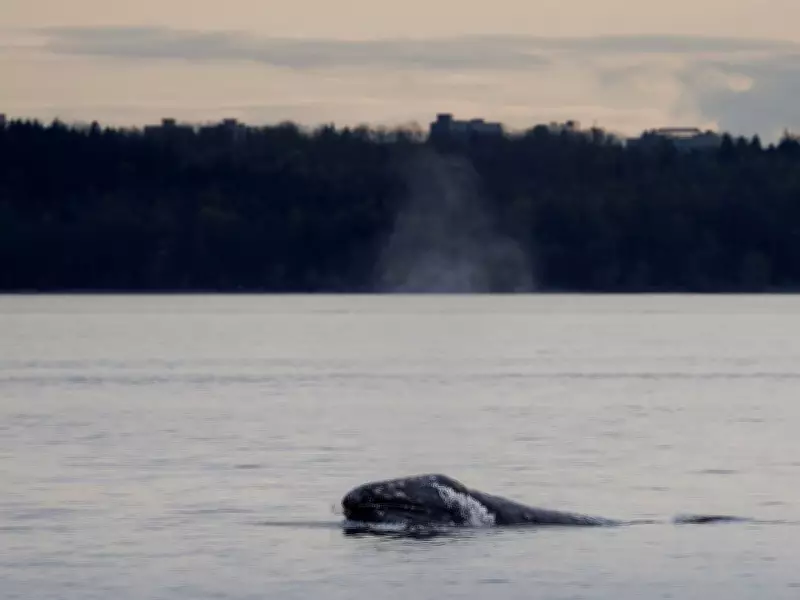
Five grey whales, some as thin as “a bag of bones,” have been discovered dead off the coast of British Columbia this year, according to Paul Cottrell, marine mammal coordinator with Fisheries and Oceans Canada’s Pacific region.
Alarming Number of Deaths
Speaking at a news conference this week, Cottrell reported that four of the five whales were found in just the last 10 days, mirroring a troubling trend seen in Washington State, where up to 15 grey whales have died in recent weeks. Similar die-offs are occurring in California and Oregon.
“Two of those four grey whales were extremely emaciated. I have never seen such poor body condition,” Cottrell said, emphasizing the severity of the situation.

Necropsies Underway
While necropsies are being conducted in collaboration with local First Nations, results are pending. In one recent necropsy performed in Sidney, the whale was found to be heavily infested with lice. “It can actually eat the animal alive, and it is very disturbing to see the poor shape of this animal,” Cottrell noted.
The whales undertake one of the longest migrations on the planet, wintering in Mexico and traveling north. “What we are seeing is these mammals traveling north are not in good body condition. Unfortunately, it looks like the last feeding in the summer was not a great year,” he added.
Population Decline and Recovery
The grey whale population peaked at about 28,000 in 2016, then dropped significantly to around 14,000 by 2023. Although numbers rebounded in 2024, mortality rates have climbed again. The worst year on record off B.C. was 2019, with 11 deaths.
“We’re hoping it’s just a blip, but indications are we’re likely going to see more mortalities,” Cottrell said, describing some whales as “really a bag of bones.”
Climate Change and Food Scarcity
Wendy Szaniszlo, a scientist with DFO’s cetacean research program, explained that grey whales are currently heading north from breeding grounds. Research shows food abundance is declining in Arctic and Sub-Arctic feeding areas, contributing to malnutrition, lower breeding rates, and mortality.
Scientists from Canada, the U.S., and Mexico are using drones to photograph whales and study body condition. “What we’ve found over the past few years is poor body condition, which is quite a concerning trend,” Szaniszlo said, noting that climate change is altering ice conditions and warming ocean temperatures, reducing prey availability.
The four most recent deaths all occurred off Vancouver Island. Experts urge continued monitoring as the situation unfolds.