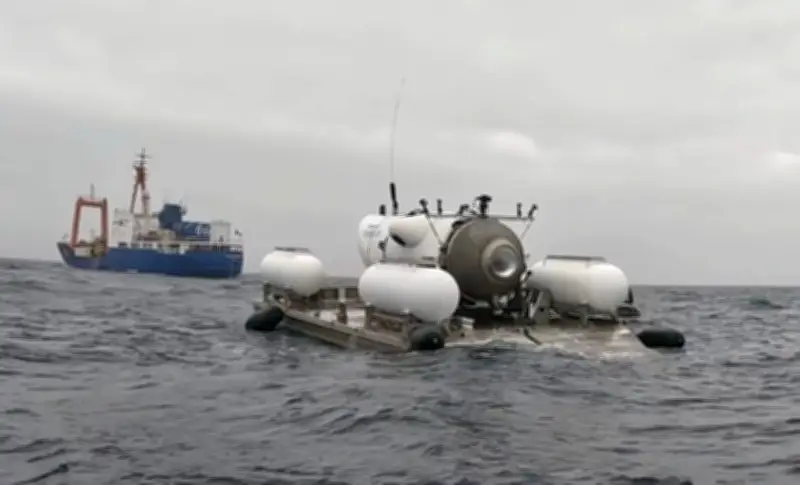
OTTAWA — Even though Transport Canada was aware OceanGate was using Canadian ports and Canadian-flagged vessels as support craft, they were not aware the company’s doomed carbon fibre submersible held no active registration in any country.
In a scathing report into the deadly June 18, 2023 Titan submersible implosion that killed OceanGate CEO Stockton Rush and four passengers, Canada’s Transportation Safety Board (TSB) highlighted regulatory blind spots and federal bureaucratic roadblocks that allowed the doomed experimental sub to operate unfettered out of Canadian ports.
“Although TC (Transport Canada) was aware that the Titan was operating from St. John’s and that it was supported by Canadian vessels, TC was unaware that the Titan was not registered with any flag state,” read an excerpt from the report. “The Titan did not receive any oversight from TC.”

Background of the Disaster
Titan was en route to the Titanic when the submersible collapsed. Thursday will mark the third anniversary of the deadly accident, which saw the untested and uninspected submersible implode while en route to the wreckage of the RMS Titanic.
The Titan imploded at a depth of 3,346 metres — where outside water pressure was just shy of 33.9 MPa (5,000 PSI), or nearly the weight of an adult grizzly bear pressing on each square centimetre of the vessel’s hull. The Titanic sits at a depth of 3,800 metres below the North Atlantic, about 600 km off the Newfoundland coast.
“The Titan’s pressure hull consisted of a carbon fibre cylinder capped at either end by titanium domes,” the report read. “The use of carbon fibre in a pressure hull for a human-occupied submersible intended for deep-ocean diving is novel; submersibles used for deep-ocean diving are typically constructed of steel or titanium.” Subsequent investigations determined Titan’s design was never tested to prove the hull’s theoretical strength. “OceanGate did not know for how long the Titan’s pressure hull would remain structurally intact when used repeatedly for dives to the depth of the Titanic,” read the report.
OceanGate Inc. is an American firm incorporated in the state of Washington, operated as a wholly-owned subsidiary of OceanGate Expeditions out of the Bahamas.
Regulatory Gaps Identified
The TSB pointed to three critical gaps that allowed the Titan disaster to slip through the cracks: regulatory blind spots with Transport Canada, Canada’s siloed bureaucracy, and OceanGate’s untested safety systems.
“Canadian government departments, including DFO (Department of Fisheries and Oceans) interacted with OceanGate from 2019 until the time of the occurrence,” the report read. “TC has no processes to obtain and use this information.” The investigation also found limited avenues for government departments to share information. “Such information from other government departments can enable TC to act and evaluate a vessel’s operation from a Canadian port and within Canadian waters,” the report read.
The report noted Titan entered Canada on numerous occasions, but because of its size and regulatory exemptions that do not cover vessels brought here as cargo or under tow, it managed to escape Transport Canada’s oversight. This situation, the report stated, was not unique, and that it is “relatively common” for vessels to operate in Canadian waters with no oversight.
“The investigation found that the lack of regulatory oversight to identify safety deficiencies resulted in increased risk to those involved in the Titan’s operations,” read an excerpt from the report. “Since 2015, the TSB determined that a similar lack of regulatory oversight was a factor in a number of occurrences involving uncertified and unregistered fishing vessels and uncertified tugs.”
Titan relied upon two Canadian-flagged vessels, the Horizon Arctic and Polar Prince, to act as its mothership during many of its dives. Between 2021 and 2023, Titan conducted seven dives within Canadian waters and three within Canada’s Exclusive Economic Zone, as well as 19 dives outside Canadian waters, including excursions to the Titanic. The Polar Prince was the Titan’s mothership during its ill-fated final dive three years ago.

Recommendations
The six recommendations contained in the report include closing loopholes for domestic uncertified vessels, tracking foreign and unregistered commercial vessels, ending bureaucratic silos, and mandating certification for submersibles operating from Canadian ports.