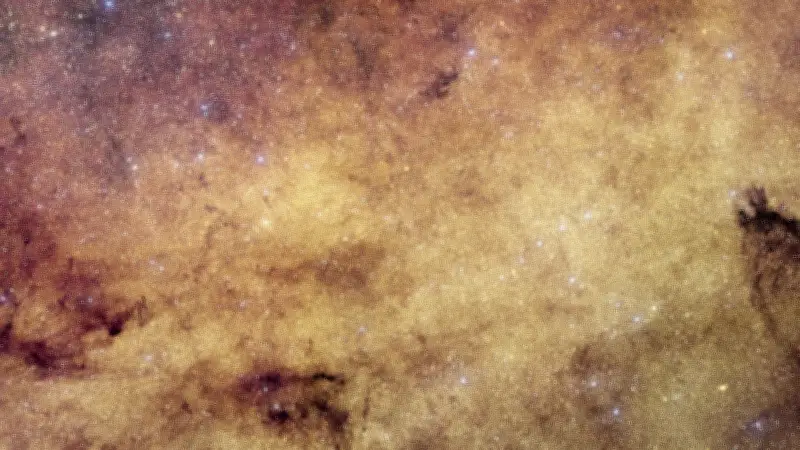
The European Space Agency's Euclid space telescope has captured the most detailed image yet of the Milky Way's heart, revealing a dense field of tiny stars in a square image released by the agency. The photograph, taken as part of Euclid's mission to map the dark universe, provides an unprecedented view of the galactic center, which is typically obscured by dust and gas when observed from Earth.
Unprecedented detail of galactic core
The image showcases a dense concentration of stars in the Milky Way's central region, offering astronomers a clearer picture of the structure and composition of our galaxy's core. According to the European Space Agency, the image was processed by J.-C. Cuillandre and E. Bertin from CEA Paris-Saclay, using data from Euclid's visible and near-infrared instruments. The telescope's vantage point in space allows it to see through much of the interstellar dust that blocks visible light, revealing stars that are otherwise hidden.
Scientific significance
The image is expected to help scientists study the formation and evolution of the Milky Way, as well as the distribution of stars and dark matter in the galactic center. Euclid's primary mission is to investigate dark energy and dark matter, but its high-resolution imaging capabilities are proving valuable for a wide range of astronomical studies. This particular observation contributes to a broader effort to map the Milky Way's structure in unprecedented detail.

“Euclid is designed to answer fundamental questions about the universe, but it also provides stunning views of our own galaxy,” said a spokesperson from the European Space Agency. “This image of the Milky Way's heart is one of the best we have ever obtained.”
Technical details
The image was captured using Euclid's VIS (Visible Instrument) and NISP (Near-Infrared Spectrometer and Photometer) instruments, which together provide high-resolution imaging across multiple wavelengths. The data were processed to enhance the visibility of faint stars and reduce noise, resulting in a clear and detailed view of the galactic center.
Euclid was launched in 2023 and is stationed at the second Lagrange point (L2), about 1.5 million kilometers from Earth. Its primary goal is to survey billions of galaxies across the cosmos to create a 3D map of the universe, but it also devotes time to observing targets within our own galaxy.