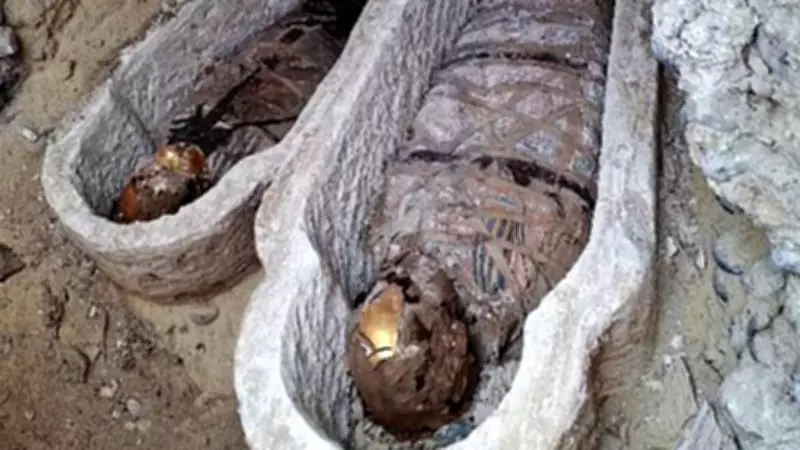
In a groundbreaking archaeological discovery, Egyptian authorities have unearthed a mummy bearing a literary passage from the ancient Greek poet Homer on its abdomen. The find, announced by the Ministry of Tourism and Antiquities, marks the first known instance of such an inscription on a mummified body.
Discovery Details
The mummy was among several recently excavated at a site in Egypt. Researchers were astonished to find a clearly legible excerpt from Homer's Odyssey written in ancient Greek script across the abdomen. The passage appears to be from the epic's opening lines, though experts are still analyzing the exact verses.
Significance of the Find
This discovery challenges previous assumptions about the use of literary texts in Egyptian funerary practices. While religious and funerary texts were common, the inclusion of a secular literary work suggests a broader cultural exchange between Greek and Egyptian traditions during the Ptolemaic period.

Dr. Amira Hassan, leading archaeologist on the site, stated: "This is a remarkable fusion of cultures. The mummy shows that Homer's works were not only admired but also considered significant enough to accompany the deceased into the afterlife."
Broader Context
The excavation also yielded other mummies and artifacts, indicating a burial ground used over several centuries. The team is now conducting further tests, including CT scans and DNA analysis, to determine the mummy's age, sex, and cause of death. Preliminary estimates suggest the mummy dates back to around 200 BC.
The Ministry of Tourism and Antiquities plans to display the mummy in a special exhibition once conservation work is complete. This find is expected to attract significant international interest and boost tourism to Egypt.
Scholars worldwide are eager to study the inscription, which could provide new insights into the transmission of Homeric texts and the cultural interactions in the ancient Mediterranean world.