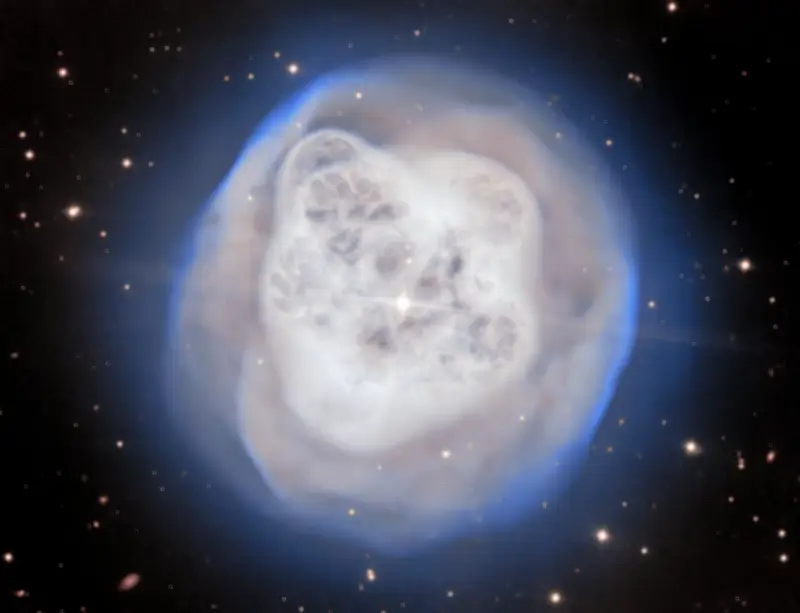
A new image captured by NOIRLab showcases a planetary nebula nicknamed the Crystal Ball Nebula, offering a spectacular view of a dying star's final throes. The International Gemini Observatory/NOIRLab/NSF/AURA released the image via CNN Newsource, highlighting the intricate structures and vibrant colors of the celestial object.
What is the Crystal Ball Nebula?
The Crystal Ball Nebula is a planetary nebula, a type of astronomical object formed when a star like our Sun exhausts its nuclear fuel and expels its outer layers into space. The remaining core becomes a white dwarf, illuminating the surrounding gas and dust. This particular nebula earned its nickname due to its spherical, crystal-like appearance in the new imagery.
Details of the Capture
The image was obtained using the Gemini North telescope, part of the International Gemini Observatory, which is operated by NOIRLab. The advanced instruments allowed astronomers to capture unprecedented detail, revealing complex filamentary structures and glowing shells of ionized gas. The observations provide insights into the late stages of stellar evolution and the chemical enrichment of the interstellar medium.

According to researchers, the Crystal Ball Nebula is located approximately 5,000 light-years away in the constellation of Cygnus. The dying star at its center is now a white dwarf, with a surface temperature exceeding 100,000 degrees Celsius. The nebula itself spans about one light-year across and is expanding at a rate of roughly 20 kilometers per second.
The stunning colors in the image correspond to different elements: red indicates hydrogen, green shows oxygen, and blue represents helium. These emissions are produced as the star's intense ultraviolet radiation ionizes the ejected material.
Planetary nebulae like this one are relatively short-lived in astronomical terms, lasting only about 10,000 to 20,000 years before dispersing into space. The Crystal Ball Nebula is estimated to be around 5,000 years old, making it a relatively young example.
The image not only serves as a beautiful reminder of the universe's dynamic nature but also provides valuable data for scientists studying the life cycles of stars. The detailed structures observed can help refine models of stellar death and the recycling of matter into new generations of stars and planets.