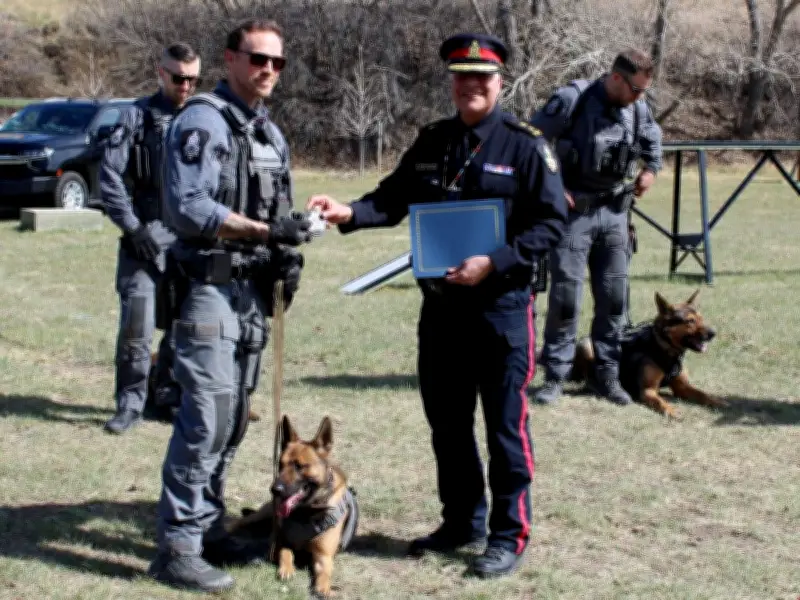
The Canadian Police Canine Association Spring Seminar, held Tuesday to Thursday in Lethbridge, brought together 17 canine teams from Alberta, British Columbia, Saskatchewan, and Manitoba. The event aimed to help handlers and dogs enhance their skills to better serve their communities.
Training Highlights
The three-day seminar featured specialized training sessions, including tracking fundamentals, behavior conditioning, problem-solving, grip-building, and proper targeting. On Wednesday afternoon, handlers learned new techniques for tracking across hard surfaces, a more challenging terrain compared to grass or soil.
Const. Braylon Hyggen of the Lethbridge Police Service canine unit explained that dogs use their keen sense of smell to locate criminals near crime scenes. However, there are always new and improved methods to train them. “There’s so many different ways we can train them, and so we find the best opportunities to just become better in doing that, to make the dogs better, the handlers better, the whole unit better for where we serve,” Hyggen said. He added, “With that, we’re just able to learn new tricks and become better at everything we do.”

Participating Teams
The Lethbridge Police Service typically maintains four canine teams, with two new dogs currently in training. The service’s newest dogs, Bobbie and Bak, along with their handlers Cst. Joel Odorski and Cst. Josh Smith, participated in the seminar. Hyggen, who has been with the canine unit for a decade and partnered with four-and-a-half-year-old Macho for two years, noted that the dogs are deployed numerous times each shift.
Const. Wade Eastman of the Edmonton Police Service emphasized that tracking training involves various scenarios where a person has left a crime scene. “In order to effectively locate these people on the streets, we need to do training on a daily basis, building our skills, so that a dog is able to follow a human owner, whether it’s in a grass terrain, hard surface,” Eastman said. Edmonton’s 12 canine teams must be adept at tracking in diverse environments. Eastman described the work as a “real-life hide-and-seek game,” with dogs rewarded by food and toys for their efforts.
Broader Impact
The Calgary Police Service, which currently has 23 dogs, notes on its website that canine teams play a vital role in law enforcement. They assist in tracking individuals involved in serious crimes and locating evidence such as weapons, clothing, drugs, explosives, and human remains. The seminar underscores the ongoing commitment to professional development for both human and canine officers across Canada.