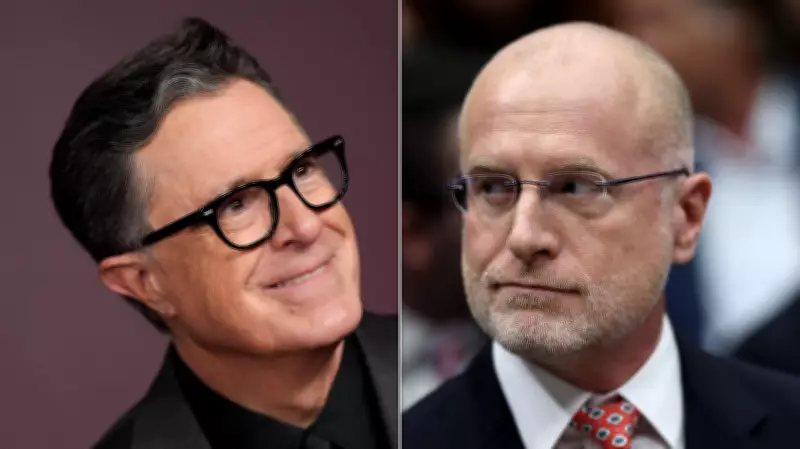
Federal Communications Commission Chair Brendan Carr firmly denied any government involvement in censoring CBS "Late Show" host Stephen Colbert during a Wednesday press conference. The controversy erupted after CBS prevented Colbert from broadcasting an interview with U.S. Senate candidate James Talarico earlier this week.
No Censorship, Just a Hoax, Claims FCC Chair
"There was no censorship here at all," Carr stated emphatically to reporters. Instead of acknowledging any regulatory pressure, Carr pointed the finger at Texas State Representative James Talarico, a Democrat, accusing him of orchestrating a "hoax" related to the interview's cancellation.
"You had a Democrat candidate who understood the way the news media works and he took advantage of all of your, sort of, prior conceptions, to run a hoax, apparently for the purpose of raising money and getting clicks," Carr claimed. "And the news media played right into it."

Colbert's Account Contradicts Carr's Claims
However, Carr's "hoax" allegation appears to lack factual support. Stephen Colbert first raised the censorship issue with his audience on Monday, not Talarico, detailing explicit instructions from CBS lawyers.
"We were told in no uncertain terms by our network's lawyers ― who called us directly ― that we could not have [Talarico] on the broadcast," Colbert said Monday. "Then I was told, in some uncertain terms, that not only could I not have him on, I could not mention me not having him on. And because my network clearly doesn't want us to talk about this, let's talk about this."
FCC's Equal-Time Rule Threat Sparks Network Compliance
Colbert explained that the FCC, under Carr's leadership, has threatened to require late-night TV talk shows to provide equal time to every political candidate in a race. It appears CBS decided to comply preemptively, even though the rule has not yet been officially changed.
"Now, as I said, at this point, he's just released a letter that says he's thinking about doing away with the exception for late night," Colbert noted. "He hasn't done away with it yet, but my network is unilaterally enforcing it as if he had ... but I want to assure you, this decision is for purely financial reasons."
Colbert accused CBS of caving to regulatory threats, stating the network discouraged Talarico as a guest due to fears of the FCC imposing an equal-time rule that hasn't previously applied to late-night talk shows. Talarico is competing against Representative Jasmine Crockett in the Democratic primary for a U.S. Senate seat from Texas.
Interview Finds Alternative Platform, Raises Millions
Despite the CBS broadcast ban, Talarico's interview aired on the "Late Show" YouTube channel, where it quickly garnered millions of views. The campaign reported raising an impressive $2.5 million within just 24 hours after the interview's online release.
Carr Defends Equal-Time Rule as Anti-Elitism Measure
In his Wednesday press conference, Carr defended the equal-time rule, arguing it was passed by Congress to prevent media elites in Hollywood and New York from unduly influencing primary elections.
"There was one partisan candidate who fed this slop to the mainstream national news media and you guys ran for it," Carr said. "I was just laughing, it was clear this story was going to turn at some point and the truth was going to come out."
The dispute highlights ongoing tensions between media networks, regulatory bodies, and political campaigns, with accusations of censorship and partisan maneuvering taking center stage in this high-profile controversy.