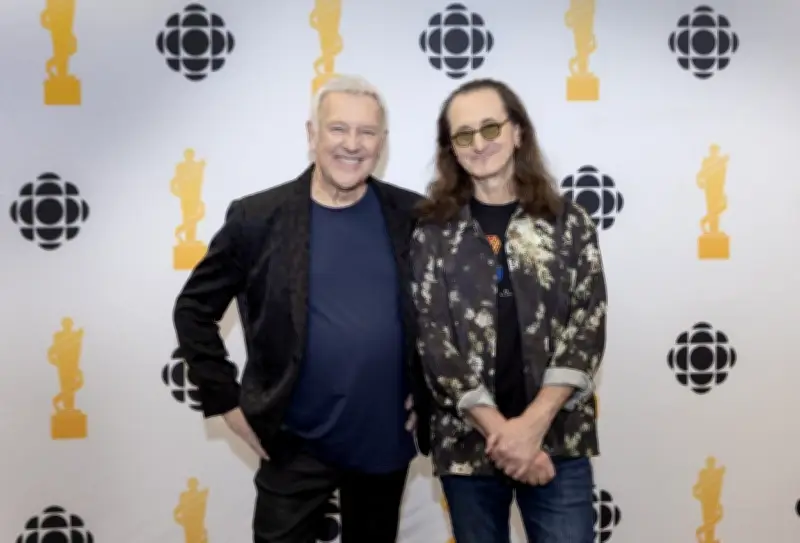
A little more than a year ago, and still months before Rush announced they were reuniting, Alex Lifeson had a twinkle in his eye as he spoke about his lifelong friendship with bandmate Geddy Lee.
"We get together all the time. We play tennis together. I go over there, and we end up sitting on the couch for hours laughing and screaming about the world and drinking too much coffee," Lifeson, 72, said in an interview from his home studio in Toronto.
He was speaking to promote the latest record from Envy of None, a side project he plays in alongside bassist Andy Curran, vocalist Maiah Wynne, and guitarist and keyboardist Alfio Annibalini. But a 30-minute conversation covering his 50-plus years making music inevitably touched on his time with one of Canada's best-known rock exports.

Rush had not performed since the final night of their R40 tour in Los Angeles in 2015. After drummer and lyricist Neil Peart's death in 2020, the book seemed permanently closed on any kind of reunion. Lifeson and Lee made no secret of their fondness for one another, having known each other for 60 years since junior high school.
In 2022, they reunited with guest drummers including Dave Grohl and Tool's Danny Carey for tribute shows dedicated to Foo Fighters drummer Taylor Hawkins. They continued playing music together in Lee's basement in Toronto.
"We gravitate to a bluesy sort of thing, maybe because that's part of our roots," Lifeson said, smiling. "But it's just fun to be with a friend playing." Lifeson conceded that during those jam sessions, the two occasionally dipped into songs from Rush's catalogue. He realized the trio's prog-rock music was nuanced and not easy to replicate all these years later.
"When you're doing it every day, you don't think about it. Now I realize how complex the arrangements are," he said, laughing. "It's eye-opening for sure. Sometimes we just play goofy songs from our past."
'We f—ing miss it'
Lifeson and Lee shocked the music world when they announced last fall the two remaining Rock & Roll Hall of Famers from Rush were reuniting, with powerhouse drummer Anika Nilles taking Peart's place behind the kit. In the years following Peart's illness and death from brain cancer, Lifeson and Lee had seemingly turned the page on Rush. But playing together had lit a spark again. After more than a decade away, the two thought it might be time to celebrate "50-something years of Rush music."
"Alex and I have done some serious soul searching and come to the decision that we f—ing miss it," Lee proudly proclaimed in a statement announcing the tour last fall. "In 2026 my BFF Lerxst (aka Lifeson) and I are going to hit the road once again to pay tribute to our past and to Neil by performing a vast selection of Rush songs in a handful of cities. No small task, because as we all know Neil was irreplaceable."
Lee told Louder magazine in a recent interview that Rush initially thought they could go out for a handful of shows. "Like six or seven residencies, and that was it," he said. Now, with the Fifty Something tour kicking off this weekend, he and Lifeson, who made their debut with Nilles in March at the 2026 Juno Awards, will be on the road well into 2027 as the trek takes them across North and South America and over to Europe.
"Nobody saw that response and it just snowballed," Lee said. The trek has the support of Peart's family. His widow, Carrie Nuttall-Peart, and daughter, Olivia, endorsed the run in a joint statement, writing, "As the band enters this new chapter, it promises to be truly unforgettable. We are excited to see how their new vision unfolds, and to hear this legendary music played live once again."
'I love this country'
After Rush wrapped their R40 tour in 2015, Lifeson thought Rush still had more years ahead of them. But following Peart's brain cancer diagnosis in 2016, he and Lee knew it was impossible to carry on. It was after their performance at the Hawkins tributes that Lifeson and Lee were encouraged to start playing together again.

"We do play some Rush stuff occasionally and I've come to realize that Rush's music is way harder than I remember," Lifeson said last year. But in that same conversation, which was happening as Nilles was in Toronto auditioning with the duo, it was clear that Lifeson had reconciled his past and had an eye on the future. A recently released commemorative box set had unearthed songs he did not even know existed.
There was also a patriotic pride as Lifeson spoke about Rush's importance in the Canadian music-making landscape. "Geddy and I still live here and I have no intention of living anywhere else. I love this country. We're so very proud of being Canadian everywhere we go," he said. "We took advantage of opportunities that came our way and we worked hard. I think if you are willing to work hard and you get a few breaks, you can do whatever you want."
The 'saddest' concert Rush played
Rush's Fifty Something tour kicks off June 7 in Los Angeles, the same city they bid fans farewell more than a decade ago. Of that gig, Lifeson said it was the "saddest" concert Rush had played. "We were soaking in every second of it," he recalled of their show at the Forum in Inglewood. "I kept looking around at faces I recognized from shows over the years, over the decades. Fans who had grown up with us ... We had played there 23 times. I looked at the clock on the back wall and every second was being catalogued in my brain."
Peart did something he had never done in his 41 years by the time the show ended. He emerged from behind his drumkit and took a bow with his bandmates. "When Neil came out, that was the one and only time he came out from his part of the stage," Lifeson remembered. "It caught both of us off-guard."
'I don't know why we were so special'
Even though Lifeson was grateful for the musical spark he had found with Envy of None, the fondness he had for Rush was palpable. Beaming proudly, Lifeson pinpointed Rush's first big break in the 1970s as he gleefully recounted how Cliff Burnstein, who co-founded music management company Q Prime, heard the band's self-titled 1974 debut and immediately signed them to a deal.
He cited Moving Pictures and 2112 as "pivotal albums" in Rush's history. With the passage of time, Lifeson was also able to look at the band's catalogue and reflect on an album, 1975's Caress of Steel, that did not land the way he had hoped. "Caress of Steel was a difficult record. It was super important to us, but it wasn't received well," he said. "We were trying things and there wasn't an audience for it."
Loath to rank Rush records, Lifeson, perhaps buoyed by those jam sessions with Lee, was happy to name a few of his favourites. "I do love Moving Pictures, when I hear songs from that record there's something about the sound of it. And maybe it triggers memories because the recording process was so fantastic. We had a great time making that record," he said of the 1981 release. "2112, of course, the energy and the courage to make a record like that at that point in our career was special. And Clockwork Angels, our last record, with possibly the greatest song we wrote, The Garden, on that record. That's also up there."
Rush was not an overnight success. But the 10-time Juno winner was also able to look back at how he and Lee, along with Peart, never gave up. "We probably spent six years on the road slowly building a following and getting out of debt. In the early '80s, with Moving Pictures, things started to turn around at that point. It was a very gradual ramp-up, so we felt like we earned it," he said. "We took advantage of opportunities that came our way and we worked hard. I think if you are willing to work hard and you get a few breaks, you can do whatever you want. I don't know why we're so special, but it happened for us."
Rush's Fifty Something tour touches down at Toronto's Scotiabank Arena on Aug. 7, 9, 11 and 13. The band will also play Montreal, Vancouver and Edmonton. For a full list of dates, visit rush.com/tour/fifty-something.