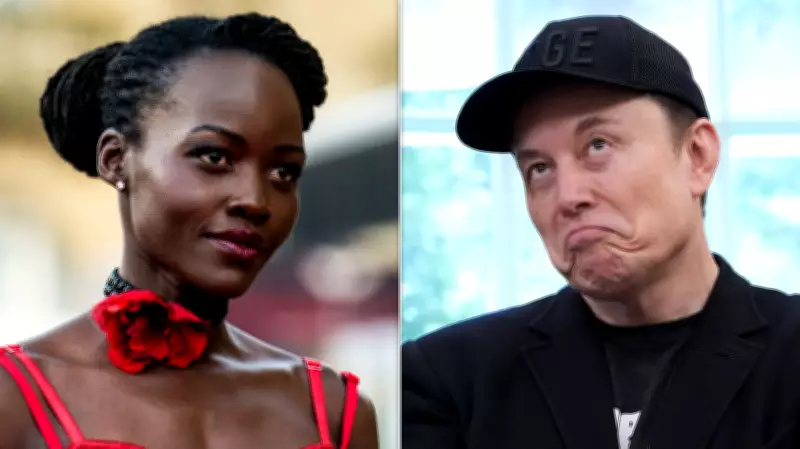
It has been a busy week for Elon Musk, but not so busy that he cannot find time to rant about one of his favorite subjects: white people being replaced by people of color. Musk, the CEO of Tesla and SpaceX, accompanied President Donald Trump on a China state visit focused on trade, AI, and manufacturing. Then, on Monday, a U.S. jury unanimously rejected Musk's lawsuit accusing Sam Altman and OpenAI of misleading him into funding the company with promises it would remain a nonprofit serving humanity. However, amid all this, the world's richest man found time to complain about how wrong he believes Kenyan actress Lupita Nyong'o is to play Helen of Troy in Christopher Nolan's film adaptation of Homer's The Odyssey.
The Controversy Begins
It started late last week when conservative political commentator Matt Walsh took issue with the Oscar winner's casting as a character renowned for her beauty and with a face that launched a thousand ships into war. Walsh posted on X: We are told that we should not object to Helen of Troy being portrayed as a black woman. And yet if a major Hollywood studio made a film set in Africa and cast a white woman as 'the most beautiful woman in Africa,' those same people would literally riot in the street. If, say, Sydney Sweeney was cast in the role, they would be driven to murderous violence. We all know this is the case. Musk chimed in: Absolutely true. Such hypocrisy in Hollywood.
Musk's Ongoing Critique
The tech CEO continued to flip out over Nolan's desecration of Homer via casting for literal days, as screenshot by the entertainment site Consequence. Elon Musk is having a normal one about Christopher Nolan's The Odyssey, the site joked on Facebook. Musk has been harping about Nolan's casting choices for The Odyssey, which comes out in July, since January. This past week, he really went all in. He is also bent out of shape about a viral rumor that Elliot Page, who is trans, is playing Achilles' Ghost, calling such potential casting the dumbest and most twisted things I have heard.

Shared Irritation Among Conservatives
Musk and Walsh's irritation over so-called woke casting is shared by many conservatives and reactionary geeks, as The Atlantic staff writer Adam Serwer has called internet commenters who fiercely oppose progressive or diversifying changes in pop culture and tech. It calls to mind the criticism that came when a Black woman, Halle Bailey, was cast as Ariel in Disney's 2023 live-action adaptation of The Little Mermaid. Or the criticism that came when a Latina, Rachel Zegler, was cast as the titular character in 2025's Snow White. Or when Black people showed up in the Lord of the Rings show, The Rings of Power. Of course, all of these characters are fictional. In the cases of Achilles and Helen of Troy, they are literary characters in a mythological fable that also includes Cyclops, sirens, and six-headed sea monsters. While the Trojan War itself likely corresponds to real historical conflicts in Bronze Age Anatolia, historians say the specific characters are largely the products of myth.

Musk's Racial Ideology
For Musk, none of that seems to matter. Based on his comments and retweets, he appears to view Nolan's casting as part of something more nefarious. On Thursday, for instance, Musk replied True again to a post claiming that The Odyssey is actually part of a left-wing effort to destroy Western civilization and everything that helped create it. When Musk looks at Lupita Nyong'o, an Oscar-winning actress widely recognized for both her talent and beauty, and dismisses her as implausible in the role, it suggests the reaction may be shaped by something beyond straightforward film criticism, said Alvin B. Tillery, the director of the Center for the Study of Diversity and Democracy and a professor of political science at Northwestern University. The great replacement theory, but for movie casting. That language is not far off from how Musk has more broadly discussed Western civilization's so-called erasure. The billionaire has warned that white people are a rapidly diminishing minority of the global population and accused the South African government of being super racist against anyone who is not Black, an apparent advancement of unfounded claims of a white genocide in the country. He is also a notable proponent of the great replacement theory, a white nationalist conspiracy theory that white populations are being replaced by immigrants from majority nonwhite nations, particularly from Africa.
Background of Musk's Views
In January, the South African billionaire posted about race nearly every day, including replying with a 100 emoji to a user who stated, If White men become a minority, we will be slaughtered, and argued that White solidarity is the only way to survive. Given Musk's remarks and retweets, his outrage over Nyong'o's casting is hardly surprising, said Tillery. Elon Musk is a white South African who grew up under apartheid, one of the most systematically brutal racial regimes in modern history, and by every available measure, that worldview does not seem to have left him, Tillery told HuffPost. Tillery believes that Musk has constructed, piece by piece (or rather, retweet by retweet), a very legible racial ideology. He has even performed what appeared to many observers as a Sieg heil salute at an inaugural event for Donald Trump, the professor said. The pattern is not ambiguous. At some point, we are obligated to call a pattern what it is.
Expert Analysis
When Musk looks at Lupita Nyong'o, an Oscar-winning actress widely recognized for both her talent and beauty, and dismisses her as implausible in the role, it suggests the reaction may be shaped by something beyond straightforward film criticism. Instead, Tillery said, it is a window into his racial imagination. His framework, inherited from and reinforced by white supremacist thinking, has a structural inability to locate Black beauty at the apex of human aesthetic experience, he explained. That is not a quirk, Tillery added, but the entire architecture of anti-Black racism, which has always depended on the degradation of Black appearance, Black bodies, and Black humanity as foundational moves. What makes Musk's current comments particularly telling, Tillery said, is his invocation of Western civilization. By endorsing the claim that casting a Black woman as Helen of Troy threatens Western civilization and everything that helped create it, Musk revealed that this was never really about Homer. It was about a possessive relationship to European cultural heritage, one that treats whiteness as the essential ingredient of Western culture, and any disruption of that as civilizational vandalism, he said. This is, quite precisely, the intellectual core of white nationalism.
Scholarly Perspective
Kirsten Moana Thompson, a professor of film and media at Seattle University, gave Musk a little more grace. While I do not doubt, on a personal level, that Elon Musk's comments are rooted in his personal white supremacist philosophies, as a scholar of the history of film and media, I wonder if Musk's comments are also rooted in this wider, essentialist approach to casting in our contemporary context, Thompson said. That approach, she explained, suggests that the authenticity of a character's experience can only be inhabited by an actor whose own embodied experience matches that identity, rather than being performed by an actor. Media representation matters, though, said Thompson, and the film industry is slowly starting to absorb that and put it into practice. Emphasis on slowly; according to a 2026 analysis from the University of California, Los Angeles, people of color still account for just 2.3 out of every 10 lead actors in theatrical films. But growing representation in film is the reason why figures like Musk might be anxious about why a fictional character, Helen of Troy, should not be played by a beautiful Black woman, Thompson said.
Conclusion
Ultimately, Tillery said, maybe we should not be soliciting a tech CEO's views on whether a Black woman can embody beauty, what belongs in Western civilization, or what honors the Greek literary tradition. But given Musk's platform, at 239.9 million followers, he is the most followed person on X, the professor thinks it is worth calling a spade a spade. Lupita Nyong'o does not need Elon Musk's validation. Neither does Christopher Nolan, he said. But the rest of us need to be honest about what we are actually looking at here.