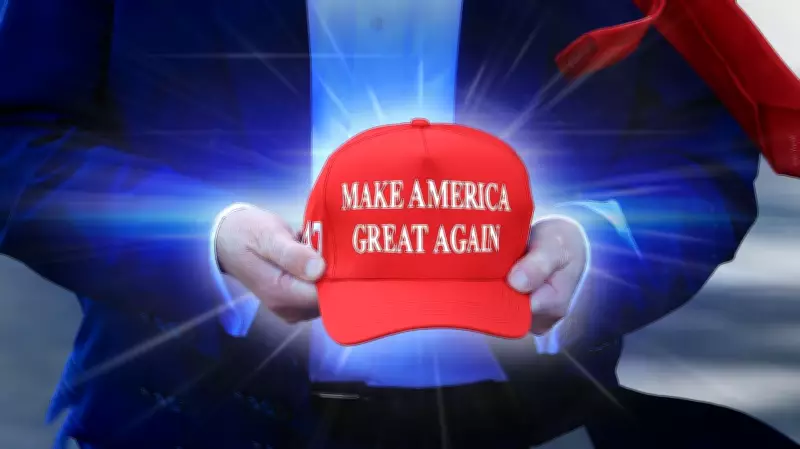
Trump's Baseball Cap: A Political Fashion Statement Decoded by Experts
The uniform has become instantly recognizable: the blue or black suit, crisp white shirt, and red tie that President Donald Trump consistently wears. Yet, in recent years, a notable wardrobe addition has repeatedly appeared during significant moments – a baseball cap. By 2026, the classic "MAGA hat" has evolved into a powerful political symbol in its own right.
The Psychology Behind the Presidential Wardrobe
Experts in fashion, political communication, and rhetoric reveal that Trump's choice to incorporate the baseball cap represents a deliberate attempt to communicate specific messages to his core supporters. Patti Wood, a body language and nonverbal communication expert and author of "SNAP: Making the Most of First Impressions, Body Language, and Charisma," explained to HuffPost that Trump's baseline attire serves a distinct purpose.
"Trump's normal baseline is he wears the blue suit, the white shirt, and typically the red tie. It's a costume to elicit 'I am a successful businessman' and it creates a sort of iconic image of him," Wood stated. This combination, dating back to his "Apprentice" days, establishes a clear visual identity associated with affluence and authority.

Edith Chan, a celebrity stylist and image consultant, elaborated on this traditional symbolism: "The blue suit, white shirt, and red tie combination creates a bold, easily recognizable silhouette that aligns with traditional symbols of authority and patriotism." However, the introduction of the baseball cap disrupts this established affluent aesthetic, creating what experts describe as a calculated visual contradiction.
The Symbolic Power of the Red Cap
While Trump has been photographed in various cap styles, including a white "USA" version during the Iran attack announcement, he remains most associated with the bright red "Make America Great Again" hat. Chan notes that this specific accessory serves multiple psychological and communicative functions.
"Hats psychologically create a sense of protection and framing around the face, which can make the wearer feel more controlled or shielded in highly visible environments like rallies," she explained. "The bright red color is intentionally attention-grabbing and communicates energy, urgency and dominance."
Wood suggests the cap's origins trace back to Trump's initial presidential campaign, when his team sought to broaden his appeal beyond his wealthy persona. "When he was running for president, they had to say 'OK, you know, people see you as this rich guy, and you had been out as a Democrat and now you're trying to appeal to the common person in the Republican party,'" Wood analyzed. "So what would that look like? Well, it would be a baseball cap, and it would be red for Republican."
Blending Formal Authority with Casual Accessibility
Chan identifies Trump's styling as an example of modern fashion's tendency to mix formal and casual elements, creating what she calls a "dual identity" presentation.
"Mixing formal and casual elements has become increasingly common in modern style. Fashion today often blends structured tailoring with relaxed pieces to signal relatability and modernity," Chan observed. "A baseball cap paired with a suit creates a contrast between institutional authority and everyday accessibility."
This combination serves specific political purposes in Trump's case. "In Trump's case, the styling seems to reinforce a dual identity: a formal political leader while also positioning himself as connected to everyday supporters. The cap softens the formality of the suit and aligns with the populist tone of his rallies," Chan explained.
When the cap features slogans like "Make America Great Again" or "USA," it transforms into what Chan describes as "a form of non-verbal communication. It functions almost like a wearable headline, immediately signaling affiliation and boldness before a word is spoken."
Contextual Successes and Failures in Political Fashion
Not all political figures have successfully blended casual and formal elements. Chan contrasted Trump's cap usage with other historical examples, noting that context dramatically influences audience reception.

"John F. Kennedy Jr. was occasionally photographed wearing a baseball cap with tailoring, but those moments were generally informal or street-style situations," Chan noted. "In that context, the cap communicated relaxed confidence and modern masculinity rather than political messaging."
However, former U.K. Conservative Party leader William Hague faced widespread ridicule in 1997 when photographed wearing a baseball cap, as it appeared mismatched with public expectations of leadership authority. Chan emphasized that "in fashion or casual environments, the cap can signal style or ease. In official leadership settings, the same accessory can carry very different symbolic weight."
This contextual sensitivity explains why Trump's cap might feel incongruous during solemn occasions like dignified transfers of fallen military members. "The off-putting feeling often comes from the fact that the baseball cap originates from sportswear and youth culture, while the suit traditionally signals authority, professionalism and formality," Chan analyzed. "When those two elements are combined, the brain registers a visual contradiction."
Nonverbal Authenticity and Audience Connection
Wood identifies potential authenticity issues with Trump's cap usage, particularly during formal announcements. She notes that the hat often appears more as a prop than functional clothing, sitting differently on his head than during casual activities like golfing.
"He's never worn the hat [fully] on his head when he's in a suit. He has it up. It's not resting," Wood observed. "My take on it is he probably doesn't want to mess up his hair. But it's not like with his golf cap – when he gets sweaty, he pulls it down. It's always up."
This discrepancy creates what Wood calls a nonverbal mismatch. "The feet are the most honest. In that subconscious, that part of you that reads nonverbal behavior, you're reading what somebody is really communicating, what is the truth? And you're reading from the feet up," she explained. "That hat that doesn't match the rest of the nonverbal, there's a part of that should read with you, 'That doesn't match. That's not right. Something's not right.'"
Despite these potential authenticity gaps, Wood acknowledges the cap's effectiveness within Trump's rally environments. "It's something that his fans, when they go hear him speak, they're all wearing. They're matching the uniform, they're saying, 'yes, I'm part of his team and I have the same power and control over my world that he does because I'm with his team.'"
The baseball cap has thus evolved from mere accessory to integral component of Trump's political branding – a visual tool that simultaneously communicates authority, populism, and affiliation, while raising questions about authenticity and contextual appropriateness that experts continue to decode.