Massive Toronto Protest Demands Regime Change in Iran
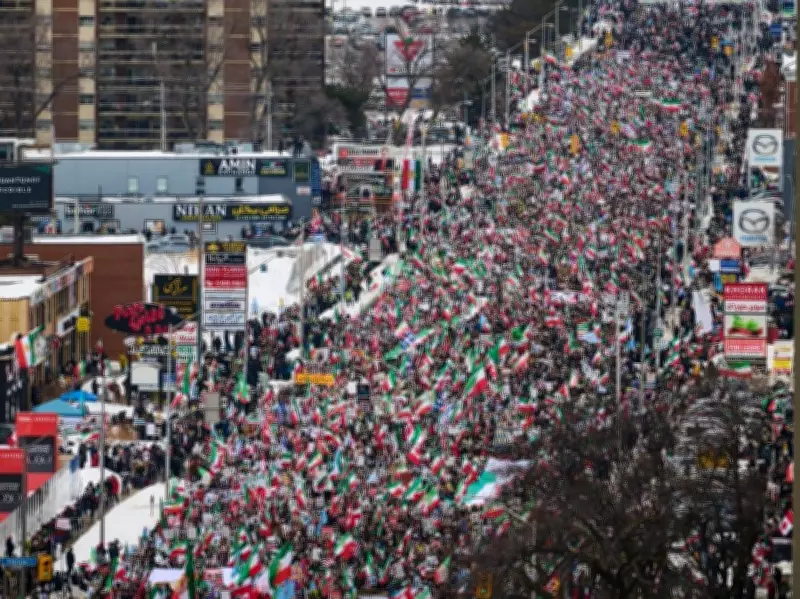
Hundreds of thousands of demonstrators flooded the streets of Toronto on Saturday, February 14, 2026, in a powerful show of solidarity with protesters in Iran. The massive rally, which saw participants chanting "King Reza Pahlavi" and drumming for regime change, aimed to draw attention to the violent crackdowns in the Islamic Republic that have resulted in significant casualties.
Unprecedented Turnout in North York
Originally, Toronto Police had prepared for an estimated 200,000 attendees, based on a previous rally of 150,000 people at Sankofa Square two weeks earlier. However, the actual turnout far exceeded expectations, with police estimating that 350,000 people participated in the march along Yonge Street in North York. This area was closed from Steeles Avenue to Sheppard Avenue to accommodate the massive crowd.
Nima Najafi, a participant at the rally, shared his personal connection to the cause. "It's hard to see that our friends and families in Iran are being kept in prison for no reason, being shot in the head for using their democratic voice," he said. Najafi noted that he had attended the earlier protest on February 1 and observed that the North York crowd was twice as large, highlighting the growing momentum of the movement.

Global Day of Action
The Toronto protest was part of a broader Global Day of Action to support Iran's Lion and Sun Revolution, with similar demonstrations occurring in cities such as Los Angeles and Munich. In Munich, German news agency dpa reported that more than 200,000 people attended a rally, underscoring the international scope of the protests.
Marchers in Toronto waved pre-1979 Iranian flags, which feature a golden lion on a red, white, and green background, symbolizing the era before the 1979 revolution that overthrew the Pahlavi dynasty. Many also carried images of King Reza Pahlavi and photos of individuals killed in Iran, adding a personal and emotional dimension to the demonstration.
Voices from the Protest
Protesters expressed a range of motivations for joining the march. Arash Karimi participated to show solidarity with unarmed civilians killed in Iran, describing government crackdowns as a "one-sided war against the people." He emphasized that "every Iranian knows someone, relatives or friends, who have been killed," reflecting the widespread impact of the violence.
Amirali Ahzan, a member of the LGBTQ community who fled Iran three years ago due to safety concerns, highlighted the marginalization faced by many. "There are so many people like me who have been marginalized and criminalized," he said, noting that homosexuality is a criminal offence in Iran. Ahzan expressed hope that the unrest would lead to political change guaranteeing more rights for the people.
Social Media and International Response
Social media platforms were flooded with videos and photos from the demonstration, amplifying its message globally. Pezhman Mehrabian, a participant, posted on X, calling for Western leaders like U.S. President Donald Trump and Prime Minister Mark Carney to recognize Iran's Lion and Sun Revolution and its leader, King Reza Pahlavi. One online post captured the sentiment of the day: "The voice of freedom can't be silenced."
The protests in Iran began in late December, initially sparked by an economic crisis that sent the country's currency into freefall. Over time, demonstrators have shifted their focus to calling for an end to the Islamic Republic, with some advocating for the return of the ousted monarchy. Iran's government has responded with crackdowns and internet blackouts, claiming that more than 3,000 people have been killed since the protests started, though activists and human rights groups estimate the death toll to be much higher, with figures ranging from 7,000 to 36,000.
This massive demonstration in Toronto not only showcased the diaspora's commitment to change but also underscored the global demand for human rights and justice in Iran, as hundreds of thousands stood together for a free and dignified future.