The Search for Harry Brooks: A Mission to Reunite History with Heirs
More than a century has elapsed since Harry Brooks, a young musician from Regina on the brink of entering the First World War, stepped into a local photo studio. There, he posed for a portrait, exchanged payment with the photographer, and left with a tangible memory of his pre-war self. The subsequent journey of those photographs remained shrouded in mystery until recently, when they surfaced in an online auction, sparking a heartfelt quest by a man determined to return them to Brooks' family.
A Discovery That Ignited a Personal Mission
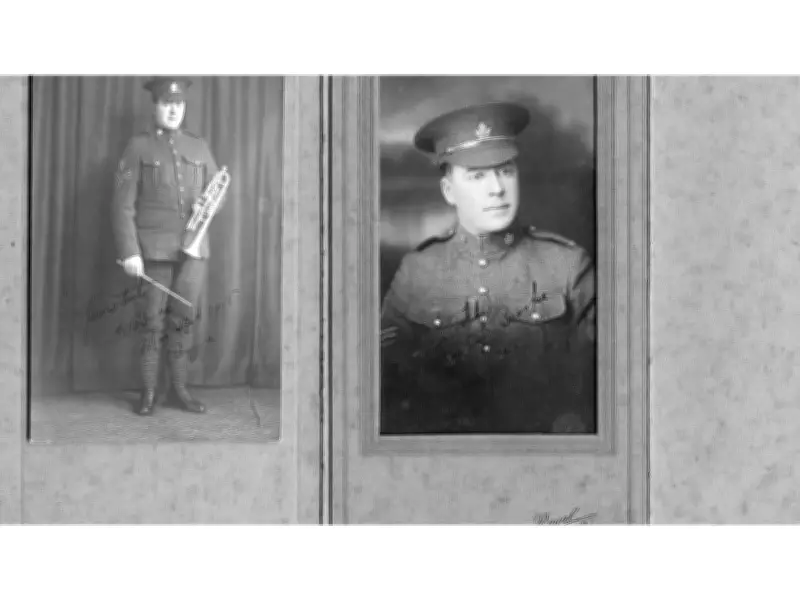
Ross Toller, a 74-year-old retired resident of Kingston, Ontario, encountered two card-stock photos of Harry Brooks during a local online auction in late 2025. The images, preserved in a decorative cardboard frame and in pristine condition, immediately captivated him. Brooks had personally inscribed his name on both photos, and the Royal Studio emblem from Regina was pressed into the cardboard, eliminating any doubt about their origin.
"Every time you look into an old photograph, there's a story there, right?" Toller reflects. "Many of these stories, unfortunately, get lost to time. But when you find one with a name on it, it gives you intent. There's family somewhere. I think reuniting a family heirloom is something quite nice."

Toller's motivation is deeply personal. His father's older brother, William Toller, died at age 21 while fighting in the First World War. A visit to the Books of Remembrance in Ottawa, where he discovered his uncle's name, ignited a lifelong interest in preserving military histories. This connection fuels his desire to find Brooks' descendants and gift them these lost photographs.
Unraveling the Life of Harry Brooks: Musician and Soldier
Harry Brooks was not just any soldier; he was one of Western Canada's finest cornet players. His enlistment papers listed his occupation as "Musician," and during much of the Great War, he led the band that greeted wounded soldiers arriving at Regina's train station from European battlefields. Drafted in late 1917 under the Military Service Act, Brooks posed for these photos at Regina's Royal Studio before departing for England in 1918, bringing his beloved cornet to the session.
His war service was relatively uneventful compared to many of his comrades. According to his 34-page war record, Brooks was a Methodist, single, with brown hair and eyes, standing 5-foot-8 and weighing 178 pounds. He lived at 2119 Albert St. in Regina and served primarily in England with the 15th reserve and 28th Battalion bands, avoiding the trenches.
However, his military journey began dramatically. On his first night in Regina barracks, a devastating fire broke out at 3 a.m. on December 18, 1917. The Regina Leader reported that Brooks "was one of the last to leave the building and barely escaped with his life," fleeing in just his underwear and a coat while carrying his soldier's kit—and presumably, his cornet.
Post-War Life and the Trail of Crumbs
After the war, Brooks immersed himself in Regina's cultural scene. He was a staple on local radio, performed live on stage, and provided background music for silent films at the Capitol Theatre. He studied under renowned cornetist Herbert Clark and led the Regina regiment band that played for the Prince of Wales in 1919. Brooks also taught cornet and trombone at Regina's Conservatory of Music.
In 1933, he moved to Indian Head, Saskatchewan, where he managed the Auditorium Theatre and led the town's bands until 1939. Local newspaper clippings from the 1930s, provided by the Indian Head Museum, depict a man deeply engaged in community life, even filming shorts of town events to screen alongside Hollywood features. By this time, his name occasionally appeared as "Harry Brook" in press reports.
In 1949, Brooks relocated to Oregon with his wife Gertrude, where he passed away in a nursing home in 1965. His obituary remembered him as a "long-time musician from Canada" who played trumpet and cello in vaudeville theatres, but it listed no children, complicating the search for living relatives.

The Enduring Mystery and Hopeful Reunion
The journey of Brooks' photos from Regina to an auction in Kingston remains a puzzle. Toller speculates that family members once possessed them, but they were lost or sold over time. "How that ever happened, I have no clue," he admits. "But there's the potential chance to reunite a family heirloom with somebody. Wouldn't that be a nice ending to the whole story?"
When asked what Brooks might think of this effort, Toller laughs, "He'd maybe play a tune for me." The quest continues, driven by the belief that every photograph holds a story waiting to be reclaimed. As Toller pores over the images, he sees not just a soldier's face but a rich tapestry of history—a life of music, service, and community that deserves to be remembered and returned to those who might cherish it most.