Montreal's Empress Theatre Faces Demolition After Decades of Neglect
For what seems like the umpteenth time in recent decades, the City of Montreal has unveiled yet another plan for the aging Empress Theatre, a neo-Egyptian architectural landmark located in the heart of Notre-Dame-de-Grâce. The fate of this once-thriving cinema on Sherbrooke Street has remained uncertain since the city first acquired the heritage property back in 1999.
A History of Failed Proposals
Over the years, a dizzying array of proposals has been put forward for the Empress Theatre. These included reviving it as a repertory movie house consistent with its original purpose, transforming it into a mixed-use cultural venue with artist studios and community offices, and even a plan from former mayor Valérie Plante's administration to sell it for residential development with non-market housing components.
None of these ambitious schemes ever materialized. Consequently, the structure built in 1927 was left to deteriorate while a political merry-go-round of municipal stewards came and went without taking decisive action.

The Latest Hollowed-Out Vision
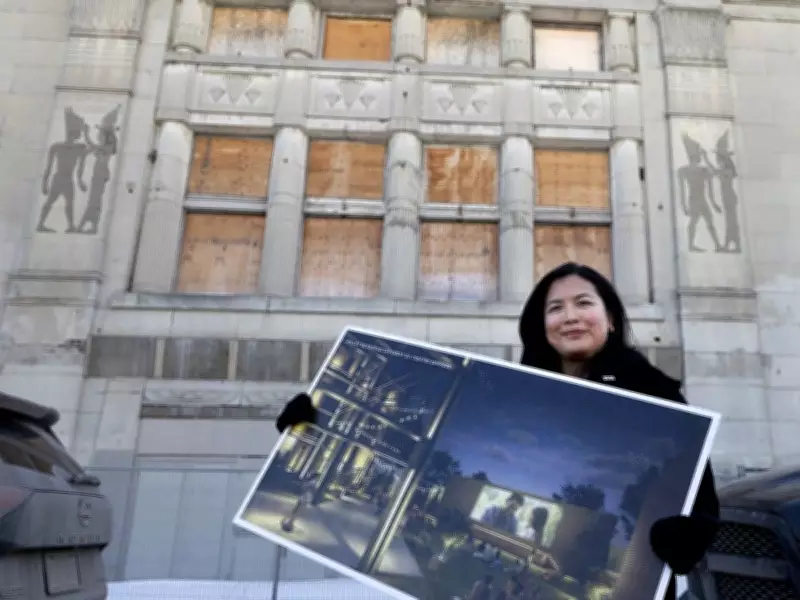
Now, another borough mayor from a different political party has introduced a new vision for the Empress. C.D.N.-N.D.G. borough mayor Stéphanie Valenzuela, elected in November, has revealed plans to transform the site into an open-air cultural space. This would essentially create a courtyard behind the original façade where people could gather for outdoor concerts or movie screenings under the stars—weather permitting, of course.
If this latest incarnation seems underwhelming and ill-suited to Montreal's wintry climate, that's because it is. The reality is that after all this foot-dragging, the Empress is in such poor condition that only two exterior walls are structurally sound enough to be preserved.
A Glorified Demolition Permit
The roughly $10-million project appears more like a glorified demolition permit than a restoration effort. Following a fire in 1992 and the city turning off the heat around 2012, the 1,550-seat auditorium and stage where burlesque dancers once performed have simply rotted away. There's little left to preserve, even if the costs of attempting to salvage the derelict interior weren't prohibitively expensive.
This represents a failure of successive municipal administrations spanning more than a quarter-century. Union Montréal, Équipe Denis Coderre (now Ensemble Montréal, Valenzuela's party), and Projet Montréal all had opportunities to act and dropped the ball. Sadly, this is an all-too-familiar narrative in Montreal, where the urban landscape is dotted with once-majestic heritage buildings sitting empty and decaying.
Broader Crisis of Heritage Neglect
The inventory of Montreal's crumbling architectural patrimony extends far beyond the Empress Theatre. It includes neighborhood schools, old fire halls, massive disused hospital campuses, and abandoned institutions formerly run by religious orders—structures that collectively give Montreal its distinctive character and beauty.
It's not that no one values this built history. On the contrary, governments cling to these important sites with high hopes of eventual redevelopment, while communities insist they remain in public hands to be reborn with new collective missions. The problem is that no one seems to possess the wherewithal to move from concept to completion.
Systemic Inertia and Rising Costs
Every level of government and countless public or parapublic bodies contribute to this rampant neglect through inertia and incompetence. As Montreal's heritage festers, the complexity of eventual renovations increases and costs skyrocket. This creates a vicious circle that dooms beloved parts of Montreal's history to the wrecking ball.
In some cases, entire city blocks sit boarded up or in disuse—even as a housing crisis pushes many residents to the brink of homelessness. The current national mobilization and significant government funding allocated to increase housing supply represent a golden opportunity to revitalize Montreal's heritage buildings, but the clock is ticking.

Other Endangered Heritage Sites
The Empress Theatre is not alone in its precarious state. Since the Centre hospitalier de l'Université de Montréal moved into new facilities nearly a decade ago, there has been ongoing debate about what to do with the vast Hôtel-Dieu site in the Plateau-Mont-Royal. This prime real estate has oscillated on and off government "surplus" lists while various stakeholders push competing plans.
Similarly, Hydro-Québec recently finalized the purchase of another decrepit Montreal hospital, the Miséricorde, which closed in the 1970s. The utility plans to conceal a major new electrical substation behind whatever heritage elements can be reclaimed after decades of abandonment.
A Modest Future for the Empress
The Empress Theatre will be little more than a shell of its vibrant former self once it reopens as a courtyard. At this point, however, the neighborhood is simply relieved that the ornate façade will survive intact and that an eyesore on a main commercial strip will receive a new, albeit modest, lease on life.
The final chapter hasn't been written for the Empress. Valenzuela revealed that the outdoor space represents only Phase 1, with the borough intending to collaborate with a developer to incorporate the façade into some kind of enclosed structure in the future. Plans are expected by the end of the administration's mandate in 2029.
Given the pace of progress over the past two decades, however, the Empress is likely to remain open to the sky for many years to come—a stark reminder of what happens when heritage preservation meets political paralysis.