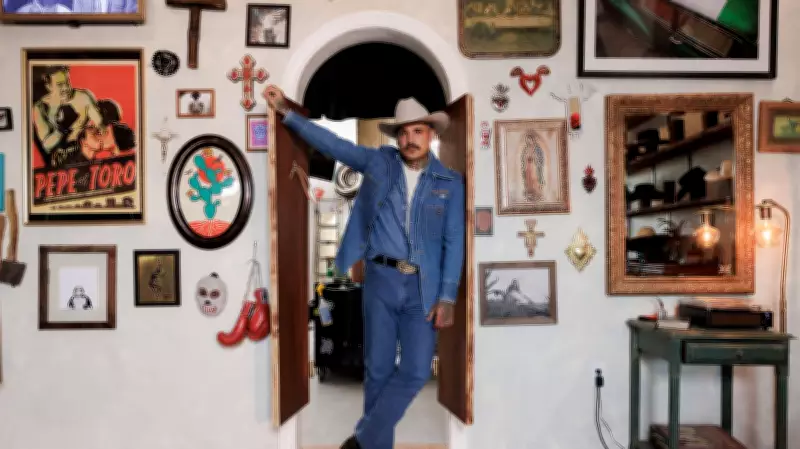
Chicano Hatmaker Gilberto Marquez Weaves Cultural Identity Through Artisan Craftsmanship
In recent years, public discourse surrounding people of Mexican descent has often been dominated by abstract political narratives, framing the community either as a threat to national fabric or as a vulnerable group under attack. Amid this polarized rhetoric, the authentic voices of millions of Mexicans and Mexican Americans can become obscured. However, a growing movement of artisans is reclaiming their narrative through a dedicated return to traditional craftsmanship, with Chicano hatmaker Gilberto Marquez emerging as a vibrant exemplar of how cultural soft power serves as one of our most effective tools for self-definition and unity.
From Mezcal to Millinery: An Unlikely Journey
Marquez's path to hatmaking began unexpectedly in 2017 through his work as a brand ambassador for Ilegal Mezcal, a role that immersed him in the spirit's deep roots in Mexican Indigenous traditions. During frequent trips to Oaxaca to visit agave fields, he purchased hats for protection against the intense sun. In a local hat shop, he observed a profound connection: hatmaking, much like mezcal production, involved meticulous craftsmanship where each piece told a unique story, with styles often indicating the wearer's regional origins.
Inspired, Marquez brought hats back to the United States, where he deconstructed and reassembled them, teaching himself the craft through repetition. He began sharing his creations on social media, quickly attracting attention from Hispanic celebrities like the cumbia band La Santa Cecilia and Los Dos Carnales, eventually leading to commissions from global icons such as Madonna. The success propelled him to open his own hat shop in downtown Los Angeles, establishing a physical space dedicated to his art.

A Father's Lesson in Cultural Pride
For Marquez, hatmaking transcends functionality or aesthetics; it is an act of cultural reclamation. Raised in Orange County, a diverse yet politically conservative area of Southern California, he recalls his father's concern that he might grow up ashamed of his heritage. A pivotal moment occurred at a local restaurant, where his father pointed to a mural of Mexican revolutionaries Pancho Villa and Emiliano Zapata, imparting a crucial lesson: "Never be embarrassed of your culture."
This directive became a guiding principle in Marquez's life. He embraced various expressions of his identity, learning Aztec dance and joining a Mexican punk rock band. While his advocacy for mezcal served as an educational tool about Mexican traditions, hatmaking felt like the most natural and profound link to his heritage, captivating him completely.
Mastering the Charro Hat and Bridging Communities
Marquez developed a particular fascination with charro hats, the large-brimmed headwear traditionally associated with Mexican cowboys and mariachis. Noting that few in the U.S. handcrafted these hats despite their prevalence in Mexican American communities, he sought instruction from a maestro in Mexico. Initially met with refusal—possibly due to his Mexican American identity—Marquez persisted until the artisan agreed to teach him, contingent on a trip to Jalisco.
This journey proved transformative, deepening Marquez's reflection on the multifaceted nature of Mexican identity. "As a Mexican-American, as a Chicano, I know that this is a culture with many subcultures," he explains, highlighting diverse expressions from cowboys and charros to Chicanos, lowriders, and roqueros. Each subculture wears distinct hats, and Marquez aspires to craft them all, recognizing headwear as a unifying object that ties together a sometimes fragmented diaspora.

Healing Historical Rifts Through Shared Craft
Marquez recounts historical tensions within the Mexican diaspora, such as the unspoken rivalries of the 1990s and early 2000s, where Mexicans might dismiss Mexican Americans as inauthentic or "whitewashed," with further divisions among regional groups in Texas, California, and the East Coast. Interestingly, he observes that recent political rhetoric, which often targets all Mexicans indiscriminately, has paradoxically helped mend these rifts. "Being scapegoated has a funny way of bringing a community together," Marquez notes, adding, "We have way more in common than not."
In an era saturated with negative messaging, grounding in tangible traditions—like savoring a smoky shot of mezcal or donning a beautifully crafted hat—offers a vital counter-narrative. While these acts do not erase systemic challenges, they serve as powerful reminders of a rich cultural legacy that predates and will outlast contemporary attacks. "We need reminders of how beautiful, rich and powerful our culture is," Marquez emphasizes. "Not only are we preserving something, but also empowering people to fall in love with their own culture." Through his artisan hats, Gilberto Marquez stitches together threads of heritage, resilience, and pride, crafting a narrative that is both deeply personal and universally resonant.