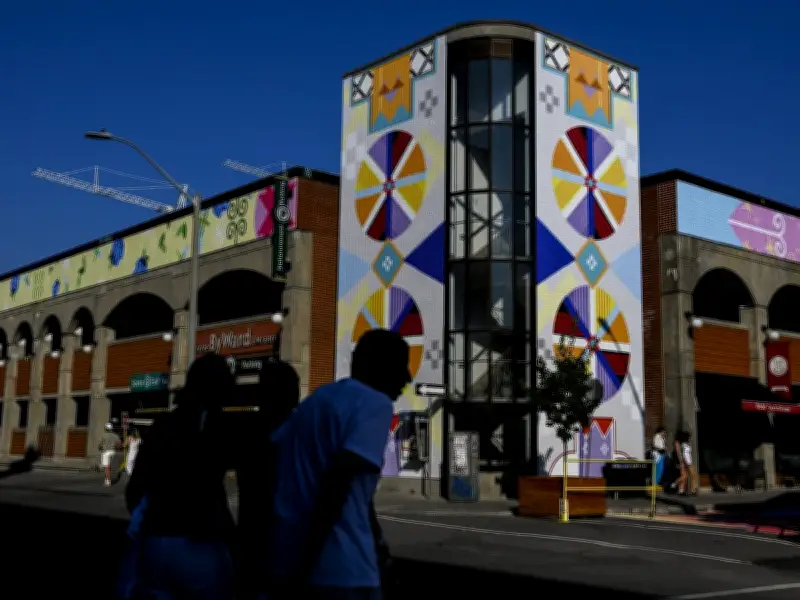
The City of Ottawa and the Ottawa Art Gallery launched the ACE District in June, an Arts, Culture and Entertainment designation to package parts of downtown into a marketable identity, supported by a $600,000 contribution to the OAG through the $18.5-million Ontario-Ottawa Agreement allocation.
Community Mural Replaced by Vinyl Wrap
In the ByWard Market, a mural painted by Haitian-Canadian artist Jimmy Baptiste in 2021 was recently covered by a vinyl wrap of geometric shapes. The original artwork, located on the William Street parking garage, featured a painted sunset, a bird streaming over an orange sky, roses, pea pods, corn, and a pair of eyes gazing out of the greenery. Baptiste's work had also illuminated the National Arts Centre’s Kipnes Lantern, wrapped OC Transpo buses for Black History Month, and reached thousands of young people through workshops in Ottawa schools.
According to Sofia Misenheimer, a graduate researcher on Montreal graffiti and street art at McGill, the vinyl wrap is part of the Arts Corridor, an OAG-led effort to link the gallery with the National Arts Centre and the National Gallery of Canada through eight to 10 new artworks, many of them printed vinyl facades by outside artists. The corridor is conceived as a legacy project for Ottawa’s 200th anniversary.

Placemaking vs. Local Art
The ACE District's flagship gesture is a sweep of abstract supergraphics on York Street West and ByWard Market Square, funded through the Bloomberg Philanthropies Asphalt Art Initiative, to last until 2028. Bloomberg’s 2022 Asphalt Art Safety Study found a 50 per cent decrease in crashes involving pedestrians or other vulnerable road users and a 27 per cent increase in drivers yielding at crosswalks. University of Pennsylvania researcher Maya Moritz, studying Philadelphia’s Mural Arts Program, found daytime crime fell by an average of 42 per cent where murals went up, with effects lasting for as long as seven years.
Despite these benefits, Misenheimer argues that the replacement of Baptiste's mural raises questions about the district's commitment to local artists. The OAG has since engaged Baptiste for a temporary summer installation in ByWard Square, but the community mural was covered without apparent consultation.
Impact on Community Identity
Misenheimer notes that the William Street parking garage mural became an early landmark for her after moving to Ottawa from Montreal. She recalls thinking that somebody had cared enough about the corner to give it a face. The new vinyl wrap, she says, has no face—a sliver of Baptiste’s original work peeks out at the base, like a forgotten signature.
While murals are inherently impermanent, Misenheimer emphasizes that the process of placemaking should involve local artists and community input. The ACE District, she concludes, risks becoming a top-down branding exercise rather than a genuine cultural initiative.