Canada's 1942 Wartime Clothing Ban: Targeting Frills and Zoot Suits
In March 1942, amidst the grim headlines of World War II atrocities, a seemingly minor story on page three of the Vancouver Sun announced significant federal clothing restrictions for men and boys. The Wartime Prices and Trade Board issued orders designed to conserve materials and labor by eliminating extravagant designs from men's apparel during the global conflict.
The Detailed Regulations
The Canadian Press report from Ottawa outlined comprehensive specifications that transformed men's fashion. The regulations prohibited numerous design elements that were deemed wasteful during wartime austerity measures. According to the official orders, manufacturers had to eliminate fancy designs, patch pockets, trouser cuffs, pleats, and double-breasted coats from their production lines.
The restrictions extended to specific garment components:

- Men's sack coats could no longer include belting, bi-swings, pleated backs, patch pockets, or inside bellows
- Vents in side or back seams were prohibited
- Cash pockets, arm shields, imitation buttonholes, and chain stitching on sleeves were banned
- Cuffs on sleeves and double-breasted designs for both sack coats and tuxedo coats were eliminated
- Buttons on sleeves were expressly forbidden
The government even specified precise measurements, limiting coat length for size 38 to 29.5 inches with proportional restrictions for other sizes. Vests faced similar constraints, with back straps, inside breast pockets, pencil pockets, double-breasted designs, and collars all prohibited. Trouser legs received particular attention, with size 32 trousers restricted to a maximum 19.5-inch bottom width.
The Unspoken Target: Zoot Suits
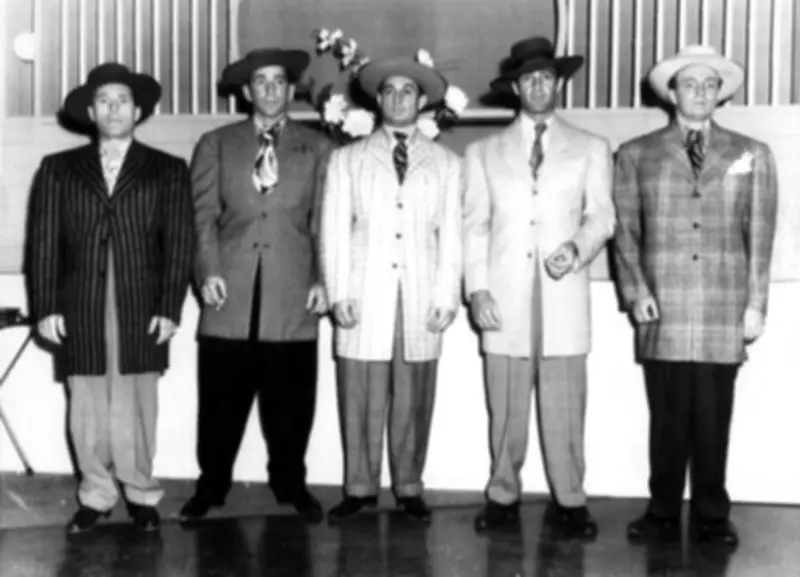
Although the official documentation didn't explicitly name them, these regulations clearly targeted the burgeoning zoot suit phenomenon that had captured youth culture across North America. The extravagant style, characterized by exaggerated proportions and abundant fabric, represented everything the wartime restrictions sought to eliminate.
A Vancouver Sun editorial from June 1943 described the zoot suit in contemporary slang: "For the uninformed, the zoot suit, in the language of its wearers, is one with 'reet pleats, stuff cuffs, a zest vest, svelte belt and 'won my wings' tie.' Translated, that means elaborate pleats in the trousers, extremely tight cuffs, a belt line just a little under the armpits."
The complete ensemble typically included a knee-length coat with enormous lapels and an exaggerated watch chain that extended well below the knee. This flamboyant style originated in the 1930s within African American communities in New York's Harlem district before spreading continent-wide during the early 1940s, particularly among jazz enthusiasts and music fans.
Cultural Significance and Tensions
The zoot suit represented more than just fashion—it became a symbol of cultural identity and resistance for marginalized communities. The 1942 hit song "A Zoot Suit (with A Reet Pleat)" performed by Dorothy Dandridge and Paul White celebrated this distinctive style that defied wartime conformity.
Despite Canada's regulatory efforts, zoot suits continued to generate controversy. The clothing style became a flashpoint for social tensions, particularly between servicemen and civilian youth who embraced the extravagant fashion. These conflicts sometimes escalated into violence, most notably in the 1943 Zoot Suit Riots in Los Angeles, where military personnel attacked Mexican American and African American youth wearing the distinctive suits.
The wartime clothing restrictions represented a fascinating intersection of practical conservation measures, cultural expression, and social conflict. While framed as necessary material conservation for the war effort, these regulations inadvertently highlighted deeper societal divisions and the powerful role of fashion as both personal expression and cultural statement during a period of national crisis.