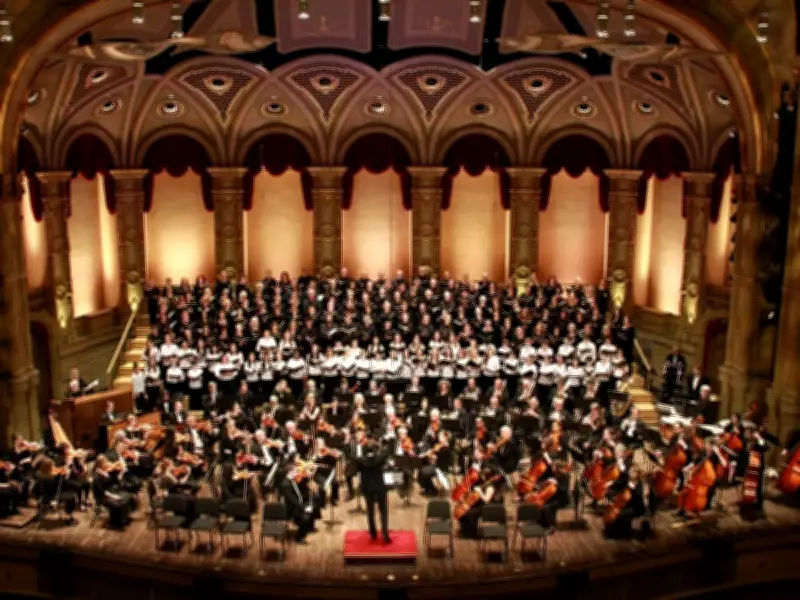
The Vancouver Symphony Orchestra concluded its season with a grand and extravagant performance of Gustav Mahler's Third Symphony, under the baton of music director Otto Tausk. This monumental work, the longest in the standard symphonic repertoire, is rarely performed due to its demands: extra brass and wind players, a mezzo-soprano soloist (Rihab Chaieb), a women's chorus, and a children's ensemble. Spanning six movements and lasting up to two hours, the symphony is often about quiet, subtle effects, yet its myriad ideas coalesce with formal brilliance.
Tausk's Strategic Vision
Mahler's score is exceptionally rich in detail, with a wealth of indications, special techniques, and effects hardwired into the music. Tausk's winning strategy was to conceive of the materials as three big gulps: the extended first movement, a central pair of scherzos, and a three-stage finale. This approach created a sustained and consistent trajectory throughout the performance.
The First Movement
The first movement, as long as a complete early Beethoven symphony, sets up much of the material for later movements. Mahler's famous dictum—'A symphony must be like the world. It must contain everything'—overflows with ideas and contradictions. Tausk's feel for the psychological drama was spot on, though he emphasized Mahler's coy vulgarities in opposition to a profoundly serious musical discussion.

The Lyrical Middle
The second movement offered lyrical relief, with Tausk emphasizing Schubertian lyricism while keeping occasional grotesquerie in the background. This approach extended to the third movement, featuring a lovely offstage posthorn solo. Its climax, a tsunami of sound crashing into a fierce coda, was handled with restraint, serving as a promise of more to come rather than the high point.
The Finale's Sublime Build
The so-called Midnight Song, a setting of Nietzsche's cryptic lines, was delivered as chamber music, with beautiful interplay between mezzo and carefully curated instruments. Tausk then launched directly into a charming interlude for women's voices, children's choir, and bells, a telling bit of staging beautifully executed. The final movement, a terminal Adagio matching the weight of the opening, revealed Tausk's clear-headed strategy: a long, slow build from tentative, heart-rending beauty into expansive glory.
Tausk ended last season with another symphonic behemoth, Richard Strauss's Alpine Symphony, which includes programmatic tags. Mahler originally gave each movement programmatic clues but wisely jettisoned them, allowing listeners to find their own way. Thus, the Third Symphony becomes not a sermon but an intimate conversation with a worldly, wise friend.