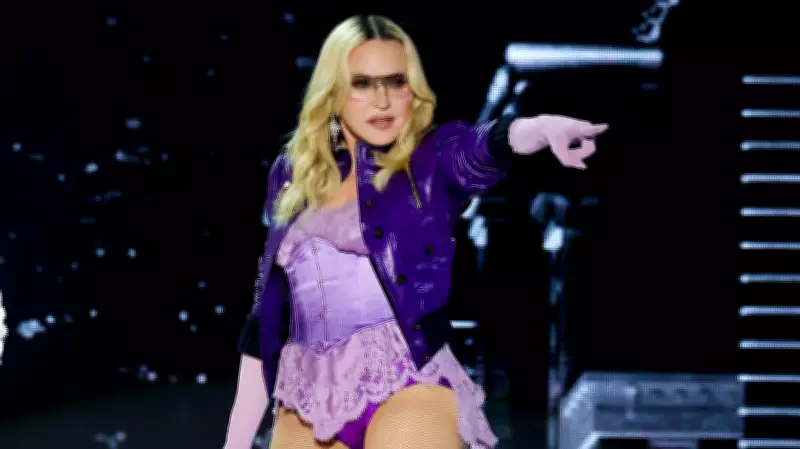
Madonna has done it again. Last Sunday, she released a house track, 'I Feel So Free,' giving the public its first taste of 'Confessions II,' the sequel to 'Confessions on the Dance Floor,' her dance-pop album that dominated the charts in 2005. On April 30, she dropped the new album's lead single, 'Bring Your Love,' in collaboration with Sabrina Carpenter. 'Confessions II,' planned for a summer release, promises to engage both Madonna's hardcore fanbase and cement her icon status with a rather unexpected audience: Gen Z.
A Renaissance with Youth
Madonna has been having a bit of a renaissance with the youth, myself included. Her recent appearance during Carpenter's Coachella set caused a stir, and on TikTok, it's hard to scroll without hearing 'Vogue' and 'La Isla Bonita.' There seems to be no shortage of young content creators commenting on her past discography, bonding over a newfound love of her music with older and newer fans. Some of this explains why, regardless of the fact that many of us weren't even born during her heyday, Gen Z is absolutely Madonna-pilled right now.
The Disappearance of the Quintessential Popstar
To dig deeper into this phenomenon, we need to examine one of our biggest cultural crises: the disappearance of the quintessential popstar. Singer Lizzo made a TikTok on this very subject, theorizing that singers can no longer create for the masses. The fragmentation of social media, whose algorithms are designed to keep us hooked through a constant feedback loop of our ultra-niche interests, means that the very idea of 'popular culture' is falling apart — or at least transforming into something unrecognizable. While you could once count on everyone turning on HBO to catch Soprano Sundays and know that the latest episode would be the talk of the town on Mondays, today, your co-worker might know absolutely nothing about 'Who TF Did I Marry,' the notorious 50-part TikTok saga. Pop culture just ain't popping anymore — at least not offline.

Gen Z's Connection to Madonna
I've observed that so many in my age demographic feel more connected to niche communities than mainstream culture, so it makes sense for us to champion one of the most timeless pop stars ever. Madonna was everywhere in the '90s. She is pop culture. And so, Gen Z is understandably drawn to the glow of a time when everyone bonded over a love or hatred of a single pop culture product and could find community in a generally understood pop culture phenomenon. Madonna's popularity was so important that academics even studied her to understand aspects of culture and society. Madonna studies developed in the '80s and '90s among emerging academics, a critical ivory-tower-meets-pop-culture moment that paved the way for the future study of Tupac, Taylor Swift and Bad Bunny.
Madonna Studies and Social Dynamics
Thanks to Madonna studies, queer, feminist and academics of color gained more visibility, utilizing critical race theory and gender studies to offer a fresh analysis of the pop star and American culture. Intellectuals and cultural critics saw Madonna's penchant for controversy as a useful tool to understand social dynamics. 'Madonna's contradictions, as it turned out, were mirror images of contradictions in larger social structures, including a neoliberal economy's tendency to sell individual identity as a brand,' Michael Dango writes in a 2024 article in the Los Angeles Review of Books. Madonna embodies the idea of identity as performance, something members of Gen Z, steeped in the culture wars over LGBTQ+ identity, race and more, can appreciate. But Madonna is human, like anyone else, and she's made her mistakes — which are also worthy of examination.

Cultural Appropriation and Criticism
Cultural appropriation is one of her bigger issues. Cultural bombshells like 'Vogue,' which highlighted the ballroom culture of New York, have led to debates that still haunt her legacy to this day, including the question of whether Madonna used LGBTQ+ culture for her own gain or was bravely showcasing a community that was demonized during the AIDS crisis. bell hooks once called Madonna a plantation mistress in her critique of the documentary 'Truth or Dare: In Bed With Madonna,' accusing the 'Like A Virgin' singer of colonizing 'the black experience for her opportunistic ends even as she attempts to mask her acts of racist aggression as admiration.' And Madonna has indeed been culturally insensitive: Wearing Black cultural hairstyles in her infamous 'Human Nature' music video and posting videos of her Black son dancing to promote unity during the George Floyd protests of 2020 are just two instances of her problematic behavior.
Learning Curve and Hypocrisies
Madonna is on a learning curve, though — and that, I appreciate. For me, Madonna exposes the hypocrisies within American culture in a very satisfying manner. In Frankenstein-ing her image as pop star of the century — combining unexpected elements of style, music and performance — she exposes the inherent hypocrisies of the structures that keep the cisheterosexist status quo running like a well-oiled machine. Long story short, whether you love or hate Madonna, engaging with her as a cultural figure forces you to reckon with the fact that the most interesting part of the American experience is the unexpected intersecting of values.
Gen Z's Love for Madonna
No matter how much America tries to package its ideal image into neat, white, straight little boxes, Madonna demonstrates that even the blondest, most blue-eyed pop star can not escape its contradictions regarding race, gender and identity. And this is a big part of why Gen Z loves her. Members of Gen Z can appreciate Madonna's radical honesty and authenticity, and see her as a 'Pop Jesus,' someone who's willing to be crucified in the media and by the general public as a sacrifice to create iconic pop moments that stand the test of time. Any engagement with Madonna is like a two-way mirror. One of her most famous utterances in 'Vogue,' 'What are you looking at?' explains it all. I argue that what you look at and judge Madonna for says as much about her as it does about you, and culture at large.
It's easy to see why she has captivated yet another generation. Very few pop stars inspire such layered cultural analyses in the critique of their celebrity. And the Queen of Pop knows no limit on her soft power.