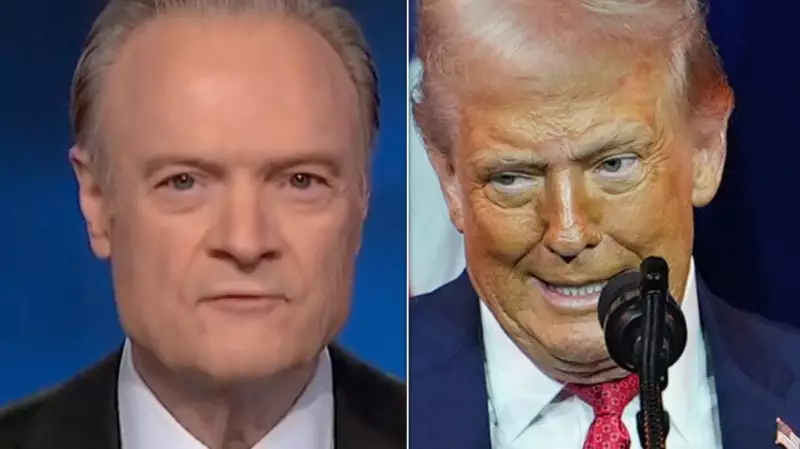
In a fiery Wednesday night monologue, MSNBC's Lawrence O'Donnell spotlighted a long-standing personal insecurity of former President Donald Trump, reignited by a recent confrontation during a visit to Detroit.
The Detroit Factory Floor Confrontation
The incident that sparked the latest round of commentary occurred during Trump's tour of a Ford facility in Detroit. According to reports, an autoworker named TJ Sabula confronted the former president, calling him a "pedophile protector." Trump's reported response was to flip off the worker and mouth the words "fuck you." This moment, captured and disseminated widely, became the catalyst for O'Donnell's segment, which connected the gesture to a much deeper and older narrative about Trump's physique.
A Decades-Old Insecurity Revived
O'Donnell meticulously traced the origins of what he presented as one of Trump's most sensitive vulnerabilities. He reminded viewers that the mockery of Trump's hands is not a new phenomenon. The label "short-fingered vulgarian" was first coined decades ago by journalist Graydon Carter, then-editor of Spy magazine, in a description of the New York businessman.

The issue famously resurfaced during the heat of the 2016 presidential campaign. O'Donnell revisited the memorable and crude back-and-forth between Trump and then-rival Senator Marco Rubio, where jabs about hand size quickly devolved into implied insults about penis size. This exchange cemented the topic as a recurring punchline in political and media circles.
O'Donnell's Analysis: A Self-Inflicted Spotlight
The core of O'Donnell's argument was that Trump, through his visceral reaction in Detroit, had voluntarily dragged the issue of his "tiny" fingers back into the political spotlight. By using his hand to make an obscene gesture directly at a critic, he inadvertently focused attention on the very body part he has historically been sensitive about.
O'Donnell suggested that the reaction was telling, framing it not just as a response to an insult, but as a reflexive act that revealed a deep-seated insecurity. The monologue posited that for a figure like Trump, whose public persona is built on an image of strength and dominance, such perceived physical shortcomings—however trivial they may seem—strike a particularly raw nerve.
The segment served to underline how personal physical characteristics can become enduring facets of a politician's public narrative, resurfacing unpredictably years, or even decades, after they first entered the public consciousness.