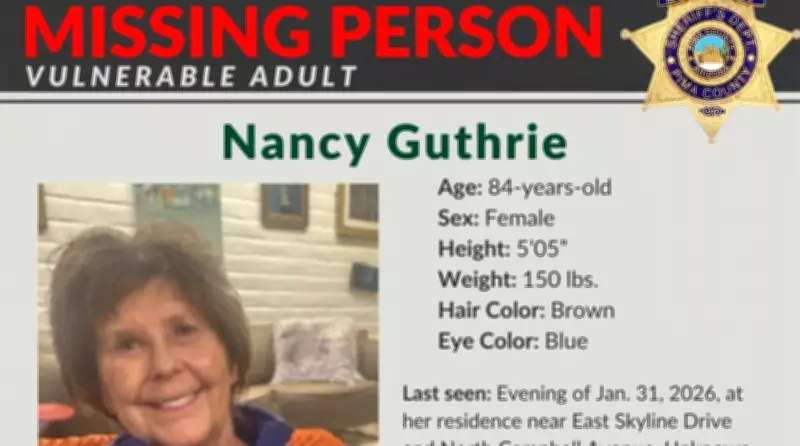
The Digital Hunt for Nancy Guthrie: Social Media's Complex Role in a High-Profile Missing Person Case
In the immediate aftermath of news breaking about the apparent abduction of "Today" show host Savannah Guthrie's mother, social media platforms became inundated with activity. The case of Nancy Guthrie, an 84-year-old grandmother believed to have been taken against her will from her home just outside Tucson, Arizona, has captured widespread attention, transforming into the latest investigation to engage online armchair detectives across multiple platforms.
The Floodgates Open Online
Influencers and concerned citizens quickly began sharing detailed timelines from the hours following Nancy Guthrie's last known sighting. Photos circulated showing what appeared to be blood on her front porch, which authorities later confirmed matched the missing grandmother. Some users pointed fingers at individuals connected to the case, labeling them as suspicious, while others documented themselves walking through her neighborhood in attempts to aid the search effort.
As the desperate search continues without identified suspects or persons of interest, posts across Instagram, TikTok, X, Facebook, and YouTube have brought millions of viewers to various tips and theories surrounding her disappearance. This digital attention has created both opportunities and challenges for law enforcement working the case.

Expert Perspectives on Digital Sleuthing
Michael Alcazar, adjunct professor at John Jay College of Criminal Justice and retired New York Police Department detective, offered a measured assessment of the social media response. "More people are aware; It keeps people alert," he explained. "If they know she hasn't been found yet, perhaps people will remember that and if they see something, they might say something."
Alcazar compared the current situation to the widespread online response to the disappearance and death of Gabby Petito in 2021, noting that public attention may have contributed to the discovery of her body. He acknowledged the growing true crime community online, stating, "I think it's just something that we have to adapt to as far as law enforcement. The true crime community is growing. ... There's a lot of people out there that want to help."
The Misinformation Challenge
However, alongside legitimate efforts comes the proliferation of misinformation that complicates investigations. Ashleigh Banfield from NewsNation announced on her podcast that a law enforcement source identified a Guthrie family member as the prime suspect, though she quickly qualified the statement. This information spread rapidly across social media, with users posting photos of the named individual.
Pima County Sheriff Chris Nanos addressed this specific rumor during a news conference, emphasizing that authorities don't have any suspects or persons of interest. "I plead with you to be careful of what it is we put out there. ... You could actually be doing some damage to the case, you could do some damage to the individual, too," he cautioned. "Social media's kind of an ugly world sometimes."
Beyond Traditional Investigation Methods
The online response has included unconventional approaches, with one medium expressing feelings that Guthrie remains close by and another woman using astrology to suggest possible scenarios. Calvin Chrustie, who has over three decades of experience in kidnapping negotiations, expressed concern about the impact of speculation. "This stuff on X and other stuff out there that's pure speculation is actually making it more difficult for the families and making it more difficult for the police to secure the safe return of the hostage," he stated.
Grassroots Digital Advocacy
Julie Urquhart, an elementary school teacher in New Brunswick, Canada, represents the well-intentioned side of online engagement. She has been posting about the case on TikTok, Instagram, and Facebook, drawn to the disappearance because she has a mother near Guthrie's age. "That's 4 million eyes that now saw that story and now maybe will see something or know something or know someone who does," she said about one of her posts that amassed significant views. "There's just so many people it hits."

Urquhart emphasized that she sources her information from national news sites and law enforcement news conferences, demonstrating how responsible digital citizens can potentially aid investigations without spreading misinformation.
The Nancy Guthrie case illustrates the complex relationship between high-profile investigations and social media engagement in the digital age. While online attention can potentially generate valuable leads and maintain public awareness, it simultaneously creates challenges for law enforcement who must navigate speculation, rumors, and unverified information circulating at unprecedented speed and scale.