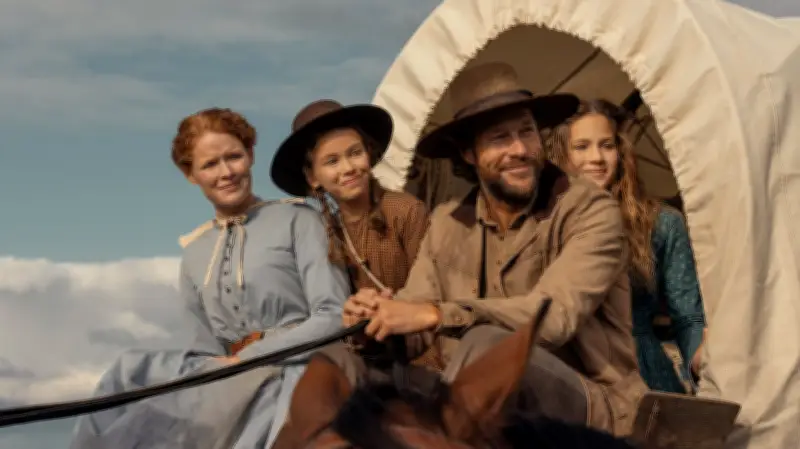
The first episode of Netflix's adaptation of "Little House on the Prairie" begins after the Ingalls family has set out in their covered wagon to leave the "Big Woods of Wisconsin" in search of "free" land and a better future in the West. They stop their search in Independence, Kansas, a town so new that it doesn't even have a post office; they squat and build a log cabin on a plot of land they hope to one day own.
The family drama, created by Rebecca Sonnenshine, is adapted from Laura Ingalls Wilder's autobiographical book series by the same name. The series was first published in the 1930s before being adapted into a 1970s TV show that ran for nine seasons and has recently become a giant streaming hit for Peacock. However, by the 1990s, Wilder's novels began to receive criticism over the Ingalls family's unquestioned expansionism and their racist descriptions of people of color.
"Independence is actually a funny name for a town like this," Laura Ingalls (Alice Halsey) says about the outpost on the Osage land of the Kansas plains that her family has grown to call home. Yes, "Independence" does seem perfectly ironic for a place where settlers' destinies are supposed to manifest at the expense of the freedoms of the Indigenous people who already live there.

Tension Between Settler Experience and Historical Hindsight
It's this tension between the narrow scope of the Ingalls family's experience as settlers on the Great Plains during the 1860s and '70s and the broader perspective historical hindsight affords that makes the latest adaptation of the story both timely and valuable. Eight episodes of the series premiered Thursday, just five days after the 250th anniversary of the country's founding, which naturally generated conversation about the complicated mythologies upon which this nation was built.
Within this context, it is obvious that a remake like "Little House on the Prairie" was primed to become fodder for the culture wars. After the show was first announced, conservative podcaster Megyn Kelly tagged Netflix and wrote, "if you wokeify 'Little House on the Prairie' I will make it my singular mission to absolutely ruin your project."
By "woke-ify," I'm going to assume Kelly meant giving space to other perspectives besides those of the white settlers who felt entitled to lace up their bootstraps on land that was not theirs. And in that case, this 2026 remake accomplishes it beautifully.
Balancing Dueling Perspectives
The show's greatest success is that it balances the dueling perspectives of white squatters like the Ingalls with those of the Osage people. Producer Joy Gormon Wettels told Vulture that this was, indeed, the show's intent: "to face the problematic nature of the historical text head-on."
The primary way the show does this is by mirroring the Ingalls family's story with that of an Osage family. Laura's father, Charles (Luke Bracey), and mother, Caroline (Crosby Fitzgerald), become close friends with Mitchell (Meegwun Fairbrother) and White Sun (Alyssa Wapanatâhk), and Laura becomes best friends with their daughter, Good Eagle (Wren Zhawenim Gotts). Mitchell helps Charles find manpower to build his house to survive winter, and Caroline educates White Sun's daughter alongside her own girls. Their friendship allows the show to explore, with genuine empathy, the complications of one family seeking a new future while a group of people tries to ensure their own.
Questioning Who Wrote the Story of Westward Expansion
The show also highlights the vulnerabilities of both groups and questions who was actually writing the story of westward expansion. Was it individuals like Charles, who were seeking a better future, or was it the titans of capitalism — in this case, the railroad barons — who turned both groups into pawns and used the government to line their pockets and promote cultural assimilation? The nuanced way the show tackles that question is important, especially if you're a parent and want your children to develop the ability to understand history from multiple perspectives, not just the way one person, like Wilder, experienced it.

But Wilder's viewpoint matters, too, and that's the other reason "Little House on the Prairie" is a story worth remaking for children today. I watched this season with both of my kids, and they were enthralled by the practicalities of life in the 1860s and '70s. Just as the show portrays a nuanced view of politics, it also captures the beauty and risk of the past and the hope found in building something new.
Survival and Joy Through a Child's Eyes
In the opening sequence, Laura and her older sister, Mary (Skywalker Hughes), are almost thrown from the back of their covered wagon after it gets stuck in a fast current while crossing a river. Their dog, Jack, is swept away. For the entire first episode, my kids wanted to know what happened to Jack. Would he survive? Would Laura see her dog again?
The question of survival became their primary interest as they watched the Ingalls family attempt to build a house for the winter, escape from grifters, fall ill to malaria, dig a well that releases poisonous gas, worry about financial debt, and fight off a wildfire. They also became fascinated by the joy produced by a blackberry picked from a bush by the banks of the river, a peppermint stick purchased at the general store, and a bag of popcorn popped over the fire.
For them, the cultural context was present, but it wasn't the point or why they wanted to watch "just one more episode" before bed. Their lens is the same one I had when I was my daughter's age and began reading Wilder's books, and it is a great reminder that adults often discount the importance of seeing a story through a child's eyes.
A Kaleidoscopic View for a Multigenerational Audience
Their perspective matters too, just as it matters to show how the myth of Manifest Destiny impacted different groups of people. I'm grateful that this new remake offers my children those same historical details within a broader context in which Indigenous people are not reduced to "savages."
In one of the later episodes, White Sun tells Laura and Good Eagle that the Osage "tell stories … to remember that moving and changing brings us closer to understanding Wah'Kon-Tah, the Great Mystery."
How the country has transformed over the last 250 years is still mysterious in many ways, a combination of forces and events that we will always be deconstructing and questioning. The discourse around a show like "Little House on the Prairie" is just another reminder of the fact that we do not consume media in a vacuum. This remake of "Little House on the Prairie" is successful not because it gets the story "right," but because it captures so many pieces of our country's complex past to create a kaleidoscopic view that will appeal to a multigenerational audience. This mass appeal is why the show has already been renewed for a second season. The real win is having a show that I can watch with my kids, and we can both see something new. "Little House on the Prairie" is streaming on Netflix.