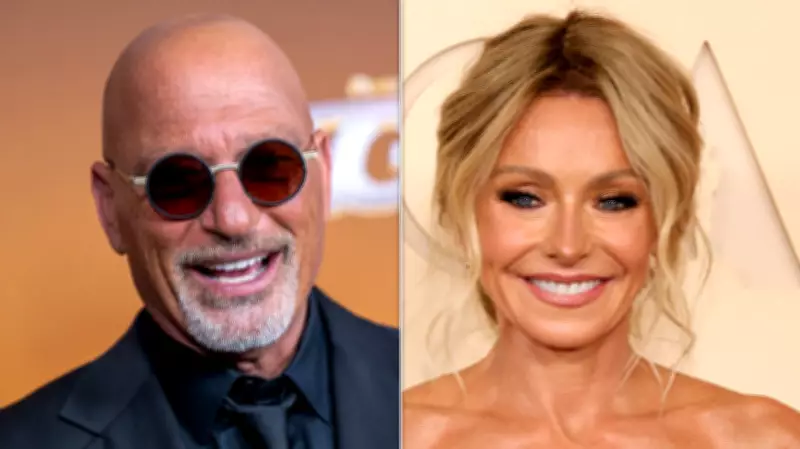
Howie Mandel's On-Air Reaction to Age-Based Compliment Sparks Widespread Discussion
Comedian Howie Mandel's recent exchange during a television appearance has generated significant online conversation, with a mental health professional noting that it highlights crucial considerations when commenting on someone's physical appearance. The incident occurred on the popular daytime talk show "Live with Kelly and Mark," where Mandel was celebrating his 70th birthday.
The Televised Exchange That Captured Attention
During the broadcast, host Mark Consuelos extended birthday congratulations to Mandel, prompting co-host Kelly Ripa to interject with the remark, "It doesn't make any sense." When Mandel questioned this statement, both Ripa and Consuelos quickly assured the comedian that he "looks great." Mandel responded with visible discomfort, stating, "I look great? That doesn't mean anything. No. No. No. No. I don't like that, because that's a caveat!"
The comedian elaborated that he perceived the compliment as being conditional upon his age, comparing it to telling someone they're "smart for a stupid person." After some lighthearted back-and-forth and shared laughter, Mandel eventually conceded that he is indeed "gorgeous," though the moment left a lasting impression on viewers.

Mandel's Clarification and Social Media Response
Following the broadcast, Mandel addressed the interaction through an Instagram video, clarifying that his comments were intended as humor despite some social media users describing the on-air moment as awkward and tense. "Philosophically, I don't believe ... somebody who's a comedian needs to apologize for a joke," Mandel stated in the video. "But this is for Kelly Ripa, who in the past has been incredibly supportive ... it is a joke, it is meant as a joke and it's not meant to offend."
The comedian acknowledged that "sometimes, as a comedian, things don't land the way you mean them to land," and offered an apology to Ripa while humorously embracing through "self-reflection" that he does look great for his age. Many responses to Mandel's post maintained a playful tone, including a comment from Michael Gelman, executive producer of "Live with Kelly and Mark," who teased: "During these divided times, one thing we can all agree upon is that you do look great … for your age."
Therapist's Perspective on Age-Qualified Compliments
Alexandra Cromer, a licensed professional counselor with Thriveworks, explained why such compliments can be problematic despite good intentions. "This specific compliment is very reductionist in nature; it posits that the person defies some negatively stereotyped norm for what others believe that they 'should' look like as they age," Cromer told HuffPost. "It also can be received as offensive because of the modifier 'for our age.' When we compliment someone, we want it to be direct and not seemingly dependent on other factors (age, gender, etc.)."
Cromer emphasized that "someone can interpret this as negative, reductionist, and a sort of limiting belief system that one holds and then are trying to assign to someone else." She advised general caution when commenting on someone's appearance, noting that "you should be very cautious, sensitive, and consider your reasons for commenting on someone's looks," as you cannot control how such remarks will be received.
Societal Pressures and Alternative Approaches
The therapist highlighted the significant societal pressures surrounding appearance and aging. "There is a tremendous societal pressure to look youthful," Cromer said. "This can and often does have a negative impact on self-esteem and self-image [on someone] as they age." She explained that society often communicates that people lose value as they age, with youth being associated with the "ideal beauty standard."
"While aging is a natural, normal process that we all will go through, it's packaged as something to be afraid of and to avoid," Cromer continued. "This can cause significant fear, anxiety and even self-criticism of your physical appearance as you age."

For those seeking to offer positive, non-offensive compliments about appearance, Cromer recommends directness without qualifications. She suggests asking yourself: "What do I hope the recipient of my compliment feels/receives/takes away from this interaction?" If the intention is to acknowledge that someone looks healthy, for example, simply saying "You look great!" or "You look so strong!" effectively communicates that sentiment without potentially offensive modifiers.
Cromer's guidance extends to a thoughtful approach before commenting on appearance, encouraging consideration of one's intentions and the possible interpretations of the recipient. This perspective adds depth to the conversation sparked by Mandel's televised moment, transforming a brief exchange into a meaningful discussion about communication, aging, and societal expectations.