Warning: This article contains spoilers from Season 2 of 'Deli Boys.'
Convincing yourself that you can mix business and pleasure is usually a universal sign that things are about to go sideways. As Season 2 of Hulu's 'Deli Boys' reveals, this also applies to gun-toting, knife-wielding matriarchs of Pakistani-American drug cartels entering situationships with fellow crime lords. The sophomore season goes beyond the unflappable Lucky Aunty (Poorna Jagannathan) at the precipice of her Messy Girl Era, a development viewers are absolutely here for.
'Deli Boys' has hit a much-awaited turning point: for Lucky, her lovably goofy man-children business partners Mir (Asif Ali) and Raj (Saagar Shaikh), and the narrative at large. The new season, which dropped May 28, retains the best parts of the show that make it so engaging: sharp dialogue, fast pacing, and cultural nuance. But its newest iteration appears to have gone to therapy, looking inward at the web of dark emotions that forms the backdrop of this season, set against a crime underworld that keeps getting darker.

To clarify, the show still hasn't relegated itself to being 'a thesis-statement type of show,' as Ali told me when Season 1 launched. Season 2 pushed the boundaries of what it knows and, in toeing the line between emotional precision and dark humor, managed to surprise even itself. With cocaine-fueled levity, 'Deli Boys' makes the case that brownness is the undercurrent to vulnerability, showing exactly how deep and how far chosen family will go for each other.
Season 2 Overview
In Season 1 of the crime-comedy series created by Abdullah Saeed, Dark DarCo appointed two co-heads in Mir and Raj, an arranged marriage as part of a business deal, many farcical C-suite board meetings, and high-stakes (potentially deadly) negotiations with competitors (other cartels). 'There is a deep emotional vacuum that we are all looking to fill, and we all make very bad decisions because of it,' Jagannathan tells me. 'And then at the end of Season 2, we understand that the journey we're on is the three of us together.'
Lucky Aunty, if you recall, is holding on by a thread. She's perhaps the only reason why Dark DarCo hasn't collapsed. (Though Mir, our business-minded and proud Drexel graduate, may disagree.) The fate of the organization all but sits on her shoulders. But Lucky is reeling in grief and processing betrayal. Baba, as we learned at the end of Season 1, was murdered by Ahmed, his right-hand man and confidant to Lucky, who wanted to be the king of cocaine.
Lucky's Transformation
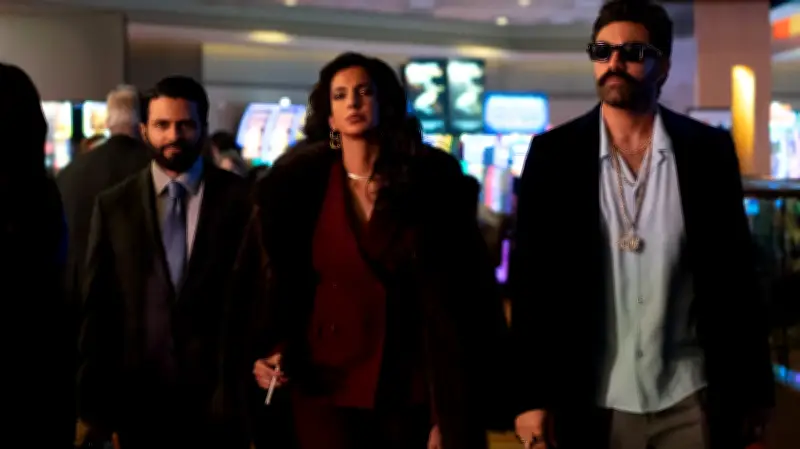
This season, she's faced with a new dilemma: She's falling for casino mogul Max Sugar (played by 'Saturday Night Live' legend Fred Armisen), but Max's laundering scheme is the key to getting the extended Dar squad out of near-financial ruin. It's too messy, she initially deems, clinging to her classic behavior of a mother figure who'd do anything to keep her chosen family safe. Then, after she and the boys are saved by Max during an armed robbery at the deli, Lucky begins her transformation, shedding her role as pseudo-mother to two grown men and pursuing messy, messy selfhood.
It's an innately brown woman thing to do, putting duty first at the expense of self and managing the complexities of interpersonal dynamics around them. In this case, it's the tug-of-war between Max and the boys, who vie for her attention in different ways. South Asians, especially South Asian women, inherit staunch beliefs about the self in relation to the collective: that selfhood is something to be suppressed, sacrificed, offered up. That was Season 1 Lucky, holding Mir, Raj, Baba, Ahmed, and others together, all while singlehandedly keeping a cocaine empire running.

But it's only in the depths of that emotional vacuum that we see Lucky figure out who she is: a woman who desires, loves, grieves, complicates, and breaks. She's got two guys fighting over her (one of whom is Danyal, played by the hilarious Kumail Nanjiani), she's mourning Baba and the version of Ahmed she knew all those years, she's raging for Raj's release from jail, and she feels a tinge of motherhood. And she's doing it all alone. It's then that she realizes no one, not Baba, Ahmed, or Max, would rescue her from the vacuum she felt. And that's a good thing, that she doesn't have to make a choice between herself and the community; it was a false choice after all. She could have it all the ways she wants. 'By the end of Season 2, she understands that she's going to have to fly solo and she's OK,' Jagannathan tells me.
Mir and Raj's Arcs
Then there are Mir and Raj, always orthogonal to each other in decision-making but always converging in the end. This season isn't any different; like Lucky, we see Mir and Raj cope with Baba's death and Ahmed's betrayal in very different ways. Raj's character arc has come far since Season 1, from the dissociative weed aficionado to the gun-totting, Luigi Mangione-esque 'Fuck Me Felon,' who flirts with murder and is steeped in vengeance. Perhaps the opposite of Lucky, the vacuum that his father left, both emotionally and in DarCo, created in Raj a sense of not only familial duty but also purpose. He's present, murderous, and vengeful because he loves and cares deeply.
On the other hand, Mir is anxiously clinging to what feels like a pipe dream throughout the season, which is to close a deal with a golf course, and there are a thousand threats to that ambition. Compared to Raj's outbursts, it's easy to relegate this dream of Mir's as a lack of depth. While his vacuum didn't get as much screen time as Raj's, for Mir there's more in what's unsaid. The prospect of lineage for BIPOC cultures at large is an important one. It reflects the continuation and preservation of identity. For Mir, the memory of Baba lives on through this golf course. And truth be told, that's where Raj and Mir converge. It's this vulnerability that 'Deli Boys' shows but doesn't tell, nor does it feel compelled to tell you the 'why.'
'One thing I've really enjoyed about the process this season, specifically, is being able to make references that have been in the zeitgeist of the diaspora without having to explain the reference in the line or the show,' Shaikh says. 'We get it, and that's who it's for. And I would love for you to get it. But I'm not going to explain it to you.'
Humor and Depth
The best thing about 'Deli Boys' is that humor and depth live side-by-side, without committing entirely to being a slapstick comedy. The show is vulnerable and holds meaning. But the most important thing it does, as Ali and Shaikh have reiterated from last season into this, is just existing.
Related: Hulu, Deli Boys, Asian Voices