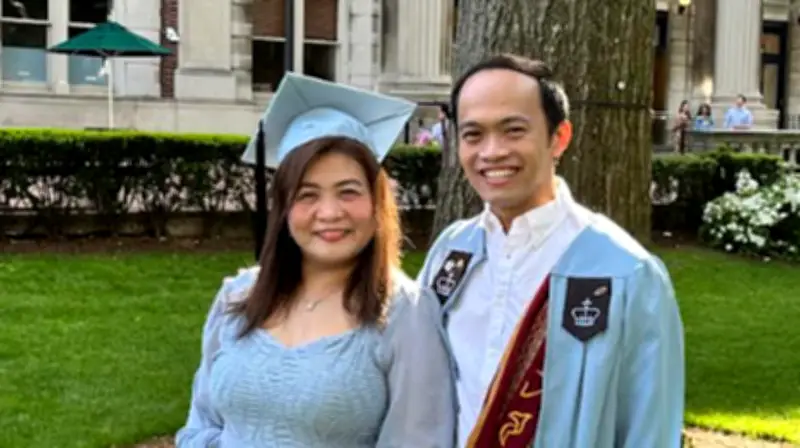
The morning I came out to my mother, I got out of bed to do it. That detail matters more than it might seem. I had been out in every other context for years — to friends, to the city, to the version of my life I had built in New York after immigrating from the Philippines. I had inhabited my identity freely in rooms where it was safe to do so. What I had not done was tell the person whose response had always mattered most. And so that morning, something in me decided: The time has come.
I got out of bed and I called her.
I had been out to friends since my early 20s. I was 34 when I finally told my mother. In truth, I think everyone had known much earlier — since I was a child. When I was 5, I danced and sang along to Britney Spears songs, already more Barbie than Ken. But knowing and naming are not the same thing. In our family, my sexuality existed as an unspoken truth — visible, but never formally entered.

I built a life anyway. I focused on school, on achievement, on becoming someone legible in other ways. I lived my private life privately. And for a long time, I believed that was enough.
Filipino Catholic families are not, in my experience, cruel about these things. They are architectural. There is what is said and what is carefully left unsaid, and the unsaid does not disappear — it simply occupies a different room in the house of the relationship, a room both parties know exists and that both parties have agreed, without discussing the agreement, not to enter.
My mother and I had been living with that room for years — she on her side of the wall, me on mine. We had a warm relationship, a genuinely close relationship, a relationship full of the ordinary comfort of a mother and son who like each other and find each other's company easy. The room was simply there, and neither of us named it.
I had rehearsed the conversation in perhaps two dozen versions over the years. Not obsessively — it wasn't the only thing I thought about. But I did it in the way you rehearse anything that carries weight: occasionally, when the conditions were quiet enough that the thing could surface without immediately being managed back down.
I had versions for her catastrophic response — the withdrawal, the silence, the relationship rearranging itself around the new information in ways that made it smaller. I had versions for her complicated response — the acceptance that came wrapped in conditions, the love that arrived alongside concern that was also, in its way, a form of qualification. I had versions for the response that was simply hard, that required time, that asked more of us than either of us was sure we had.
I had responses prepared for all of these. I was ready.
She answered on the second ring. We talked for a few minutes about nothing — the familiar warmth of how we always begin, the rhythm of a relationship that has its own cadences.
Then she asked about him.
She had known that we had been living together — first in New York, then San Francisco, then back to New York — under the language of housemates. That morning, she asked directly if he was my partner.
“Yes,” I said.
That was the moment. Not a speech. Not a declaration. Just the first time I allowed the truth to remain unedited in her presence.
There was a pause. Brief. Not the pause of surprise — the pause of confirmation.
“I felt it. I know. I'm supportive, so long as he won't hurt you.”
Fourteen words. She had crossed from confirmation to condition — not a qualification of her support, I understood immediately, but its expression. The condition was love. She was not saying: I'll accept this if. She was saying: I'm already here, and what I care about is whether someone is taking care of you.
I had been preparing for the catastrophic version. I had been preparing for the complicated version. I had not adequately prepared for the version that was simply her.
The relief that arrived after the call was not what I expected. I had anticipated something clean — the specific pleasure of a weight lifted, the lightness of someone who has been carrying something and has finally set it down.

What I actually felt was more unsettling than that. It was the sudden awareness of how much of my life had been organized around the weight. Not just the big things — the careful omissions in family conversations, the subject changes, the managed versions of my life I had offered at holidays. The small things too. The specific restraint I brought to any conversation about my interior life. The habit of editing, of withholding, of adjusting in real time.
The relief was not the absence of weight. It was the revelation of the weight's size.
My mother began asking about him the next time we spoke. It wasn't with the pointed curiosity of someone managing their response to new information — it was with the ordinary interest of someone asking about the people who matter to her son. She incorporated him into her understanding of my life the way she incorporated everything else: directly, practically, with the specific warmth of a woman who has decided that the most important thing is whether someone is being treated well.
The room we had both been careful not to enter for years was now simply open. We walked in. The furniture was ordinary. I do not know why I had believed for so long that it contained something that would rearrange everything.
It has been three months since that call.
The change is not dramatic. It is precise. I do not have to translate my life anymore. I do not have to say “housemate.” I do not have to time conversations or manage details. I do not have to maintain the small, continuous fictions that once felt necessary.
It feels less like gaining something and more like removing something — like pulling out a thorn that had been lodged so long I had stopped noticing the wound.
I live now without editing the truth, especially with the person I was most careful with.
It would be easy to read a story like this and conclude that things have become simpler — that time has resolved what once felt difficult. But that is not universally true.
If anything, the terrain has grown more complex for my community. Visibility has increased, but so has scrutiny. Safety, security and belonging are not evenly distributed. For many people, coming out still carries real risk — emotional, cultural, even physical. And in a world preoccupied with larger urgencies, the act of claiming one's identity can feel both essential and impossibly heavy.
Sometimes the difficulty is not in knowing who you are, but in deciding when it is safe — or worth it — to say it out loud.
And yet, I have come to understand something I could not see before: that freedom, at some point, requires self-permission. That even in uncertainty, there is a moment when the door must be opened from the inside.
My mother had known for years. She had been waiting, not impatiently, not with urgency, but with the particular quality of a person who understands that some things arrive when the other person is ready to bring them, and not before.
She was ready before I was. She was simply waiting for me to walk through the door.
It took me 30 seconds to say the thing I had been carrying for 15 years.
It took her four words — “I know. I'm supportive.” — to make me understand why I had waited that long.
Richard Estrella is a brand strategist, writer and painter based in New York City. He previously worked across marketing, policy and international affairs, including at the United Nations and in the consumer goods and tech sector. He is the author of “I Am Overthinking (and it's ok!)” (2025). His new book, “Inside a Water Drop” (May 2026) explores identity, migration and the inner architecture of the self. His work sits at the intersection of personal narrative, culture and emotional systems.