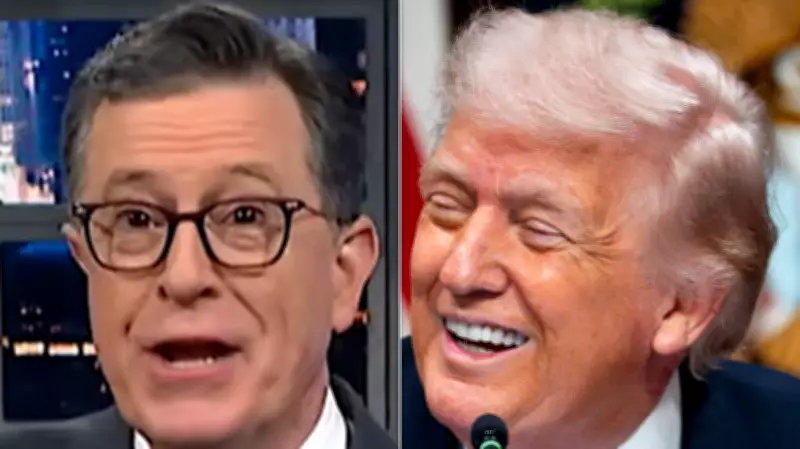
In a sharp and humorous critique on Wednesday, "Late Show" host Stephen Colbert took aim at President Donald Trump, his administration, and congressional Republicans for their efforts to sidestep labeling the escalating tensions with Iran as a war. Colbert argued that despite a concerted push to avoid the term, their strategy was ultimately undermined by Trump himself, who inadvertently used the forbidden word in public remarks.
The White House Memo and Colbert's Satirical Take
Colbert highlighted a White House memo that circulated among the president's allies, instructing them to refrain from using the word "war" when discussing the Iran conflict. Instead, the memo suggested alternative phrasing such as "targeted major combat operations." Colbert quipped, "So, it's worse than a war. It's a war that got a thesaurus for Christmas," poking fun at what he perceived as an attempt to soften the language around serious military actions.
Trump's Contradictory Statements
The comedian pointed to two specific instances where Trump contradicted the administration's messaging by using the term "war" in reference to Iran. One notable example included a video clip where Trump stated, "I have to go back and look at the war, a lot of things happening..." Colbert remarked, "You know you're not supposed to say it, but that just puts the word in your brain. It's like when your boss has a huge pimple on his nose, and you're like, 'Don't talk about the pimple,' but as soon as he walks in, you go, 'Hi, Mr. Pimple!'" This analogy underscored the inevitability of the word surfacing despite efforts to suppress it.

Broader Implications and Public Reaction
Colbert's monologue delved into the broader implications of this linguistic maneuvering, suggesting it reflects a pattern of inconsistency within the Trump administration. By avoiding the term "war," critics argue that the government may be downplaying the severity of the conflict, potentially misleading the public about the risks and realities involved. The segment resonated with viewers, sparking discussions on social media and in political circles about transparency and accountability in government communications.
This incident is part of a larger trend where Colbert uses his platform to critique political figures and policies, blending comedy with pointed commentary. His ability to highlight contradictions in official narratives has made his show a popular source for political satire, especially in times of international tension.