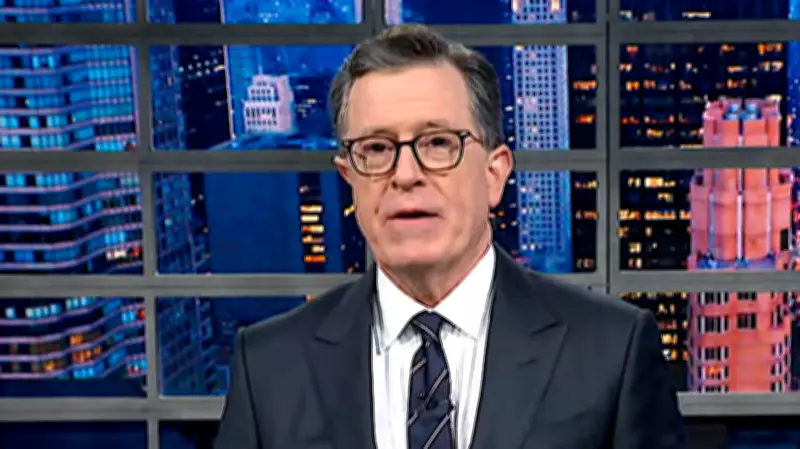
In a recent episode of "The Late Show," host Stephen Colbert surprisingly aligned with former President Donald Trump's assertion that the United States had fully accomplished its military aims in the ongoing conflict with Iran. This agreement came amidst the announcement of a fragile two-week ceasefire, which Trump celebrated on Truth Social by stating, "...We have already met and exceeded all Military objectives." Colbert, known for his sharp political commentary, echoed this sentiment during his Wednesday night monologue, adding a layer of ironic humor to the discussion.
Colbert's Satirical Take on War Objectives
Colbert began by affirming Trump's claim, saying, "It's true, this war reached all of its objectives." However, he quickly pivoted to a satirical twist, noting, "It's been weeks since anyone mentioned the Epstein files." This remark highlighted how the war had shifted public attention away from other contentious issues, underscoring the complex dynamics at play in media coverage and political discourse.
Mocking the Ceasefire Conditions
The comedian then delved into Trump's previous statements about potential deals with Iran, where the former president had emphatically declared, "There will be no deal with Iran except UNCONDITIONAL SURRENDER!" Colbert retorted with sarcasm, stating, "And that's exactly what he got – with just 10 conditions." He pointed out that while the White House has not officially disclosed these alleged conditions, Iranian state media has released a list claiming to outline them.

According to Colbert, these purported conditions include:
- Iran maintaining control over the strategic Strait of Hormuz.
- The United States removing all primary and secondary sanctions against Iran.
- Acceptance of Iran's uranium enrichment for its nuclear program.
Colbert emphasized that these terms align closely with Iran's pre-war demands, suggesting little concession from their side. He quipped, "So, it's a real win-win, in that Iran won twice?" This biting commentary mocked the perceived imbalance in the ceasefire agreement, implying that Iran emerged with significant advantages despite the rhetoric of unconditional surrender.
Broader Implications and Public Reaction
The segment not only provided comedic relief but also sparked discussions about the efficacy and outcomes of the war. Colbert's monologue served as a critique of the political narratives surrounding the conflict, questioning whether the stated objectives were genuinely met or if the ceasefire terms favored Iran more than acknowledged. His blend of humor and insight resonated with viewers, offering a unique perspective on a serious geopolitical issue.
As the ceasefire remains on shaky grounds, Colbert's remarks underscore the ongoing uncertainties in U.S.-Iran relations. The show's opening monologue continues to be a platform for dissecting complex political events with wit and clarity, engaging audiences in critical conversations about war, diplomacy, and media representation.