Super Bowl 2026 Pregame Features Black National Anthem Amidst Political Controversy
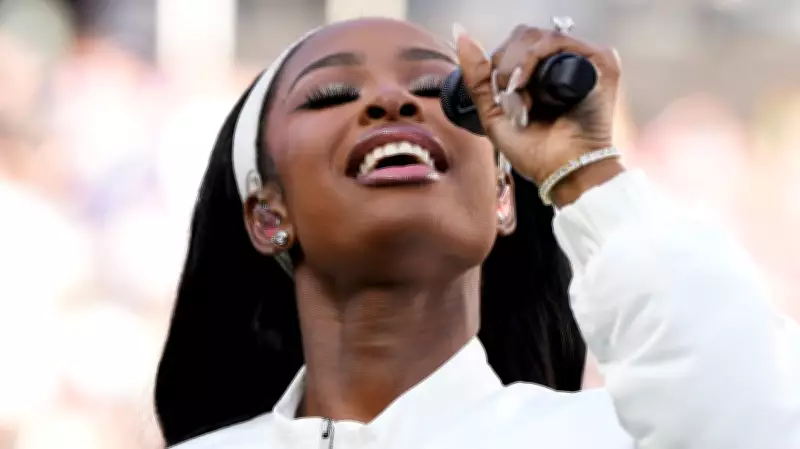
The inclusion of the hymn "Lift Every Voice and Sing" during the pregame ceremony at Super Bowl 2026 in Santa Clara, California, has ignited significant controversy among certain political factions, while simultaneously receiving widespread acclaim from cultural observers and historians. Grammy award-winning singer Coco Jones delivered a powerful rendition of the song, often referred to as the Black national anthem, which was met with both celebration and criticism across social media platforms.
Performance Honors Tradition While Sparking Debate
Jones' performance was particularly notable for its homage to musical history, as her ensemble drew inspiration from the tracksuit worn by Whitney Houston during her iconic 1991 Super Bowl performance of "The Star-Spangled Banner." This connection between generations of Black musical excellence was widely praised online, with many viewers celebrating the artistic tribute to Houston's legendary moment.
However, the inclusion of "Lift Every Voice and Sing" in the Super Bowl festivities prompted immediate backlash from some conservative commentators and MAGA supporters. Critics took to social media platform X to voice their objections, with one user declaring: "The United States of America has ONLY ONE National Anthem. Kicking off the #SuperBowl in the year of our great nation's 250th birthday, with the 'Black National Anthem', is a disgrace & racially divisive..."

Historical Context and Scholarly Perspective
Scholars of African-American studies and history emphasize that these criticisms fundamentally misunderstand the song's purpose and historical significance. LaGarrett King, professor of social studies education and director of the Center for K-12 Black History and Racial Literacy Education at the University at Buffalo, explained: "If Black History is American history, it cannot be divisive. The song is important to our imperfect history, and it is OK if we citizens are reminded of it from time to time."
The historical record reveals that "Lift Every Voice and Sing" predates the official adoption of "The Star-Spangled Banner" as America's national anthem. Written as a poem by James Weldon Johnson and composed by his brother Rosamond Johnson, the hymn was first performed publicly by children at a school celebration in 1900. The NAACP adopted it as the Black national anthem in 1919, twelve years before "The Star-Spangled Banner" became the official U.S. national anthem in 1931.
NFL's Inclusion and Ongoing Controversy
The National Football League began featuring performances of "Lift Every Voice and Sing" at the Super Bowl in 2021, and conservative criticism has been consistent since that time. This year's controversy follows similar objections raised in 2025 when Grammy winner Ledisi performed the hymn alongside a choir of 125 high school students from the Greater New Orleans High School Chorale Collective.
Professor King noted the symbolic importance of the NFL's inclusion of the hymn, particularly given the racial demographics of the league: "While the NFL hosting performances of 'Lift Every Voice and Sing' ahead of the Super Bowl game is largely symbolic, it can still honor Black players, who represent over half of the NFL. The national anthem does little to honor them given its history."
Examining Anthem Histories and Racial Equity
King pointed to longstanding scholarly criticism of certain lyrics in "The Star-Spangled Banner" and the background of its author, Francis Scott Key, who was a slave owner and used his position as Washington D.C.'s district attorney to defend slavery. "It must be understood that the National Anthem had racist undertones within the third stanza," King explained. "Therefore, I could ask why would we as Americans want to support such a man with the honor of our national anthem, if we would like to disassociate ourselves from our racist past? It is evident that the National Anthem was not written for Black citizens."

Shaun Harper, a professor of business, public policy and education at the University of Southern California, emphasized the economic contributions of Black athletes to the NFL: "Black people make the most money for the NFL every season. Given this, there should be absolutely no resistance to the singing of an anthem that affirms their history and identities as Americans."
Harper also noted the timing significance: "Do critics realize or even care that the Super Bowl is always played during Black History Month? How did 'Lift Every Voice and Sing,' a soul-stirring anthem written 126 years ago, suddenly become divisive?"
Broader Implications for American Identity
King suggested that the backlash reflects a particular vision of American identity: "It seems that MAGA supporters believe there is a hierarchy of 'Americanism,' meaning that American symbols are sacred and no other approaches to citizenship or celebrations should be adopted or portrayed within American institutions."
The professor concluded with a broader perspective on national symbolism: "The song is symbolic of Black unity and resistance to those acts that are oppressive. The song resembles the American story. It is important to understand that our country is diverse and is not a white nation, or that only white symbolism matters. We cannot force patriotism, especially by resisting cultural histories that have lasted for over a century."
"Lift Every Voice and Sing" continues to be performed regularly at schools, churches, and historically Black colleges and universities across the United States, maintaining its status as an important cultural touchstone within the African-American community and American society more broadly.